

Appendix: Problem Index
625
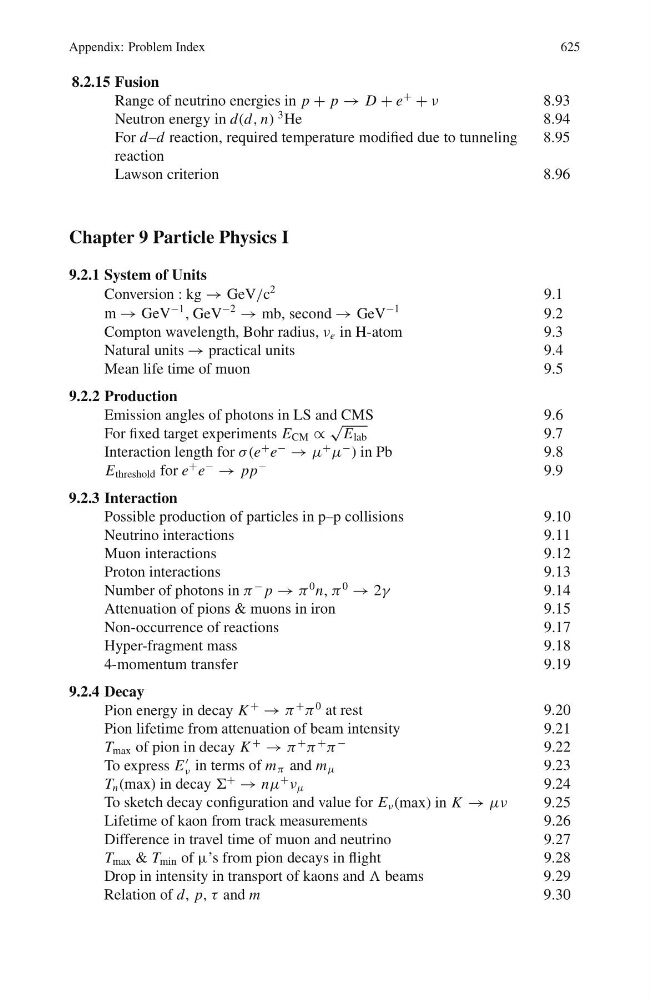
8.2.15 Fusion
Range of neutrino energies in p + p → D + e
+
+ ν
8.93
Neutron energy in d(d, n)
3 He
8.94
For d–d reaction, required temperature modified due to tunneling
reaction
8.95
Lawson criterion
8.96
Chapter 9 Particle Physics I
9.2.1 System of Units
Conversion : kg → GeV/c
2
9.1
m → GeV
−1 , GeV
−2
→ mb, second → GeV
−1
9.2
Compton wavelength, Bohr radius, ν e in H-atom
9.3
Natural units → practical units
9.4
Mean life time of muon
9.5
9.2.2 Production
Emission angles of photons in LS and CMS
9.6
For fixed target experiments E CM ∝
√
E lab
9.7
Interaction length for σ (e
+ e
−
→ μ
+
μ
− ) in Pb
9.8
E threshold for e
+ e
−
→ pp
−
9.9
9.2.3 Interaction
Possible production of particles in p–p collisions
9.10
Neutrino interactions
9.11
Muon interactions
9.12
Proton interactions
9.13
Number of photons in π
− p → π
0 n, π
0
→ 2γ
9.14
Attenuation of pions & muons in iron
9.15
Non-occurrence of reactions
9.17
Hyper-fragment mass
9.18
4-momentum transfer
9.19
9.2.4 Decay
Pion energy in decay K
+
→ π
+
π
0 at rest
9.20
Pion lifetime from attenuation of beam intensity
9.21
T max of pion in decay K
+
→ π
+
π
+
π
−
9.22
To express E
ν in terms of m π and m μ
9.23
T n (max) in decay Σ
+
→ nμ
+
ν μ
9.24
To sketch decay configuration and value for E ν (max) in K → μν
9.25
Lifetime of kaon from track measurements
9.26
Difference in travel time of muon and neutrino
9.27
T max & T min of μ’s from pion decays in flight
9.28
Drop in intensity in transport of kaons and Λ beams
9.29
Relation of d, p, τ and m
9.30