

Appendix: Problem Index
607
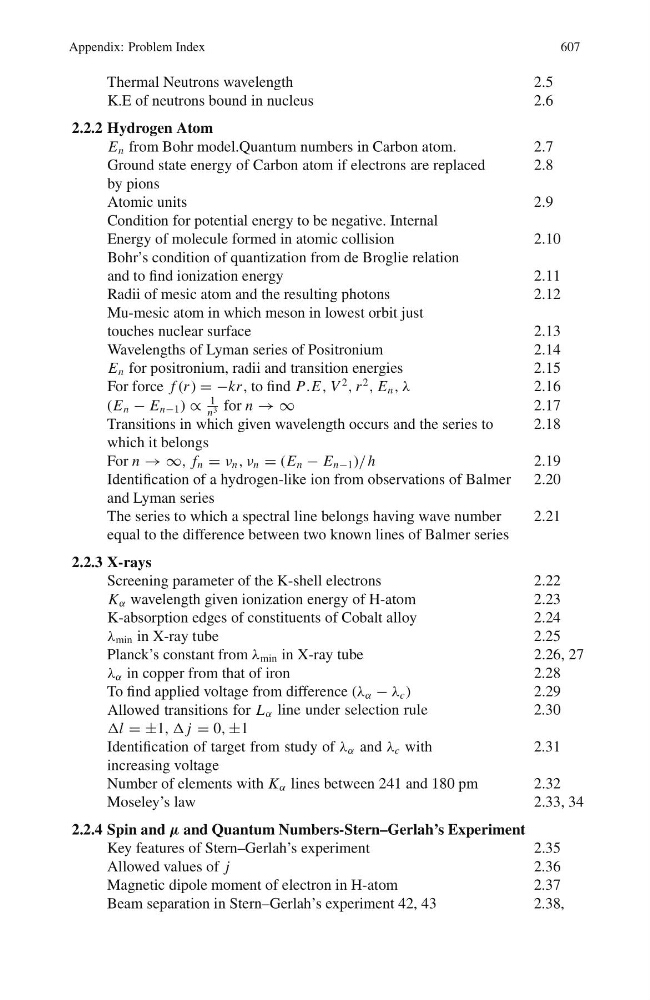
Thermal Neutrons wavelength
2.5
K.E of neutrons bound in nucleus
2.6
2.2.2 Hydrogen Atom
E n from Bohr model.Quantum numbers in Carbon atom.
2.7
Ground state energy of Carbon atom if electrons are replaced
by pions
2.8
Atomic units
2.9
Condition for potential energy to be negative. Internal
Energy of molecule formed in atomic collision
2.10
Bohr’s condition of quantization from de Broglie relation
and to find ionization energy
2.11
Radii of mesic atom and the resulting photons
2.12
Mu-mesic atom in which meson in lowest orbit just
touches nuclear surface
2.13
Wavelengths of Lyman series of Positronium
2.14
E n for positronium, radii and transition energies
2.15
For force f (r ) = −kr, to find P.E, V
2
, r
2
, E n , λ
2.16
(E n − E n−1 ) ∝
1
n 3 for n → ∞
2.17
Transitions in which given wavelength occurs and the series to
which it belongs
2.18
For n → ∞, f n = ν n , ν n = (E n − E n−1 )/ h
2.19
Identification of a hydrogen-like ion from observations of Balmer
and Lyman series
2.20
The series to which a spectral line belongs having wave number
equal to the difference between two known lines of Balmer series
2.21
2.2.3 X-rays
Screening parameter of the K-shell electrons
2.22
K α wavelength given ionization energy of H-atom
2.23
K-absorption edges of constituents of Cobalt alloy
2.24
λ min in X-ray tube
2.25
Planck’s constant from λ min in X-ray tube
2.26, 27
λ α in copper from that of iron
2.28
To find applied voltage from difference (λ α − λ c )
2 . 2 9
Allowed transitions for L α line under selection rule
Δl = ±1, Δ j = 0, ±1
2.30
Identification of target from study of λ α and λ c with
increasing voltage
2.31
Number of elements with K α lines between 241 and 180 pm
2.32
Moseley’s law
2.33, 34
2.2.4 Spin and μ and Quantum Numbers-Stern–Gerlah’s Experiment
Key features of Stern–Gerlah’s experiment
2.35
Allowed values of j
2.36
Magnetic dipole moment of electron in H-atom
2.37
Beam separation in Stern–Gerlah’s experiment 42, 43
2.38,