

10.3 Solutions
597
The two vertices 1 and 2 where the W boson couples pertain to weak
interactions and have strengths
√ α w . Vertex 3 is electromagnetic and has
strength
√ α em . The overall strength of the diagram is
√ α w .
√ α w .
√ α em or
α w
√ α em
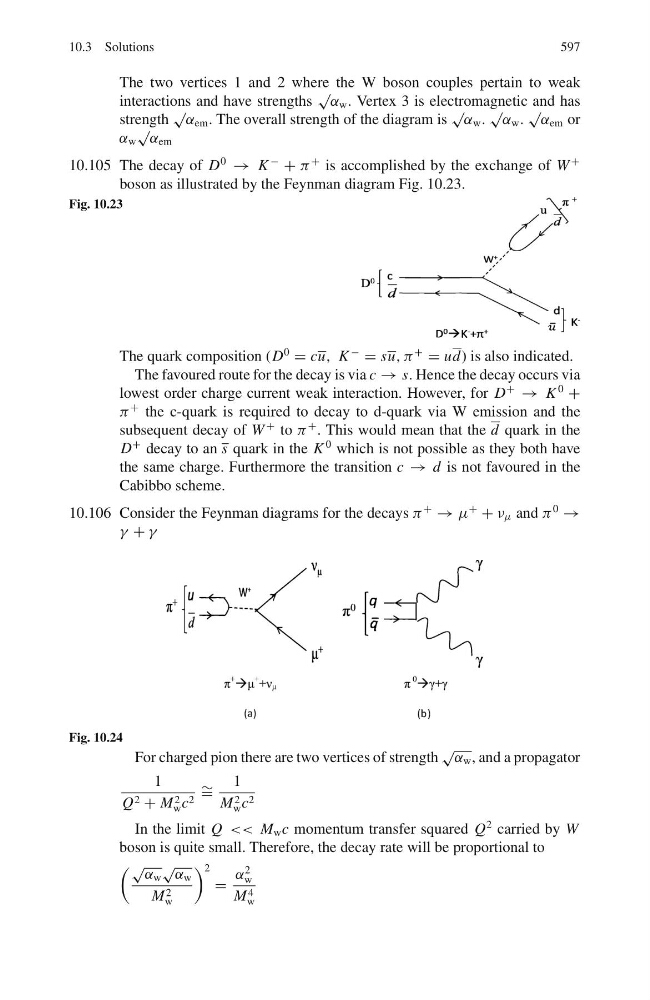
10.105 The decay of D
0
→ K
−
+ π
+ is accomplished by the exchange of W
+
boson as illustrated by the Feynman diagram Fig. 10.23.
Fig. 10.23
The quark composition (D
0
= cu, K
−
= su, π
+
= ud) is also indicated.
The favoured route for the decay is via c → s. Hence the decay occurs via
lowest order charge current weak interaction. However, for D
+
→ K
0
+
π
+ the c-quark is required to decay to d-quark via W emission and the
subsequent decay of W
+ to π
+ . This would mean that the d quark in the
D
+ decay to an s quark in the K
0 which is not possible as they both have
the same charge. Furthermore the transition c → d is not favoured in the
Cabibbo scheme.
10.106 Consider the Feynman diagrams for the decays π
+
→ μ
+
+ ν μ and π
0
→
γ + γ
Fig. 10.24
For charged pion there are two vertices of strength
√
α w , and a propagator
1
Q 2 + M 2
w c 2
∼ =
1
M 2
w c 2
In the limit Q << M w c momentum transfer squared Q
2 carried by W
boson is quite small. Therefore, the decay rate will be proportional to
√ α w
√ α w
M 2
w
2
=
α
2
w
M 4
w