

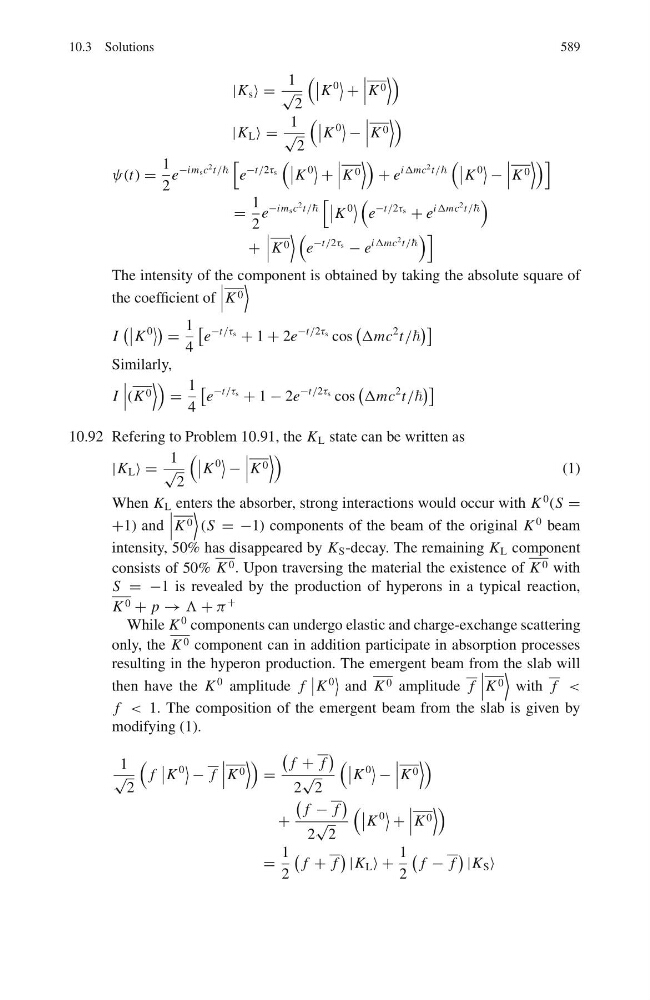
10.3 Solutions
589
|K s =
1
√
2
K
0
+
K 0
|K L =
1
√
2
K
0
−
K 0
ψ(t) =
1
2
e
−im s c
2 t/
e
−t/2τ s
K
0
+
K 0
+ e
iΔmc
2 t/
K
0
−
K 0
=
1
2
e
−imsc
2 t/
K
0
e
−t/2τs
+ e
iΔmc
2 t/
+
K 0
e
−t/2τs
− e
iΔmc
2 t/
The intensity of the component is obtained by taking the absolute square of
the coefficient of
K 0
I
K
0
=
1
4
e
−t/τ s + 1 + 2e
−t/2τ s cos
Δmc
2 t/
Similarly,
I
(K 0
=
1
4
e
−t/τ s + 1 − 2e
−t/2τ s cos
Δmc
2 t/
10.92 Refering to Problem 10.91, the K L state can be written as
|K L =
1
√
2
K
0
−
K 0
(1)
When K L enters the absorber, strong interactions would occur with K
0 (S =
+1) and
K 0
(S = −1) components of the beam of the original K
0 beam
intensity, 50% has disappeared by K S -decay. The remaining K L component
consists of 50% K 0 . Upon traversing the material the existence of K 0 with
S = −1 is revealed by the production of hyperons in a typical reaction,
K 0 + p → Λ + π
+
While K
0 components can undergo elastic and charge-exchange scattering
only, the K 0 component can in addition participate in absorption processes
resulting in the hyperon production. The emergent beam from the slab will
then have the K
0 amplitude f
K
0
and K 0 amplitude f
K 0
with f <
f < 1. The composition of the emergent beam from the slab is given by
modifying (1).
1
√
2
f
K
0
− f
K 0
=
f + f
2
√
2
K
0
−
K 0
+
f − f
2
√
2
K
0
+
K 0
=
1
2
f + f
|K L +
1
2
f − f
|K S