

1.3 Solutions
43
Thus the gamma function is an extension of the factorial function to numbers
which are not integers.
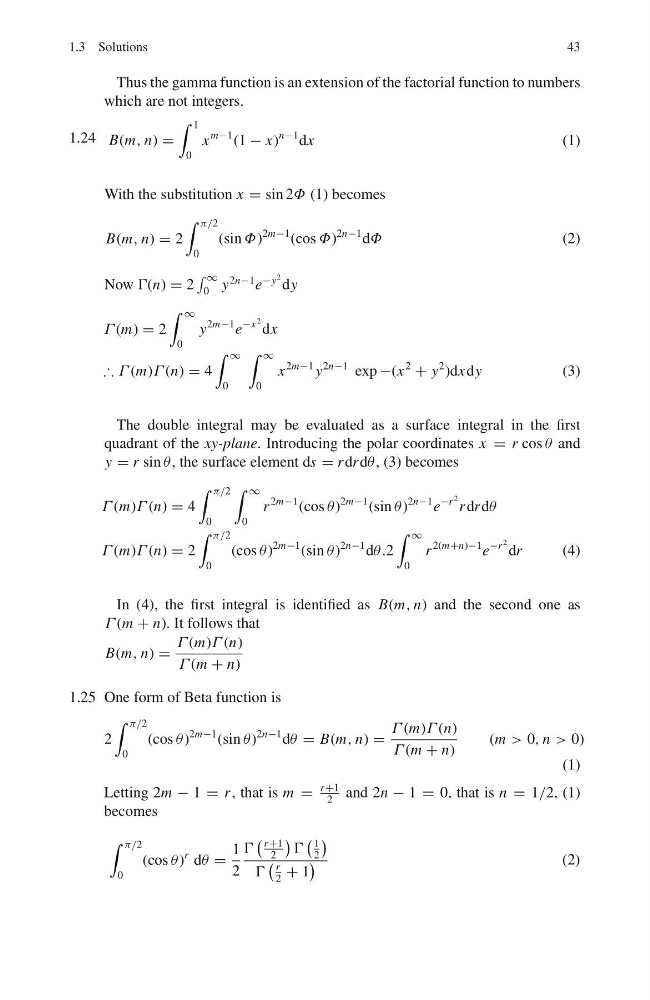
1.24 B(m, n) =
1
0
x
m−1 (1 − x)
n−1 dx
(1)
With the substitution x = sin 2Φ (1) becomes
B(m, n) = 2
π/2
0
(sin Φ)
2m−1 (cos Φ)
2n−1 dΦ
(2)
Now Γ(n) = 2
∞
0 y
2n−1 e
−y
2 dy
Γ (m) = 2
∞
0
y
2m−1 e
−x
2 dx
∴ Γ (m)Γ (n) = 4
∞
0
∞
0
x
2m−1 y
2n−1 exp −(x
2
+ y
2 )dxdy
(3)
The double integral may be evaluated as a surface integral in the first
quadrant of the xy-plane. Introducing the polar coordinates x = r cos θ and
y = r sin θ , the surface element ds = r dr dθ, (3) becomes
Γ (m)Γ (n) = 4
π/2
0
∞
0
r
2m−1 (cos θ)
2m−1 (sin θ )
2n−1 e
−r
2 r dr dθ
Γ (m)Γ (n) = 2
π/2
0
(cos θ)
2m−1 (sin θ)
2n−1 dθ.2
∞
0
r
2(m+n)−1 e
−r
2 dr
(4)
In (4), the first integral is identified as B(m, n) and the second one as
Γ (m + n). It follows that
B(m, n) =
Γ (m)Γ (n)
Γ (m + n)
1.25 One form of Beta function is
2
π/2
0
(cos θ)
2m−1 (sin θ)
2n−1 dθ = B(m, n) =
Γ (m)Γ (n)
Γ (m + n)
(m > 0, n > 0)
(1)
Letting 2m − 1 = r , that is m =
r +1
2
and 2n − 1 = 0, that is n = 1/2, (1)
becomes
π/2
0
(cos θ )
r dθ =
1
2
Γ
r +1
2
Γ
1
2
Γ
r
2
+ 1
(2)
43
Thus the gamma function is an extension of the factorial function to numbers
which are not integers.
1.24 B(m, n) =
1
0
x
m−1 (1 − x)
n−1 dx
(1)
With the substitution x = sin 2Φ (1) becomes
B(m, n) = 2
π/2
0
(sin Φ)
2m−1 (cos Φ)
2n−1 dΦ
(2)
Now Γ(n) = 2
∞
0 y
2n−1 e
−y
2 dy
Γ (m) = 2
∞
0
y
2m−1 e
−x
2 dx
∴ Γ (m)Γ (n) = 4
∞
0
∞
0
x
2m−1 y
2n−1 exp −(x
2
+ y
2 )dxdy
(3)
The double integral may be evaluated as a surface integral in the first
quadrant of the xy-plane. Introducing the polar coordinates x = r cos θ and
y = r sin θ , the surface element ds = r dr dθ, (3) becomes
Γ (m)Γ (n) = 4
π/2
0
∞
0
r
2m−1 (cos θ)
2m−1 (sin θ )
2n−1 e
−r
2 r dr dθ
Γ (m)Γ (n) = 2
π/2
0
(cos θ)
2m−1 (sin θ)
2n−1 dθ.2
∞
0
r
2(m+n)−1 e
−r
2 dr
(4)
In (4), the first integral is identified as B(m, n) and the second one as
Γ (m + n). It follows that
B(m, n) =
Γ (m)Γ (n)
Γ (m + n)
1.25 One form of Beta function is
2
π/2
0
(cos θ)
2m−1 (sin θ)
2n−1 dθ = B(m, n) =
Γ (m)Γ (n)
Γ (m + n)
(m > 0, n > 0)
(1)
Letting 2m − 1 = r , that is m =
r +1
2
and 2n − 1 = 0, that is n = 1/2, (1)
becomes
π/2
0
(cos θ )
r dθ =
1
2
Γ
r +1
2
Γ
1
2
Γ
r
2
+ 1
(2)