

564
10 Particle Physics – II
Therefore, σ 1 = C |M 3 |
2
where C = constant
For reaction (2) we have the mixture of I = 1/2 and I = 3/2 states.
Refering to the table for 3/2 × 1/2 C.G. coefficients we can write
|ψ i =
ψ f
=
1
3
φ
3
2
, −
1
2
−
2
3
φ
1
2
, −
1
2
Therefore,
σ 2 = C
ψ f |H 1 + H 3 | ψ i
2 = C
1
3
M 3 +
2
3
M 1
2
For the reaction (3) we have
|ψ i =
1
3
φ
3
2
, −
1
2
−
2
3
φ
1
2
, −
1
2
ψ f
=
2
3
φ
3
2
, −
1
2
+
1
3
φ
1
2
, −
1
2
Therefore, σ 3 = C
2
9
M 3 −
2
9
M 1
2
The ratio of cross-sections are
σ 1 : σ 2 : σ 3 = |M 3 |
2 :
1
9
|M 3 + 2M 1 |
2 :
2
9
|M 3 − M 1 |
2
If a 1/2 << a 3/2 , M 1 << M 3 , σ 1 : σ 2 : σ 3 = 9 : 1 : 2
And if a 1/2 >> a 3/2 , M 1 >> M 3 , σ 1 : σ 2 : σ 3 = 0 : 2 : 1
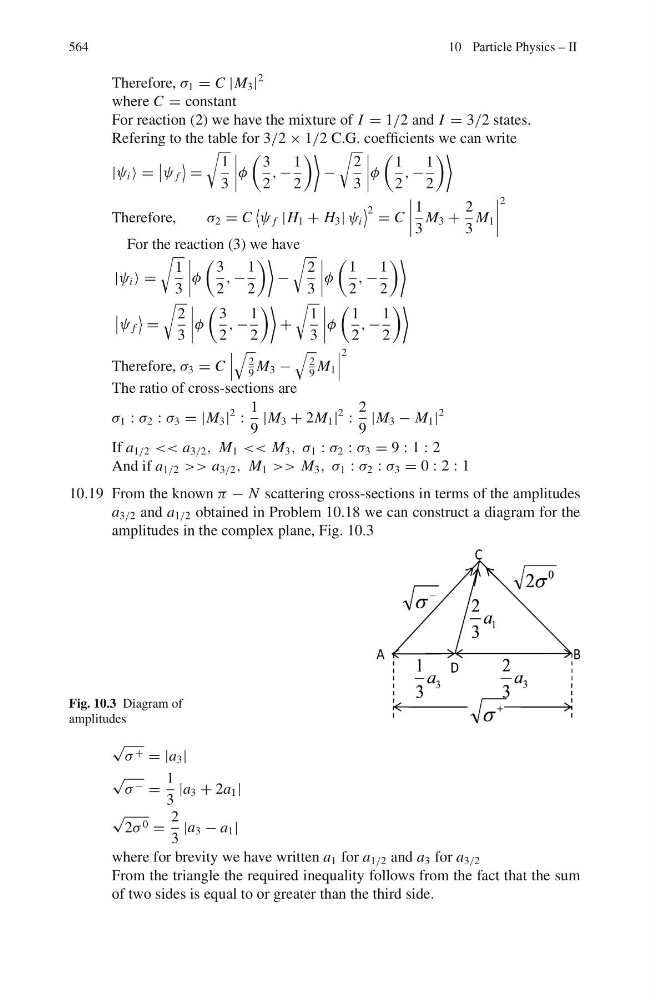
10.19 From the known π − N scattering cross-sections in terms of the amplitudes
a 3/2 and a 1/2 obtained in Problem 10.18 we can construct a diagram for the
amplitudes in the complex plane, Fig. 10.3
Fig. 10.3 Diagram of
amplitudes
√
σ + = |a 3 |
√
σ − =
1
3
|a 3 + 2a 1 |
√
2σ 0 =
2
3
|a 3 − a 1 |
where for brevity we have written a 1 for a 1/2 and a 3 for a 3/2
From the triangle the required inequality follows from the fact that the sum
of two sides is equal to or greater than the third side.