

552
10 Particle Physics – II
dσ
dΩ
=
α
2
2 c
2
4E
2
CM
(1 + cos
2
θ)
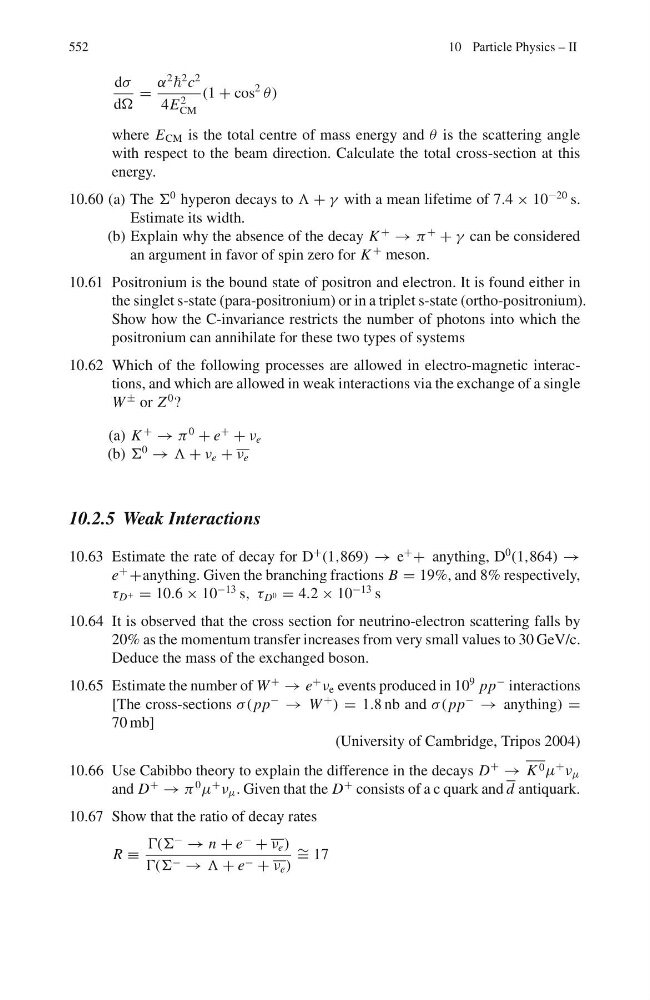
where E CM is the total centre of mass energy and θ is the scattering angle
with respect to the beam direction. Calculate the total cross-section at this
energy.
10.60 (a) The Σ
0 hyperon decays to Λ + γ with a mean lifetime of 7.4 × 10
−20 s.
Estimate its width.
(b) Explain why the absence of the decay K
+
→ π
+
+ γ can be considered
an argument in favor of spin zero for K
+ meson.
10.61 Positronium is the bound state of positron and electron. It is found either in
the singlet s-state (para-positronium) or in a triplet s-state (ortho-positronium).
Show how the C-invariance restricts the number of photons into which the
positronium can annihilate for these two types of systems
10.62 Which of the following processes are allowed in electro-magnetic interactions, and which are allowed in weak interactions via the exchange of a single
W
± or Z
0 ?
(a) K
+
→ π
0
+ e
+
+ ν e
(b) Σ
0
→ Λ + ν e + ν e
10.2.5 Weak Interactions
10.63 Estimate the rate of decay for D
+ (1,869) → e
+
+ anything, D
0 (1,864) →
e
+
+anything. Given the branching fractions B = 19%, and 8% respectively,
τ D + = 10.6 × 10
−13 s, τ D 0 = 4.2 × 10
−13 s
10.64 It is observed that the cross section for neutrino-electron scattering falls by
20% as the momentum transfer increases from very small values to 30 GeV/c.
Deduce the mass of the exchanged boson.
10.65 Estimate the number of W
+
→ e
+
ν e events produced in 10
9 pp
− interactions
[The cross-sections σ ( pp
−
→ W
+ ) = 1.8 nb and σ ( pp
−
→ anything) =
70 mb]
(University of Cambridge, Tripos 2004)
10.66 Use Cabibbo theory to explain the difference in the decays D
+
→ K 0 μ
+
ν μ
and D
+
→ π
0
μ
+
ν μ . Given that the D
+ consists of a c quark and d antiquark.
10.67 Show that the ratio of decay rates
R ≡
Γ(Σ
−
→ n + e
−
+ ν e )
Γ(Σ − → Λ + e − + ν e )
∼ = 17
10 Particle Physics – II
dσ
dΩ
=
α
2
2 c
2
4E
2
CM
(1 + cos
2
θ)
where E CM is the total centre of mass energy and θ is the scattering angle
with respect to the beam direction. Calculate the total cross-section at this
energy.
10.60 (a) The Σ
0 hyperon decays to Λ + γ with a mean lifetime of 7.4 × 10
−20 s.
Estimate its width.
(b) Explain why the absence of the decay K
+
→ π
+
+ γ can be considered
an argument in favor of spin zero for K
+ meson.
10.61 Positronium is the bound state of positron and electron. It is found either in
the singlet s-state (para-positronium) or in a triplet s-state (ortho-positronium).
Show how the C-invariance restricts the number of photons into which the
positronium can annihilate for these two types of systems
10.62 Which of the following processes are allowed in electro-magnetic interactions, and which are allowed in weak interactions via the exchange of a single
W
± or Z
0 ?
(a) K
+
→ π
0
+ e
+
+ ν e
(b) Σ
0
→ Λ + ν e + ν e
10.2.5 Weak Interactions
10.63 Estimate the rate of decay for D
+ (1,869) → e
+
+ anything, D
0 (1,864) →
e
+
+anything. Given the branching fractions B = 19%, and 8% respectively,
τ D + = 10.6 × 10
−13 s, τ D 0 = 4.2 × 10
−13 s
10.64 It is observed that the cross section for neutrino-electron scattering falls by
20% as the momentum transfer increases from very small values to 30 GeV/c.
Deduce the mass of the exchanged boson.
10.65 Estimate the number of W
+
→ e
+
ν e events produced in 10
9 pp
− interactions
[The cross-sections σ ( pp
−
→ W
+ ) = 1.8 nb and σ ( pp
−
→ anything) =
70 mb]
(University of Cambridge, Tripos 2004)
10.66 Use Cabibbo theory to explain the difference in the decays D
+
→ K 0 μ
+
ν μ
and D
+
→ π
0
μ
+
ν μ . Given that the D
+ consists of a c quark and d antiquark.
10.67 Show that the ratio of decay rates
R ≡
Γ(Σ
−
→ n + e
−
+ ν e )
Γ(Σ − → Λ + e − + ν e )
∼ = 17