

10.2 Problems
547
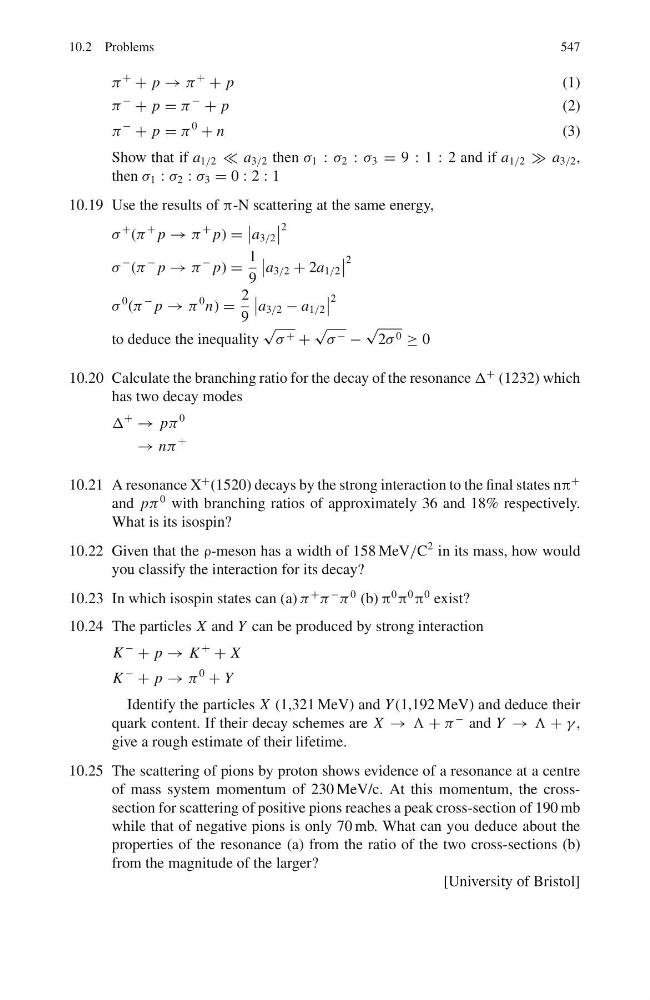
π
+
+ p → π
+
+ p
(1)
π
−
+ p = π
−
+ p
(2)
π
−
+ p = π
0
+ n
(3)
Show that if a 1/2 a 3/2 then σ 1 : σ 2 : σ 3 = 9 : 1 : 2 and if a 1/2 a 3/2 ,
then σ 1 : σ 2 : σ 3 = 0 : 2 : 1
10.19 Use the results of π-N scattering at the same energy,
σ
+ (π
+ p → π
+ p) =
a 3/2
2
σ
− (π
− p → π
− p) =
1
9
a 3/2 + 2a 1/2
2
σ
0 (π
− p → π
0 n) =
2
9
a 3/2 − a 1/2
2
to deduce the inequality
√ σ + +
√
σ − −
√
2σ 0 ≥ 0
10.20 Calculate the branching ratio for the decay of the resonance Δ
+ (1232) which
has two decay modes
Δ
+
→ pπ
0
→ nπ
+
10.21 A resonance X
+ (1520) decays by the strong interaction to the final states nπ
+
and pπ
0 with branching ratios of approximately 36 and 18% respectively.
What is its isospin?
10.22 Given that the ρ-meson has a width of 158 MeV/C
2 in its mass, how would
you classify the interaction for its decay?
10.23 In which isospin states can (a) π
+
π
−
π
0 (b) π
0
π
0
π
0 exist?
10.24 The particles X and Y can be produced by strong interaction
K
−
+ p → K
+
+ X
K
−
+ p → π
0
+ Y
Identify the particles X (1,321 MeV) and Y (1,192 MeV) and deduce their
quark content. If their decay schemes are X → Λ + π
− and Y → Λ + γ ,
give a rough estimate of their lifetime.
10.25 The scattering of pions by proton shows evidence of a resonance at a centre
of mass system momentum of 230 MeV/c. At this momentum, the crosssection for scattering of positive pions reaches a peak cross-section of 190 mb
while that of negative pions is only 70 mb. What can you deduce about the
properties of the resonance (a) from the ratio of the two cross-sections (b)
from the magnitude of the larger?
[University of Bristol]
547
π
+
+ p → π
+
+ p
(1)
π
−
+ p = π
−
+ p
(2)
π
−
+ p = π
0
+ n
(3)
Show that if a 1/2 a 3/2 then σ 1 : σ 2 : σ 3 = 9 : 1 : 2 and if a 1/2 a 3/2 ,
then σ 1 : σ 2 : σ 3 = 0 : 2 : 1
10.19 Use the results of π-N scattering at the same energy,
σ
+ (π
+ p → π
+ p) =
a 3/2
2
σ
− (π
− p → π
− p) =
1
9
a 3/2 + 2a 1/2
2
σ
0 (π
− p → π
0 n) =
2
9
a 3/2 − a 1/2
2
to deduce the inequality
√ σ + +
√
σ − −
√
2σ 0 ≥ 0
10.20 Calculate the branching ratio for the decay of the resonance Δ
+ (1232) which
has two decay modes
Δ
+
→ pπ
0
→ nπ
+
10.21 A resonance X
+ (1520) decays by the strong interaction to the final states nπ
+
and pπ
0 with branching ratios of approximately 36 and 18% respectively.
What is its isospin?
10.22 Given that the ρ-meson has a width of 158 MeV/C
2 in its mass, how would
you classify the interaction for its decay?
10.23 In which isospin states can (a) π
+
π
−
π
0 (b) π
0
π
0
π
0 exist?
10.24 The particles X and Y can be produced by strong interaction
K
−
+ p → K
+
+ X
K
−
+ p → π
0
+ Y
Identify the particles X (1,321 MeV) and Y (1,192 MeV) and deduce their
quark content. If their decay schemes are X → Λ + π
− and Y → Λ + γ ,
give a rough estimate of their lifetime.
10.25 The scattering of pions by proton shows evidence of a resonance at a centre
of mass system momentum of 230 MeV/c. At this momentum, the crosssection for scattering of positive pions reaches a peak cross-section of 190 mb
while that of negative pions is only 70 mb. What can you deduce about the
properties of the resonance (a) from the ratio of the two cross-sections (b)
from the magnitude of the larger?
[University of Bristol]