

540
10 Particle Physics – II
The TCP theorem: A lagrangian which is invariant under proper Lorentz transformation is invariant with respect to the combined operation CPT, taken in any order.
The predictions of the TCP theorem which have been verified are
(i) the existence of an anti particle for every particle.
(ii) The equality of masses, lifetimes, and magnetic moments of particles and anti
particles.
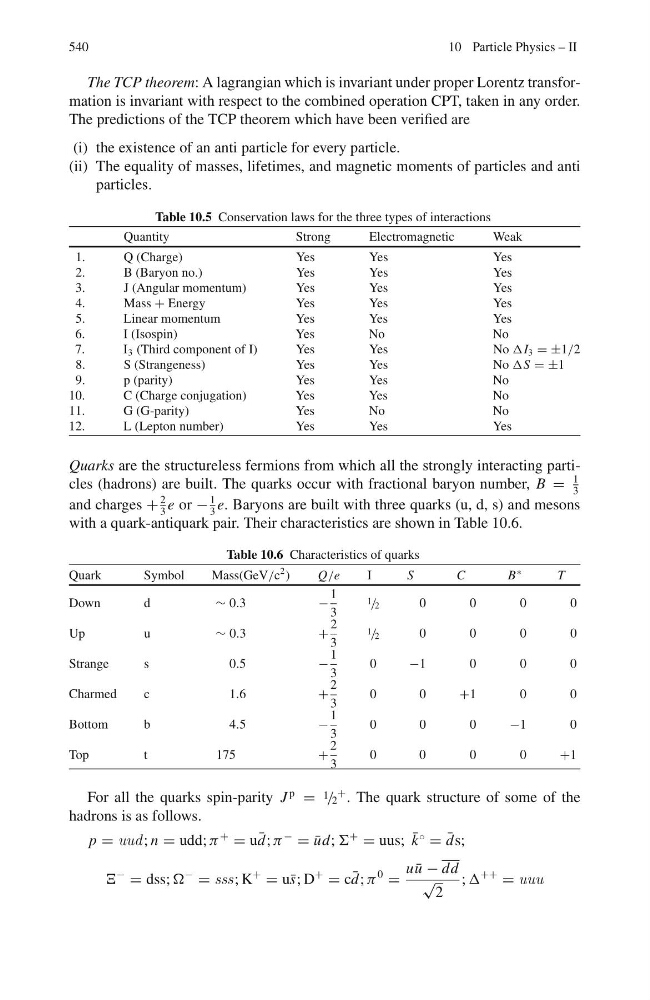
Table 10.5 Conservation laws for the three types of interactions
Quantity
Strong
Electromagnetic
Weak
1.
Q (Charge)
Yes
Yes
Yes
2.
B (Baryon no.)
Yes
Yes
Yes
3.
J (Angular momentum)
Yes
Yes
Yes
4.
Mass + Energy
Yes
Yes
Yes
5.
Linear momentum
Yes
Yes
Yes
6.
I (Isospin)
Yes
No
No
7.
I 3 (Third component of I)
Yes
Yes
No ΔI 3 = ±1/2
8.
S (Strangeness)
Yes
Yes
No ΔS = ±1
9.
p (parity)
Yes
Yes
No
10.
C (Charge conjugation)
Yes
Yes
No
11.
G (G-parity)
Yes
No
No
12.
L (Lepton number)
Yes
Yes
Yes
Quarks are the structureless fermions from which all the strongly interacting particles (hadrons) are built. The quarks occur with fractional baryon number, B =
1
3
and charges +
2
3
e or −
1
3
e. Baryons are built with three quarks (u, d, s) and mesons
with a quark-antiquark pair. Their characteristics are shown in Table 10.6.
Table 10.6 Characteristics of quarks
Quark
Symbol
Mass(GeV/c
2 )
Q/e
I
S
C
B
∗
T
Down
d
∼ 0.3
−
1
3
1 /2
0
0
0
0
Up
u
∼ 0.3
+
2
3
1 /2
0
0
0
0
Strange
s
0.5
−
1
3
0
−1
0
0
0
Charmed
c
1.6
+
2
3
0
0
+1
0
0
Bottom
b
4.5
−
1
3
0
0
0
−1
0
Top
t
175
+
2
3
0
0
0
0
+1
For all the quarks spin-parity J
p
= 1 / 2
+ . The quark structure of some of the
hadrons is as follows.
p = uud ; n = udd; π
+
= u ¯
d; π
−
= ¯
ud; Σ
+
= uus; ¯
k
◦
= ¯
ds;
Ξ
−
= dss; Ω
−
= sss; K
+
= u¯ s; D
+
= c ¯
d; π
0
=
u ¯
u − dd
√
2
; Δ
++
= uuu
10 Particle Physics – II
The TCP theorem: A lagrangian which is invariant under proper Lorentz transformation is invariant with respect to the combined operation CPT, taken in any order.
The predictions of the TCP theorem which have been verified are
(i) the existence of an anti particle for every particle.
(ii) The equality of masses, lifetimes, and magnetic moments of particles and anti
particles.
Table 10.5 Conservation laws for the three types of interactions
Quantity
Strong
Electromagnetic
Weak
1.
Q (Charge)
Yes
Yes
Yes
2.
B (Baryon no.)
Yes
Yes
Yes
3.
J (Angular momentum)
Yes
Yes
Yes
4.
Mass + Energy
Yes
Yes
Yes
5.
Linear momentum
Yes
Yes
Yes
6.
I (Isospin)
Yes
No
No
7.
I 3 (Third component of I)
Yes
Yes
No ΔI 3 = ±1/2
8.
S (Strangeness)
Yes
Yes
No ΔS = ±1
9.
p (parity)
Yes
Yes
No
10.
C (Charge conjugation)
Yes
Yes
No
11.
G (G-parity)
Yes
No
No
12.
L (Lepton number)
Yes
Yes
Yes
Quarks are the structureless fermions from which all the strongly interacting particles (hadrons) are built. The quarks occur with fractional baryon number, B =
1
3
and charges +
2
3
e or −
1
3
e. Baryons are built with three quarks (u, d, s) and mesons
with a quark-antiquark pair. Their characteristics are shown in Table 10.6.
Table 10.6 Characteristics of quarks
Quark
Symbol
Mass(GeV/c
2 )
Q/e
I
S
C
B
∗
T
Down
d
∼ 0.3
−
1
3
1 /2
0
0
0
0
Up
u
∼ 0.3
+
2
3
1 /2
0
0
0
0
Strange
s
0.5
−
1
3
0
−1
0
0
0
Charmed
c
1.6
+
2
3
0
0
+1
0
0
Bottom
b
4.5
−
1
3
0
0
0
−1
0
Top
t
175
+
2
3
0
0
0
0
+1
For all the quarks spin-parity J
p
= 1 / 2
+ . The quark structure of some of the
hadrons is as follows.
p = uud ; n = udd; π
+
= u ¯
d; π
−
= ¯
ud; Σ
+
= uus; ¯
k
◦
= ¯
ds;
Ξ
−
= dss; Ω
−
= sss; K
+
= u¯ s; D
+
= c ¯
d; π
0
=
u ¯
u − dd
√
2
; Δ
++
= uuu