

9.3 Solutions
531
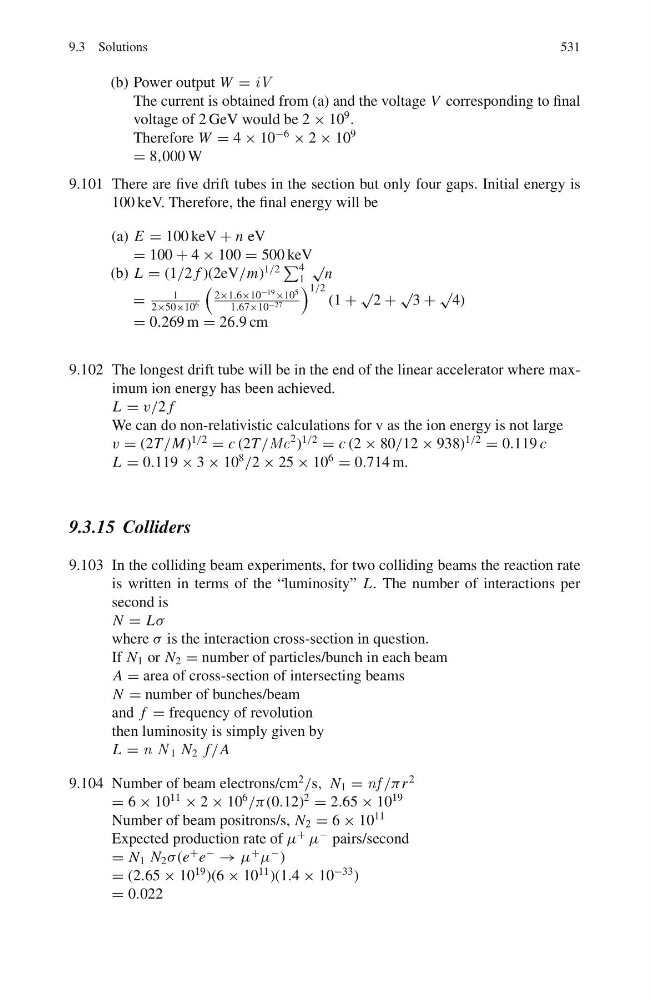
(b) Power output W = iV
The current is obtained from (a) and the voltage V corresponding to final
voltage of 2 GeV would be 2 × 10
9 .
Therefore W = 4 × 10
−6
× 2 × 10
9
= 8,000 W
9.101 There are five drift tubes in the section but only four gaps. Initial energy is
100 keV. Therefore, the final energy will be
(a) E = 100 keV + n eV
= 100 + 4 × 100 = 500 keV
(b) L = (1/2 f )(2eV/m)
1/2
4
1
√
n
=
1
2×50×10 6
2×1.6×10
−19 ×10
5
1.67×10 −27
1/2
(1 +
√
2 +
√
3 +
√
4)
= 0.269 m = 26.9 cm
9.102 The longest drift tube will be in the end of the linear accelerator where maximum ion energy has been achieved.
L = v/2 f
We can do non-relativistic calculations for v as the ion energy is not large
v = (2T /M)
1/2
= c (2T /Mc
2 )
1/2
= c (2 × 80/12 × 938)
1/2
= 0.119 c
L = 0.119 × 3 × 10
8
/2 × 25 × 10
6
= 0.714 m.
9.3.15 Colliders
9.103 In the colliding beam experiments, for two colliding beams the reaction rate
is written in terms of the “luminosity” L. The number of interactions per
second is
N = Lσ
where σ is the interaction cross-section in question.
If N 1 or N 2 = number of particles/bunch in each beam
A = area of cross-section of intersecting beams
N = number of bunches/beam
and f = frequency of revolution
then luminosity is simply given by
L = n N 1 N 2 f /A
9.104 Number of beam electrons/cm
2
/s, N 1 = nf /πr
2
= 6 × 10
11
× 2 × 10
6
/π (0.12)
2
= 2.65 × 10
19
Number of beam positrons/s, N 2 = 6 × 10
11
Expected production rate of μ
+
μ
− pairs/second
= N 1 N 2 σ (e
+ e
−
→ μ
+
μ
− )
= (2.65 × 10
19 )(6 × 10
11 )(1.4 × 10
−33 )
= 0.022
531
(b) Power output W = iV
The current is obtained from (a) and the voltage V corresponding to final
voltage of 2 GeV would be 2 × 10
9 .
Therefore W = 4 × 10
−6
× 2 × 10
9
= 8,000 W
9.101 There are five drift tubes in the section but only four gaps. Initial energy is
100 keV. Therefore, the final energy will be
(a) E = 100 keV + n eV
= 100 + 4 × 100 = 500 keV
(b) L = (1/2 f )(2eV/m)
1/2
4
1
√
n
=
1
2×50×10 6
2×1.6×10
−19 ×10
5
1.67×10 −27
1/2
(1 +
√
2 +
√
3 +
√
4)
= 0.269 m = 26.9 cm
9.102 The longest drift tube will be in the end of the linear accelerator where maximum ion energy has been achieved.
L = v/2 f
We can do non-relativistic calculations for v as the ion energy is not large
v = (2T /M)
1/2
= c (2T /Mc
2 )
1/2
= c (2 × 80/12 × 938)
1/2
= 0.119 c
L = 0.119 × 3 × 10
8
/2 × 25 × 10
6
= 0.714 m.
9.3.15 Colliders
9.103 In the colliding beam experiments, for two colliding beams the reaction rate
is written in terms of the “luminosity” L. The number of interactions per
second is
N = Lσ
where σ is the interaction cross-section in question.
If N 1 or N 2 = number of particles/bunch in each beam
A = area of cross-section of intersecting beams
N = number of bunches/beam
and f = frequency of revolution
then luminosity is simply given by
L = n N 1 N 2 f /A
9.104 Number of beam electrons/cm
2
/s, N 1 = nf /πr
2
= 6 × 10
11
× 2 × 10
6
/π (0.12)
2
= 2.65 × 10
19
Number of beam positrons/s, N 2 = 6 × 10
11
Expected production rate of μ
+
μ
− pairs/second
= N 1 N 2 σ (e
+ e
−
→ μ
+
μ
− )
= (2.65 × 10
19 )(6 × 10
11 )(1.4 × 10
−33 )
= 0.022