

522
9 Particle Physics – I
= 1.13 × 10
−11 T
= 1.13 × 10
−7 G
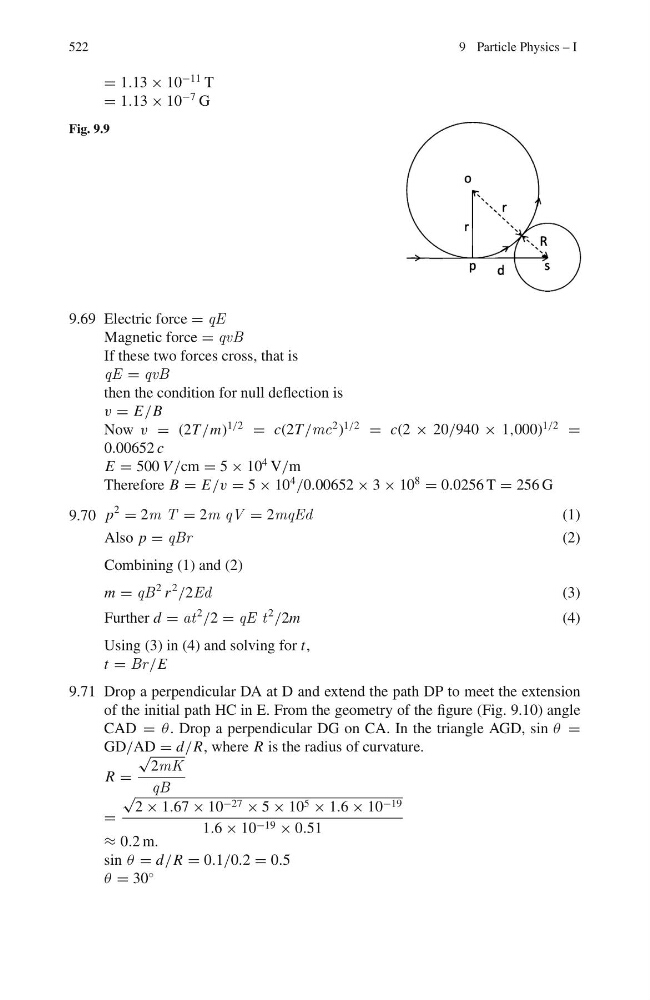
Fig. 9.9
9.69 Electric force = qE
Magnetic force = qvB
If these two forces cross, that is
qE = qvB
then the condition for null deflection is
v = E/B
Now v = (2T /m)
1/2
= c(2T /mc
2 )
1/2
= c(2 × 20/940 × 1,000)
1/2
=
0.00652 c
E = 500 V /cm = 5 × 10
4 V/m
Therefore B = E/v = 5 × 10
4
/0.00652 × 3 × 10
8
= 0.0256 T = 256 G
9.70 p
2
= 2m T = 2m qV = 2mqEd
(1)
Also p = qBr
(2)
Combining (1) and (2)
m = qB
2 r
2
/2Ed
(3)
Further d = at
2
/2 = qE t
2
/2m
(4)
Using (3) in (4) and solving for t,
t = Br /E
9.71 Drop a perpendicular DA at D and extend the path DP to meet the extension
of the initial path HC in E. From the geometry of the figure (Fig. 9.10) angle
CAD = θ . Drop a perpendicular DG on CA. In the triangle AGD, sin θ =
GD/AD = d/R, where R is the radius of curvature.
R =
√
2mK
qB
=
√
2 × 1.67 × 10 −27 × 5 × 10 5 × 1.6 × 10 −19
1.6 × 10 −19 × 0.51
≈ 0.2 m.
sin θ = d/R = 0.1/0.2 = 0.5
θ = 30
◦
9 Particle Physics – I
= 1.13 × 10
−11 T
= 1.13 × 10
−7 G
Fig. 9.9
9.69 Electric force = qE
Magnetic force = qvB
If these two forces cross, that is
qE = qvB
then the condition for null deflection is
v = E/B
Now v = (2T /m)
1/2
= c(2T /mc
2 )
1/2
= c(2 × 20/940 × 1,000)
1/2
=
0.00652 c
E = 500 V /cm = 5 × 10
4 V/m
Therefore B = E/v = 5 × 10
4
/0.00652 × 3 × 10
8
= 0.0256 T = 256 G
9.70 p
2
= 2m T = 2m qV = 2mqEd
(1)
Also p = qBr
(2)
Combining (1) and (2)
m = qB
2 r
2
/2Ed
(3)
Further d = at
2
/2 = qE t
2
/2m
(4)
Using (3) in (4) and solving for t,
t = Br /E
9.71 Drop a perpendicular DA at D and extend the path DP to meet the extension
of the initial path HC in E. From the geometry of the figure (Fig. 9.10) angle
CAD = θ . Drop a perpendicular DG on CA. In the triangle AGD, sin θ =
GD/AD = d/R, where R is the radius of curvature.
R =
√
2mK
qB
=
√
2 × 1.67 × 10 −27 × 5 × 10 5 × 1.6 × 10 −19
1.6 × 10 −19 × 0.51
≈ 0.2 m.
sin θ = d/R = 0.1/0.2 = 0.5
θ = 30
◦