

512
9 Particle Physics – I
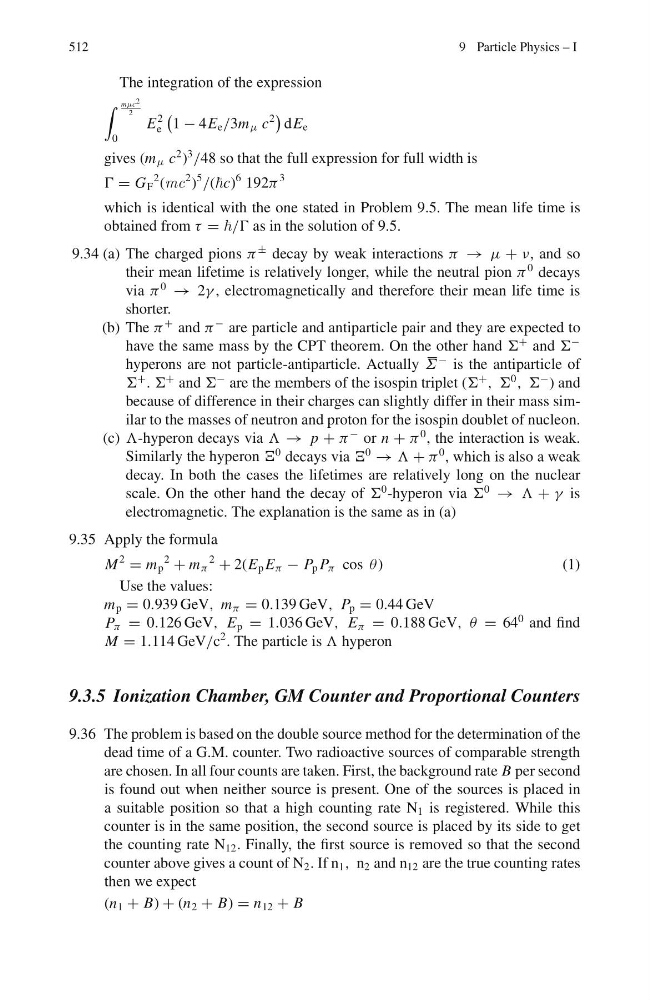
The integration of the expression
mμc 2
2
0
E
2
e
1 − 4E e /3m μ c
2
dE e
gives (m μ c
2 )
3
/48 so that the full expression for full width is
Γ = G F
2 (mc
2 )
5
/(c)
6 192π
3
which is identical with the one stated in Problem 9.5. The mean life time is
obtained from τ = /Γ as in the solution of 9.5.
9.34 (a) The charged pions π
± decay by weak interactions π → μ + ν, and so
their mean lifetime is relatively longer, while the neutral pion π
0 decays
via π
0
→ 2γ , electromagnetically and therefore their mean life time is
shorter.
(b) The π
+ and π
− are particle and antiparticle pair and they are expected to
have the same mass by the CPT theorem. On the other hand Σ
+ and Σ
−
hyperons are not particle-antiparticle. Actually Σ − − is the antiparticle of
Σ
+ . Σ
+ and Σ
− are the members of the isospin triplet (Σ
+
, Σ
0
, Σ
− ) and
because of difference in their charges can slightly differ in their mass similar to the masses of neutron and proton for the isospin doublet of nucleon.
(c) Λ-hyperon decays via Λ → p + π
− or n + π
0 , the interaction is weak.
Similarly the hyperon Ξ
0 decays via Ξ
0
→ Λ + π
0 , which is also a weak
decay. In both the cases the lifetimes are relatively long on the nuclear
scale. On the other hand the decay of Σ
0 -hyperon via Σ
0
→ Λ + γ is
electromagnetic. The explanation is the same as in (a)
9.35 Apply the formula
M
2
= m p
2
+ m π
2
+ 2(E p E π − P p P π cos θ)
( 1 )
Use the values:
m p = 0.939 GeV, m π = 0.139 GeV, P p = 0.44 GeV
P π = 0.126 GeV, E p = 1.036 GeV, E π = 0.188 GeV, θ = 64
0 and find
M = 1.114 GeV/c
2 . The particle is Λ hyperon
9.3.5 Ionization Chamber, GM Counter and Proportional Counters
9.36 The problem is based on the double source method for the determination of the
dead time of a G.M. counter. Two radioactive sources of comparable strength
are chosen. In all four counts are taken. First, the background rate B per second
is found out when neither source is present. One of the sources is placed in
a suitable position so that a high counting rate N 1 is registered. While this
counter is in the same position, the second source is placed by its side to get
the counting rate N 12 . Finally, the first source is removed so that the second
counter above gives a count of N 2 . If n 1 , n 2 and n 12 are the true counting rates
then we expect
(n 1 + B) + (n 2 + B) = n 12 + B
9 Particle Physics – I
The integration of the expression
mμc 2
2
0
E
2
e
1 − 4E e /3m μ c
2
dE e
gives (m μ c
2 )
3
/48 so that the full expression for full width is
Γ = G F
2 (mc
2 )
5
/(c)
6 192π
3
which is identical with the one stated in Problem 9.5. The mean life time is
obtained from τ = /Γ as in the solution of 9.5.
9.34 (a) The charged pions π
± decay by weak interactions π → μ + ν, and so
their mean lifetime is relatively longer, while the neutral pion π
0 decays
via π
0
→ 2γ , electromagnetically and therefore their mean life time is
shorter.
(b) The π
+ and π
− are particle and antiparticle pair and they are expected to
have the same mass by the CPT theorem. On the other hand Σ
+ and Σ
−
hyperons are not particle-antiparticle. Actually Σ − − is the antiparticle of
Σ
+ . Σ
+ and Σ
− are the members of the isospin triplet (Σ
+
, Σ
0
, Σ
− ) and
because of difference in their charges can slightly differ in their mass similar to the masses of neutron and proton for the isospin doublet of nucleon.
(c) Λ-hyperon decays via Λ → p + π
− or n + π
0 , the interaction is weak.
Similarly the hyperon Ξ
0 decays via Ξ
0
→ Λ + π
0 , which is also a weak
decay. In both the cases the lifetimes are relatively long on the nuclear
scale. On the other hand the decay of Σ
0 -hyperon via Σ
0
→ Λ + γ is
electromagnetic. The explanation is the same as in (a)
9.35 Apply the formula
M
2
= m p
2
+ m π
2
+ 2(E p E π − P p P π cos θ)
( 1 )
Use the values:
m p = 0.939 GeV, m π = 0.139 GeV, P p = 0.44 GeV
P π = 0.126 GeV, E p = 1.036 GeV, E π = 0.188 GeV, θ = 64
0 and find
M = 1.114 GeV/c
2 . The particle is Λ hyperon
9.3.5 Ionization Chamber, GM Counter and Proportional Counters
9.36 The problem is based on the double source method for the determination of the
dead time of a G.M. counter. Two radioactive sources of comparable strength
are chosen. In all four counts are taken. First, the background rate B per second
is found out when neither source is present. One of the sources is placed in
a suitable position so that a high counting rate N 1 is registered. While this
counter is in the same position, the second source is placed by its side to get
the counting rate N 12 . Finally, the first source is removed so that the second
counter above gives a count of N 2 . If n 1 , n 2 and n 12 are the true counting rates
then we expect
(n 1 + B) + (n 2 + B) = n 12 + B