

9.3 Solutions
507
= 6.02 × 10
23
× 7.9 × 600 × 10
−27
/55.95 = 0.051 cm
−1
I /I 0 = 1/500 = exp(−0.051 x)
Take log e on both sides of the equation and solve for x.
We find x = 122 cm = 1.22 m.
Thus a thickness of 1.22 m iron will reduce the pion beam by a factor of
500. This does not include the reduction due to the decay of pions. Muons have
much less interaction cross-section so that much greater thickness is required.
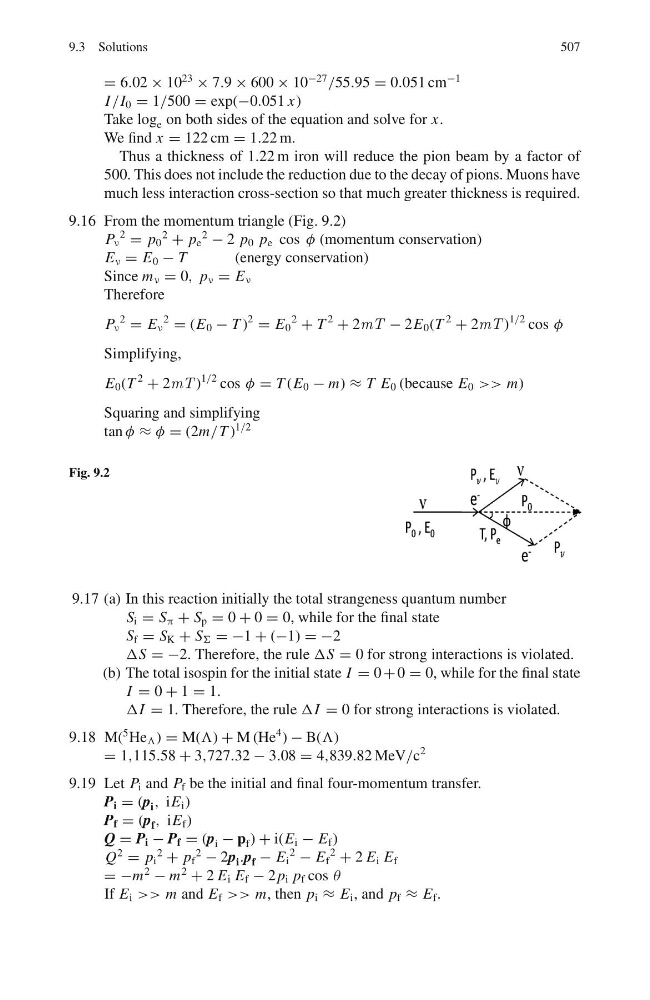
9.16 From the momentum triangle (Fig. 9.2)
P ν
2
= p 0
2
+ p e
2
− 2 p 0 p e cos φ (momentum conservation)
E ν = E 0 − T
(energy conservation)
Since m ν = 0, p ν = E ν
Therefore
P ν
2
= E ν
2
= (E 0 − T )
2
= E 0
2
+ T
2
+ 2mT − 2E 0 (T
2
+ 2mT )
1/2 cos φ
Simplifying,
E 0 (T
2
+ 2mT )
1/2 cos φ = T (E 0 − m) ≈ T E 0 (because E 0 >> m)
Squaring and simplifying
tan φ ≈ φ = (2m/T )
1/2
Fig. 9.2
9.17 (a) In this reaction initially the total strangeness quantum number
S i = S π + S p = 0 + 0 = 0, while for the final state
S f = S K + S Σ = −1 + (−1) = −2
ΔS = −2. Therefore, the rule ΔS = 0 for strong interactions is violated.
(b) The total isospin for the initial state I = 0 + 0 = 0, while for the final state
I = 0 + 1 = 1.
ΔI = 1. Therefore, the rule ΔI = 0 for strong interactions is violated.
9.18 M(
5 He Λ ) = M(Λ) + M (He
4 ) − B(Λ)
= 1,115.58 + 3,727.32 − 3.08 = 4,839.82 MeV/c
2
9.19 Let P i and P f be the initial and final four-momentum transfer.
P i = (p i , iE i )
P f = (p f , iE f )
Q = P i − P f = (p i − p f ) + i(E i − E f )
Q
2
= p i
2
+ p f
2
− 2p i .p f − E i
2
− E f
2
+ 2 E i E f
= −m
2
− m
2
+ 2 E i E f − 2 p i p f cos θ
If E i >> m and E f >> m, then p i ≈ E i , and p f ≈ E f .
507
= 6.02 × 10
23
× 7.9 × 600 × 10
−27
/55.95 = 0.051 cm
−1
I /I 0 = 1/500 = exp(−0.051 x)
Take log e on both sides of the equation and solve for x.
We find x = 122 cm = 1.22 m.
Thus a thickness of 1.22 m iron will reduce the pion beam by a factor of
500. This does not include the reduction due to the decay of pions. Muons have
much less interaction cross-section so that much greater thickness is required.
9.16 From the momentum triangle (Fig. 9.2)
P ν
2
= p 0
2
+ p e
2
− 2 p 0 p e cos φ (momentum conservation)
E ν = E 0 − T
(energy conservation)
Since m ν = 0, p ν = E ν
Therefore
P ν
2
= E ν
2
= (E 0 − T )
2
= E 0
2
+ T
2
+ 2mT − 2E 0 (T
2
+ 2mT )
1/2 cos φ
Simplifying,
E 0 (T
2
+ 2mT )
1/2 cos φ = T (E 0 − m) ≈ T E 0 (because E 0 >> m)
Squaring and simplifying
tan φ ≈ φ = (2m/T )
1/2
Fig. 9.2
9.17 (a) In this reaction initially the total strangeness quantum number
S i = S π + S p = 0 + 0 = 0, while for the final state
S f = S K + S Σ = −1 + (−1) = −2
ΔS = −2. Therefore, the rule ΔS = 0 for strong interactions is violated.
(b) The total isospin for the initial state I = 0 + 0 = 0, while for the final state
I = 0 + 1 = 1.
ΔI = 1. Therefore, the rule ΔI = 0 for strong interactions is violated.
9.18 M(
5 He Λ ) = M(Λ) + M (He
4 ) − B(Λ)
= 1,115.58 + 3,727.32 − 3.08 = 4,839.82 MeV/c
2
9.19 Let P i and P f be the initial and final four-momentum transfer.
P i = (p i , iE i )
P f = (p f , iE f )
Q = P i − P f = (p i − p f ) + i(E i − E f )
Q
2
= p i
2
+ p f
2
− 2p i .p f − E i
2
− E f
2
+ 2 E i E f
= −m
2
− m
2
+ 2 E i E f − 2 p i p f cos θ
If E i >> m and E f >> m, then p i ≈ E i , and p f ≈ E f .