

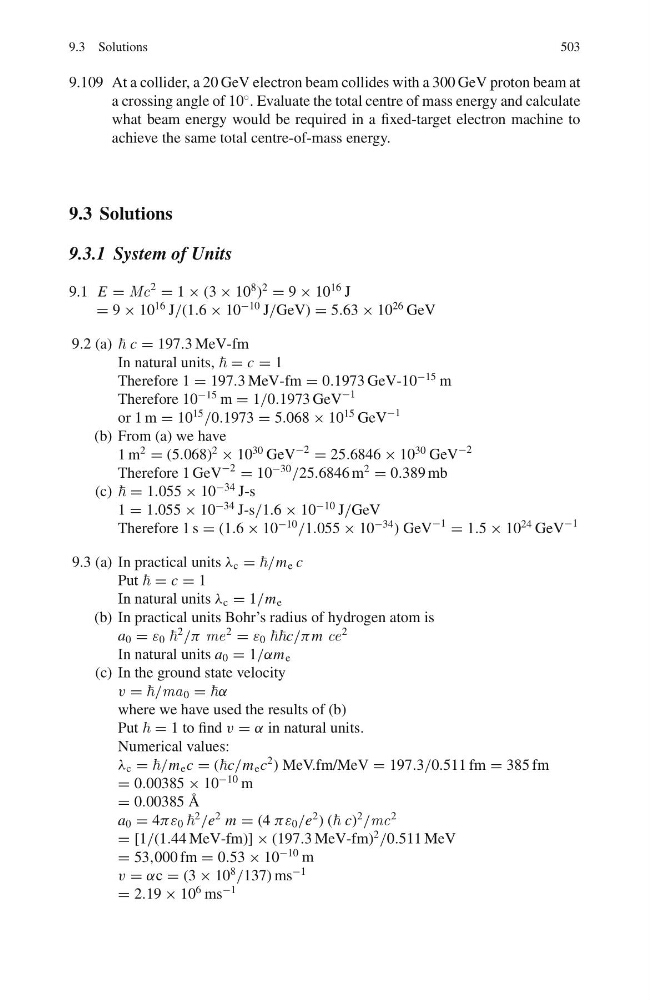
9.3 Solutions
503
9.109 At a collider, a 20 GeV electron beam collides with a 300 GeV proton beam at
a crossing angle of 10
◦ . Evaluate the total centre of mass energy and calculate
what beam energy would be required in a fixed-target electron machine to
achieve the same total centre-of-mass energy.
9.3 Solutions
9.3.1 System of Units
9.1 E = Mc
2
= 1 × (3 × 10
8 )
2
= 9 × 10
16 J
= 9 × 10
16 J/(1.6 × 10
−10 J/GeV) = 5.63 × 10
26 GeV
9.2 (a) c = 197.3 MeV-fm
In natural units, = c = 1
Therefore 1 = 197.3 MeV-fm = 0.1973 GeV-10
−15 m
Therefore 10
−15 m = 1/0.1973 GeV
−1
or 1 m = 10
15
/0.1973 = 5.068 × 10
15 GeV
−1
(b) From (a) we have
1 m
2
= (5.068)
2
× 10
30 GeV
−2
= 25.6846 × 10
30 GeV
−2
Therefore 1 GeV
−2
= 10
−30
/25.6846 m
2
= 0.389 mb
(c) = 1.055 × 10
−34 J-s
1 = 1.055 × 10
−34 J-s/1.6 × 10
−10 J/GeV
Therefore 1 s = (1.6 × 10
−10
/1.055 × 10
−34 ) GeV
−1
= 1.5 × 10
24 GeV
−1
9.3 (a) In practical units λ c = /m e c
Put = c = 1
In natural units λ c = 1/m e
(b) In practical units Bohr’s radius of hydrogen atom is
a 0 = ε 0
2
/π me
2
= ε 0 c/π m ce
2
In natural units a 0 = 1/αm e
(c) In the ground state velocity
v = /ma 0 = α
where we have used the results of (b)
Put = 1 to find v = α in natural units.
Numerical values:
λ c = /m e c = (c/m e c
2 ) MeV.fm/MeV = 197.3/0.511 fm = 385 fm
= 0.00385 × 10
−10 m
= 0.00385 ˚
A
a 0 = 4πε 0
2
/e
2 m = (4 πε 0 /e
2 ) ( c)
2
/mc
2
= [1/(1.44 MeV-fm)] × (197.3 MeV-fm)
2
/0.511 MeV
= 53,000 fm = 0.53 × 10
−10 m
v = αc = (3 × 10
8
/137) ms
−1
= 2.19 × 10
6 ms
−1
503
9.109 At a collider, a 20 GeV electron beam collides with a 300 GeV proton beam at
a crossing angle of 10
◦ . Evaluate the total centre of mass energy and calculate
what beam energy would be required in a fixed-target electron machine to
achieve the same total centre-of-mass energy.
9.3 Solutions
9.3.1 System of Units
9.1 E = Mc
2
= 1 × (3 × 10
8 )
2
= 9 × 10
16 J
= 9 × 10
16 J/(1.6 × 10
−10 J/GeV) = 5.63 × 10
26 GeV
9.2 (a) c = 197.3 MeV-fm
In natural units, = c = 1
Therefore 1 = 197.3 MeV-fm = 0.1973 GeV-10
−15 m
Therefore 10
−15 m = 1/0.1973 GeV
−1
or 1 m = 10
15
/0.1973 = 5.068 × 10
15 GeV
−1
(b) From (a) we have
1 m
2
= (5.068)
2
× 10
30 GeV
−2
= 25.6846 × 10
30 GeV
−2
Therefore 1 GeV
−2
= 10
−30
/25.6846 m
2
= 0.389 mb
(c) = 1.055 × 10
−34 J-s
1 = 1.055 × 10
−34 J-s/1.6 × 10
−10 J/GeV
Therefore 1 s = (1.6 × 10
−10
/1.055 × 10
−34 ) GeV
−1
= 1.5 × 10
24 GeV
−1
9.3 (a) In practical units λ c = /m e c
Put = c = 1
In natural units λ c = 1/m e
(b) In practical units Bohr’s radius of hydrogen atom is
a 0 = ε 0
2
/π me
2
= ε 0 c/π m ce
2
In natural units a 0 = 1/αm e
(c) In the ground state velocity
v = /ma 0 = α
where we have used the results of (b)
Put = 1 to find v = α in natural units.
Numerical values:
λ c = /m e c = (c/m e c
2 ) MeV.fm/MeV = 197.3/0.511 fm = 385 fm
= 0.00385 × 10
−10 m
= 0.00385 ˚
A
a 0 = 4πε 0
2
/e
2 m = (4 πε 0 /e
2 ) ( c)
2
/mc
2
= [1/(1.44 MeV-fm)] × (197.3 MeV-fm)
2
/0.511 MeV
= 53,000 fm = 0.53 × 10
−10 m
v = αc = (3 × 10
8
/137) ms
−1
= 2.19 × 10
6 ms
−1