

1.3 Solutions
35
(b) If the field is solenoidal, then, ∇.r F(r ) = 0
∂(x F(r ))
∂ x
+
∂(y F(r ))
∂ y
+
∂(z F(r ))
∂z
= 0
F + x
∂ F
∂ x
+ F + y
∂ F
∂ y
+ F + z
∂ F
∂z
= 0
3F(r ) + x
∂ F
∂r
x
r
+ y
∂ F
∂r
y
r
+ z
∂ F
∂r
z
r
= 0
3F(r ) +
∂ F
∂r
x
2
+ y
2
+ z
2
r
= 0
But (x
2
+ y
2
+ z
2 ) = r
2 , therefore,
∂ F
∂r
= −
3F(r)
r
Integrating, ln F = −3 ln r + ln C where C = constant
ln F = − ln r
3
+ ln C = ln
C
r 3
Therefore F = C/r
3 . Thus, the field is A =
r
r 3 (inverse square law)
1.6 x = t, y = t
2
, z = t
3
Therefore, y = x
2
, z = x
3
, dy = 2xdx, dz = 3x
2 dx
c
A.dr =
(y ˆ
i + xz ˆ j + x yz ˆ
k).( ˆ
idx + ˆ jdy + ˆ
kdz)
=
1
0
x
2 dx + 2
1
0
x
5 dx + 3
1
0
x
8 dx
=
1
3
+
1
3
+
1
3
= 1
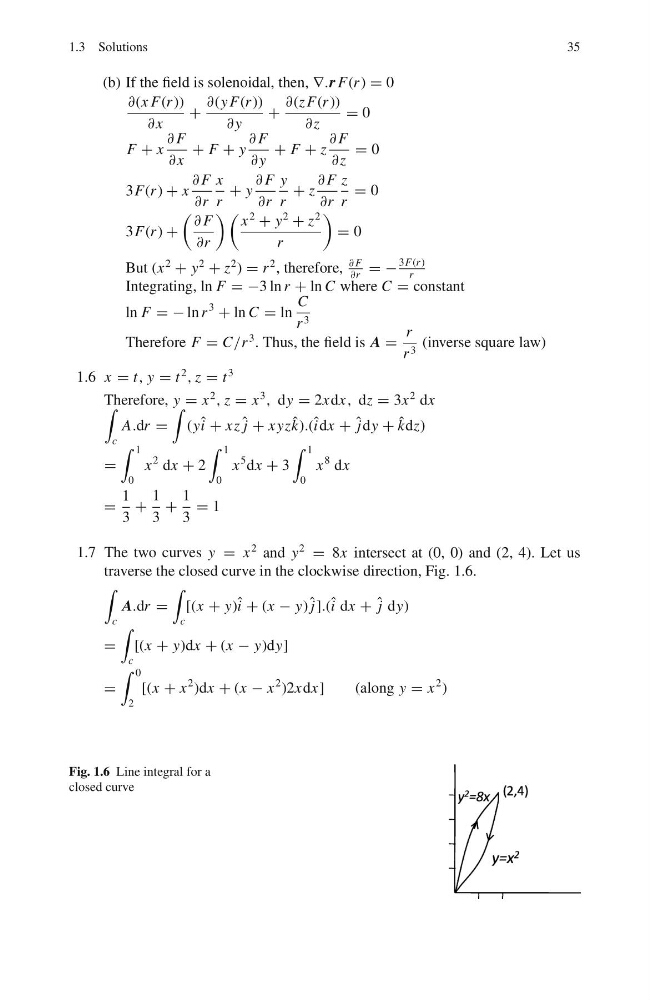
1.7 The two curves y = x
2 and y
2
= 8x intersect at (0, 0) and (2, 4). Let us
traverse the closed curve in the clockwise direction, Fig. 1.6.
c
A.dr =
c
[(x + y) ˆ
i + (x − y) ˆ j].( ˆ
i dx + ˆ j dy)
=
c
[(x + y)dx + (x − y)dy]
=
0
2
[(x + x
2 )dx + (x − x
2 )2xdx]
(along y = x
2 )
Fig. 1.6 Line integral for a
closed curve
35
(b) If the field is solenoidal, then, ∇.r F(r ) = 0
∂(x F(r ))
∂ x
+
∂(y F(r ))
∂ y
+
∂(z F(r ))
∂z
= 0
F + x
∂ F
∂ x
+ F + y
∂ F
∂ y
+ F + z
∂ F
∂z
= 0
3F(r ) + x
∂ F
∂r
x
r
+ y
∂ F
∂r
y
r
+ z
∂ F
∂r
z
r
= 0
3F(r ) +
∂ F
∂r
x
2
+ y
2
+ z
2
r
= 0
But (x
2
+ y
2
+ z
2 ) = r
2 , therefore,
∂ F
∂r
= −
3F(r)
r
Integrating, ln F = −3 ln r + ln C where C = constant
ln F = − ln r
3
+ ln C = ln
C
r 3
Therefore F = C/r
3 . Thus, the field is A =
r
r 3 (inverse square law)
1.6 x = t, y = t
2
, z = t
3
Therefore, y = x
2
, z = x
3
, dy = 2xdx, dz = 3x
2 dx
c
A.dr =
(y ˆ
i + xz ˆ j + x yz ˆ
k).( ˆ
idx + ˆ jdy + ˆ
kdz)
=
1
0
x
2 dx + 2
1
0
x
5 dx + 3
1
0
x
8 dx
=
1
3
+
1
3
+
1
3
= 1
1.7 The two curves y = x
2 and y
2
= 8x intersect at (0, 0) and (2, 4). Let us
traverse the closed curve in the clockwise direction, Fig. 1.6.
c
A.dr =
c
[(x + y) ˆ
i + (x − y) ˆ j].( ˆ
i dx + ˆ j dy)
=
c
[(x + y)dx + (x − y)dy]
=
0
2
[(x + x
2 )dx + (x − x
2 )2xdx]
(along y = x
2 )
Fig. 1.6 Line integral for a
closed curve