

9.2 Problems
497
9.61 In an experiment using a Cerenkov counter, one measures the kinetic energy of
a given particle species as E(kin) = 420 MeV and observes that the Cerenkov
angle in flint glass of refractive index (μ = 1.88) is θ = arc cos(0.55). What
particles are being detected (calculate their mass in m e units)
9.62 Calculate the number of Cerenkov photons produced by a particle travelling
at β = 0.95 in water (n = 1.33) in the response range (3500–5500 A) per unit
path length.
9.63 Estimate the minimum length of a gas Cerenkov counter that could be used
in threshold mode to distinguish between charged pions and charged kaons
with momentum 15 GeV/c. Assume that a minimum of 175 photons need to
be radiated to ensure a high probability of detection. Assume also that the radiation covers the whole visible spectrum between 400 and 700 nm and neglect
the variation with wavelength of the refractive index of the gas (n = 1.0004)
9.64 What type of material would you choose for a threshold Cerenkov counter
which is to be sensitive to 900 MeV/c pions but not to 900 MeV/c protons.
9.2.8 Solid State Detector
9.65 A depletion-layer detector has an electrical capacitance determined by the
thickness of the insulating dielectric. Estimate the capacitance of a silicon
detector with the following characteristics: area 1.5 cm
2 , dielectric constant
10, depletion layer 40 μm. What potential will be developed across the capacitance by the absorption of a 5.0 MeV alpha particle which produces one ion
pair for each 3.5 eV dissipated?
9.2.9 Emulsions
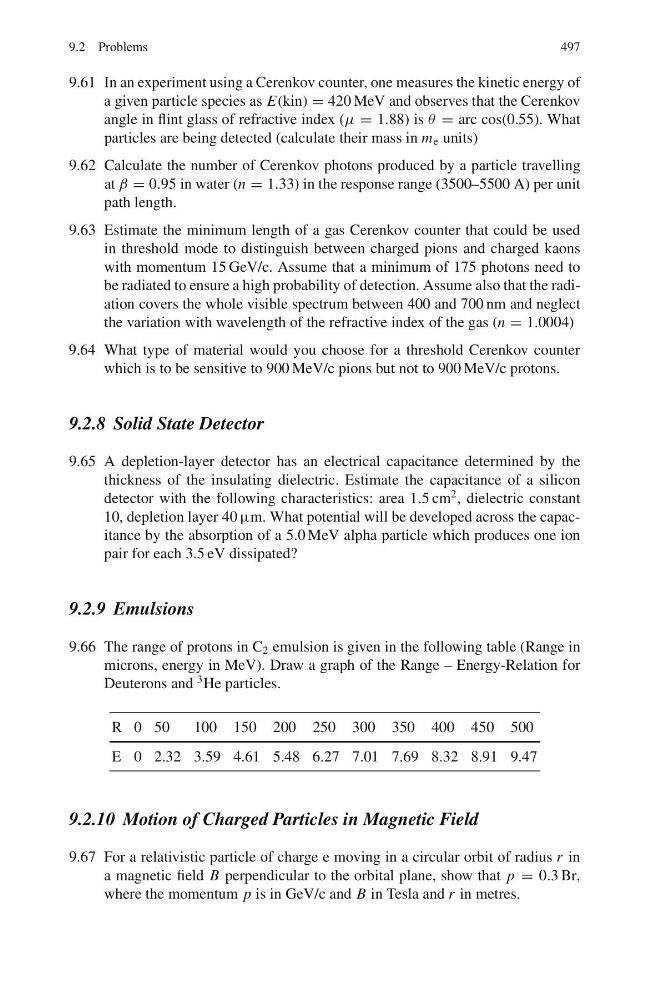
9.66 The range of protons in C 2 emulsion is given in the following table (Range in
microns, energy in MeV). Draw a graph of the Range – Energy-Relation for
Deuterons and
3 He particles.
R 0 50
100 150 200 250 300 350 400 450 500
E 0 2.32 3.59 4.61 5.48 6.27 7.01 7.69 8.32 8.91 9.47
9.2.10 Motion of Charged Particles in Magnetic Field
9.67 For a relativistic particle of charge e moving in a circular orbit of radius r in
a magnetic field B perpendicular to the orbital plane, show that p = 0.3 Br,
where the momentum p is in GeV/c and B in Tesla and r in metres.
497
9.61 In an experiment using a Cerenkov counter, one measures the kinetic energy of
a given particle species as E(kin) = 420 MeV and observes that the Cerenkov
angle in flint glass of refractive index (μ = 1.88) is θ = arc cos(0.55). What
particles are being detected (calculate their mass in m e units)
9.62 Calculate the number of Cerenkov photons produced by a particle travelling
at β = 0.95 in water (n = 1.33) in the response range (3500–5500 A) per unit
path length.
9.63 Estimate the minimum length of a gas Cerenkov counter that could be used
in threshold mode to distinguish between charged pions and charged kaons
with momentum 15 GeV/c. Assume that a minimum of 175 photons need to
be radiated to ensure a high probability of detection. Assume also that the radiation covers the whole visible spectrum between 400 and 700 nm and neglect
the variation with wavelength of the refractive index of the gas (n = 1.0004)
9.64 What type of material would you choose for a threshold Cerenkov counter
which is to be sensitive to 900 MeV/c pions but not to 900 MeV/c protons.
9.2.8 Solid State Detector
9.65 A depletion-layer detector has an electrical capacitance determined by the
thickness of the insulating dielectric. Estimate the capacitance of a silicon
detector with the following characteristics: area 1.5 cm
2 , dielectric constant
10, depletion layer 40 μm. What potential will be developed across the capacitance by the absorption of a 5.0 MeV alpha particle which produces one ion
pair for each 3.5 eV dissipated?
9.2.9 Emulsions
9.66 The range of protons in C 2 emulsion is given in the following table (Range in
microns, energy in MeV). Draw a graph of the Range – Energy-Relation for
Deuterons and
3 He particles.
R 0 50
100 150 200 250 300 350 400 450 500
E 0 2.32 3.59 4.61 5.48 6.27 7.01 7.69 8.32 8.91 9.47
9.2.10 Motion of Charged Particles in Magnetic Field
9.67 For a relativistic particle of charge e moving in a circular orbit of radius r in
a magnetic field B perpendicular to the orbital plane, show that p = 0.3 Br,
where the momentum p is in GeV/c and B in Tesla and r in metres.