

9.2 Problems
489
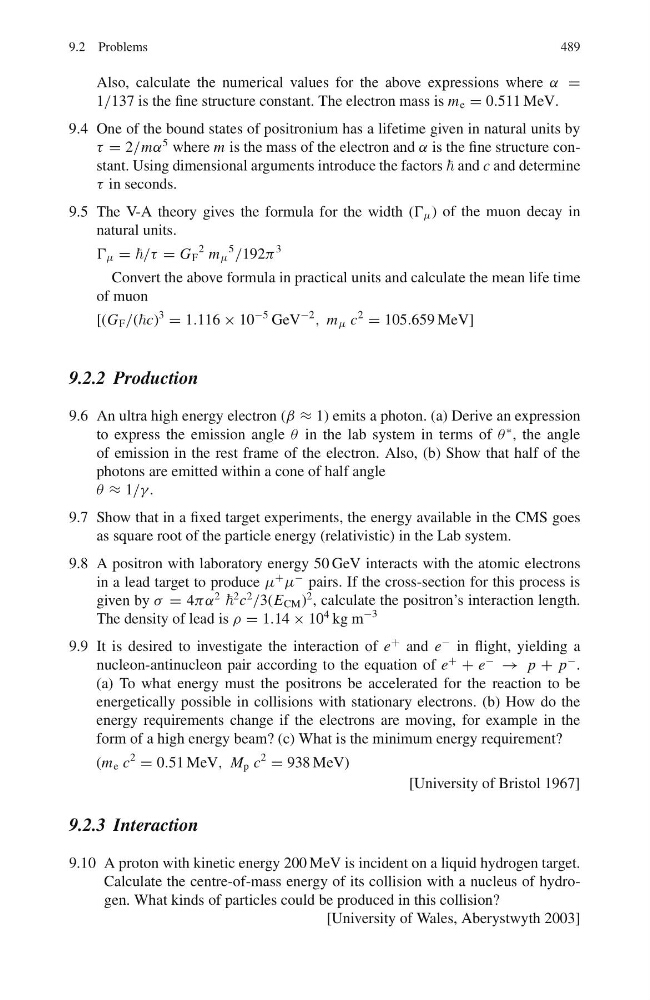
Also, calculate the numerical values for the above expressions where α =
1/137 is the fine structure constant. The electron mass is m e = 0.511 MeV.
9.4 One of the bound states of positronium has a lifetime given in natural units by
τ = 2/mα
5 where m is the mass of the electron and α is the fine structure constant. Using dimensional arguments introduce the factors and c and determine
τ in seconds.
9.5 The V-A theory gives the formula for the width (Γ μ ) of the muon decay in
natural units.
Γ μ = /τ = G F
2 m μ
5
/192π
3
Convert the above formula in practical units and calculate the mean life time
of muon
[(G F /(c)
3
= 1.116 × 10
−5 GeV
−2
, m μ c
2
= 105.659 MeV]
9.2.2 Production
9.6 An ultra high energy electron (β ≈ 1) emits a photon. (a) Derive an expression
to express the emission angle θ in the lab system in terms of θ
∗ , the angle
of emission in the rest frame of the electron. Also, (b) Show that half of the
photons are emitted within a cone of half angle
θ ≈ 1/γ .
9.7 Show that in a fixed target experiments, the energy available in the CMS goes
as square root of the particle energy (relativistic) in the Lab system.
9.8 A positron with laboratory energy 50 GeV interacts with the atomic electrons
in a lead target to produce μ
+
μ
− pairs. If the cross-section for this process is
given by σ = 4πα
2
2 c
2
/3(E CM )
2 , calculate the positron’s interaction length.
The density of lead is ρ = 1.14 × 10
4 kg m
−3
9.9 It is desired to investigate the interaction of e
+ and e
− in flight, yielding a
nucleon-antinucleon pair according to the equation of e
+
+ e
−
→ p + p
− .
(a) To what energy must the positrons be accelerated for the reaction to be
energetically possible in collisions with stationary electrons. (b) How do the
energy requirements change if the electrons are moving, for example in the
form of a high energy beam? (c) What is the minimum energy requirement?
(m e c
2
= 0.51 MeV, M p c
2
= 938 MeV)
[University of Bristol 1967]
9.2.3 Interaction
9.10 A proton with kinetic energy 200 MeV is incident on a liquid hydrogen target.
Calculate the centre-of-mass energy of its collision with a nucleus of hydrogen. What kinds of particles could be produced in this collision?
[University of Wales, Aberystwyth 2003]
489
Also, calculate the numerical values for the above expressions where α =
1/137 is the fine structure constant. The electron mass is m e = 0.511 MeV.
9.4 One of the bound states of positronium has a lifetime given in natural units by
τ = 2/mα
5 where m is the mass of the electron and α is the fine structure constant. Using dimensional arguments introduce the factors and c and determine
τ in seconds.
9.5 The V-A theory gives the formula for the width (Γ μ ) of the muon decay in
natural units.
Γ μ = /τ = G F
2 m μ
5
/192π
3
Convert the above formula in practical units and calculate the mean life time
of muon
[(G F /(c)
3
= 1.116 × 10
−5 GeV
−2
, m μ c
2
= 105.659 MeV]
9.2.2 Production
9.6 An ultra high energy electron (β ≈ 1) emits a photon. (a) Derive an expression
to express the emission angle θ in the lab system in terms of θ
∗ , the angle
of emission in the rest frame of the electron. Also, (b) Show that half of the
photons are emitted within a cone of half angle
θ ≈ 1/γ .
9.7 Show that in a fixed target experiments, the energy available in the CMS goes
as square root of the particle energy (relativistic) in the Lab system.
9.8 A positron with laboratory energy 50 GeV interacts with the atomic electrons
in a lead target to produce μ
+
μ
− pairs. If the cross-section for this process is
given by σ = 4πα
2
2 c
2
/3(E CM )
2 , calculate the positron’s interaction length.
The density of lead is ρ = 1.14 × 10
4 kg m
−3
9.9 It is desired to investigate the interaction of e
+ and e
− in flight, yielding a
nucleon-antinucleon pair according to the equation of e
+
+ e
−
→ p + p
− .
(a) To what energy must the positrons be accelerated for the reaction to be
energetically possible in collisions with stationary electrons. (b) How do the
energy requirements change if the electrons are moving, for example in the
form of a high energy beam? (c) What is the minimum energy requirement?
(m e c
2
= 0.51 MeV, M p c
2
= 938 MeV)
[University of Bristol 1967]
9.2.3 Interaction
9.10 A proton with kinetic energy 200 MeV is incident on a liquid hydrogen target.
Calculate the centre-of-mass energy of its collision with a nucleus of hydrogen. What kinds of particles could be produced in this collision?
[University of Wales, Aberystwyth 2003]