

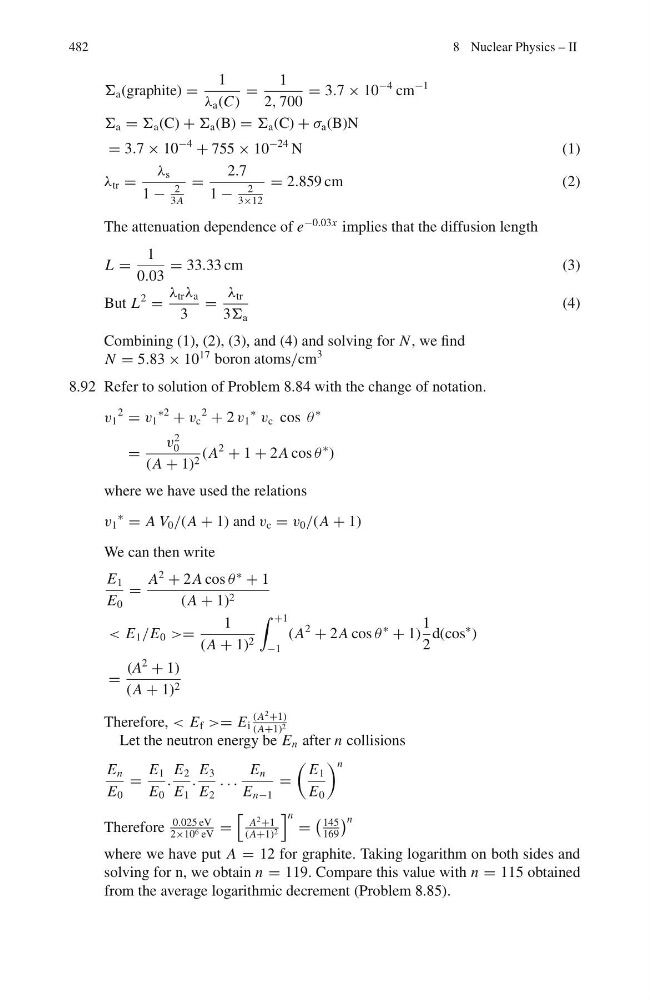
482
8 Nuclear Physics – II
Σ a (graphite) =
1
λ a (C)
=
1
2, 700
= 3.7 × 10
−4 cm
−1
Σ a = Σ a (C) + Σ a (B) = Σ a (C) + σ a (B)N
= 3.7 × 10
−4
+ 755 × 10
−24 N
( 1 )
λ tr =
λ s
1 −
2
3A
=
2.7
1 −
2
3×12
= 2.859 cm
(2)
The attenuation dependence of e
−0.03x implies that the diffusion length
L =
1
0.03
= 33.33 cm
(3)
But L
2
=
λ tr λ a
3
=
λ tr
3Σ a
(4)
Combining (1), (2), (3), and (4) and solving for N , we find
N = 5.83 × 10
17 boron atoms/cm
3
8.92 Refer to solution of Problem 8.84 with the change of notation.
v 1
2
= v 1
∗2
+ v c
2
+ 2 v 1
∗
v c cos θ
∗
=
v
2
0
( A + 1) 2 (A
2
+ 1 + 2A cos θ
∗ )
where we have used the relations
v 1
∗
= A V 0 /(A + 1) and v c = v 0 /(A + 1)
We can then write
E 1
E 0
=
A
2
+ 2A cos θ
∗
+ 1
(A + 1) 2
< E 1 /E 0 >=
1
(A + 1) 2
+1
−1
(A
2
+ 2A cos θ
∗
+ 1)
1
2
d(cos
∗ )
=
(A
2
+ 1)
( A + 1) 2
Therefore, < E f >= E i
(A
2 +1)
(A+1) 2
Let the neutron energy be E n after n collisions
E n
E 0
=
E 1
E 0
.
E 2
E 1
.
E 3
E 2
. . .
E n
E n−1
=
E 1
E 0
n
Therefore
0.025 eV
2×10 6 eV
=
A
2 +1
(A+1) 2
n =
145
169
n
where we have put A = 12 for graphite. Taking logarithm on both sides and
solving for n, we obtain n = 119. Compare this value with n = 115 obtained
from the average logarithmic decrement (Problem 8.85).
8 Nuclear Physics – II
Σ a (graphite) =
1
λ a (C)
=
1
2, 700
= 3.7 × 10
−4 cm
−1
Σ a = Σ a (C) + Σ a (B) = Σ a (C) + σ a (B)N
= 3.7 × 10
−4
+ 755 × 10
−24 N
( 1 )
λ tr =
λ s
1 −
2
3A
=
2.7
1 −
2
3×12
= 2.859 cm
(2)
The attenuation dependence of e
−0.03x implies that the diffusion length
L =
1
0.03
= 33.33 cm
(3)
But L
2
=
λ tr λ a
3
=
λ tr
3Σ a
(4)
Combining (1), (2), (3), and (4) and solving for N , we find
N = 5.83 × 10
17 boron atoms/cm
3
8.92 Refer to solution of Problem 8.84 with the change of notation.
v 1
2
= v 1
∗2
+ v c
2
+ 2 v 1
∗
v c cos θ
∗
=
v
2
0
( A + 1) 2 (A
2
+ 1 + 2A cos θ
∗ )
where we have used the relations
v 1
∗
= A V 0 /(A + 1) and v c = v 0 /(A + 1)
We can then write
E 1
E 0
=
A
2
+ 2A cos θ
∗
+ 1
(A + 1) 2
< E 1 /E 0 >=
1
(A + 1) 2
+1
−1
(A
2
+ 2A cos θ
∗
+ 1)
1
2
d(cos
∗ )
=
(A
2
+ 1)
( A + 1) 2
Therefore, < E f >= E i
(A
2 +1)
(A+1) 2
Let the neutron energy be E n after n collisions
E n
E 0
=
E 1
E 0
.
E 2
E 1
.
E 3
E 2
. . .
E n
E n−1
=
E 1
E 0
n
Therefore
0.025 eV
2×10 6 eV
=
A
2 +1
(A+1) 2
n =
145
169
n
where we have put A = 12 for graphite. Taking logarithm on both sides and
solving for n, we obtain n = 119. Compare this value with n = 115 obtained
from the average logarithmic decrement (Problem 8.85).