

8.3 Solutions
467
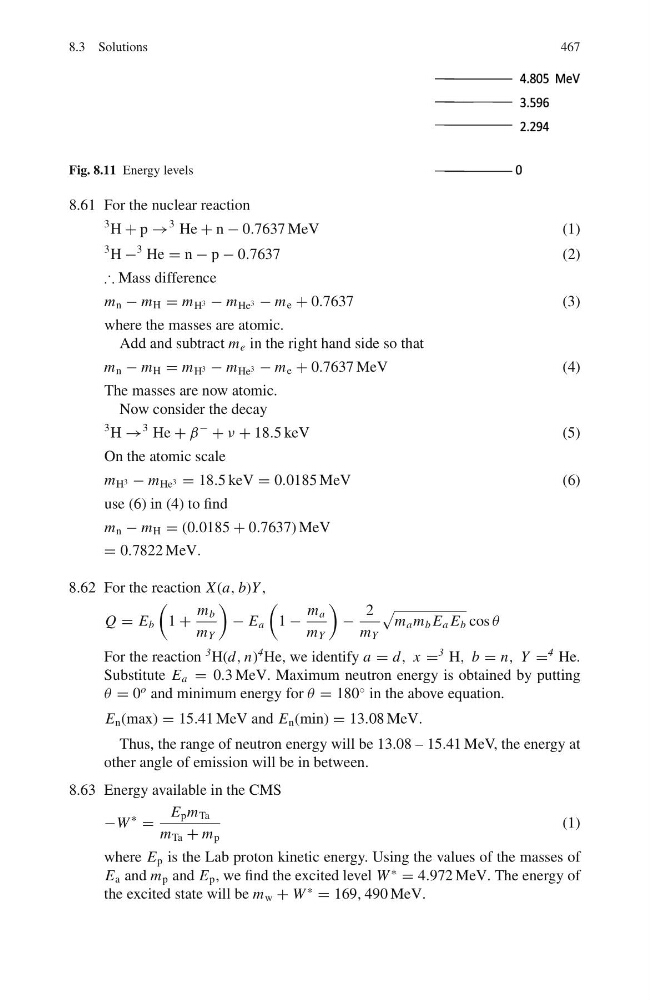
Fig. 8.11 Energy levels
8.61 For the nuclear reaction
3 H + p →
3 He + n − 0.7637 MeV
(1)
3 H −
3 He = n − p − 0.7637
(2)
∴ Mass difference
m n − m H = m H 3 − m He 3 − m e + 0.7637
(3)
where the masses are atomic.
Add and subtract m e in the right hand side so that
m n − m H = m H 3 − m He 3 − m e + 0.7637 MeV
(4)
The masses are now atomic.
Now consider the decay
3 H →
3 He + β
−
+ ν + 18.5 keV
(5)
On the atomic scale
m H 3 − m He 3 = 18.5 keV = 0.0185 MeV
(6)
use (6) in (4) to find
m n − m H = (0.0185 + 0.7637) MeV
= 0.7822 MeV.
8.62 For the reaction X (a, b)Y ,
Q = E b
1 +
m b
m Y
− E a
1 −
m a
m Y
−
2
m Y
m a m b E a E b cos θ
For the reaction
3 H(d, n)
4 He, we identify a = d, x =
3 H, b = n, Y =
4 He.
Substitute E a = 0.3 MeV. Maximum neutron energy is obtained by putting
θ = 0
o and minimum energy for θ = 180
◦ in the above equation.
E n (max) = 15.41 MeV and E n (min) = 13.08 MeV.
Thus, the range of neutron energy will be 13.08 – 15.41 MeV, the energy at
other angle of emission will be in between.
8.63 Energy available in the CMS
−W
∗
=
E p m Ta
m Ta + m p
(1)
where E p is the Lab proton kinetic energy. Using the values of the masses of
E a and m p and E p , we find the excited level W
∗
= 4.972 MeV. The energy of
the excited state will be m w + W
∗
= 169, 490 MeV.
467
Fig. 8.11 Energy levels
8.61 For the nuclear reaction
3 H + p →
3 He + n − 0.7637 MeV
(1)
3 H −
3 He = n − p − 0.7637
(2)
∴ Mass difference
m n − m H = m H 3 − m He 3 − m e + 0.7637
(3)
where the masses are atomic.
Add and subtract m e in the right hand side so that
m n − m H = m H 3 − m He 3 − m e + 0.7637 MeV
(4)
The masses are now atomic.
Now consider the decay
3 H →
3 He + β
−
+ ν + 18.5 keV
(5)
On the atomic scale
m H 3 − m He 3 = 18.5 keV = 0.0185 MeV
(6)
use (6) in (4) to find
m n − m H = (0.0185 + 0.7637) MeV
= 0.7822 MeV.
8.62 For the reaction X (a, b)Y ,
Q = E b
1 +
m b
m Y
− E a
1 −
m a
m Y
−
2
m Y
m a m b E a E b cos θ
For the reaction
3 H(d, n)
4 He, we identify a = d, x =
3 H, b = n, Y =
4 He.
Substitute E a = 0.3 MeV. Maximum neutron energy is obtained by putting
θ = 0
o and minimum energy for θ = 180
◦ in the above equation.
E n (max) = 15.41 MeV and E n (min) = 13.08 MeV.
Thus, the range of neutron energy will be 13.08 – 15.41 MeV, the energy at
other angle of emission will be in between.
8.63 Energy available in the CMS
−W
∗
=
E p m Ta
m Ta + m p
(1)
where E p is the Lab proton kinetic energy. Using the values of the masses of
E a and m p and E p , we find the excited level W
∗
= 4.972 MeV. The energy of
the excited state will be m w + W
∗
= 169, 490 MeV.