

1.2 Problems
31
1.84 Evaluate
c
4z
2 −3z+1
(z−1) 3 dz when C is any simple closed curve enclosing z = 1.
1.85 Locate in the finite z-plane all the singularities of the following function and
name them:
4z
3
− 2z + 1
(z − 3) 2 (z − i)(z + 1 − 2i)
1.86 Determine the residues of the following function at the poles z = 1 and
z = −2:
1
(z − 1)(z + 2) 2
1.87 Find the Laurent series about the singularity for the function:
e
x
(z − 2) 2
1.88 Evaluate I =
∞
0
dx
x 4 +1
1.2.12 Calculus of Variation
1.89 What is the curve which has shortest length between two points?
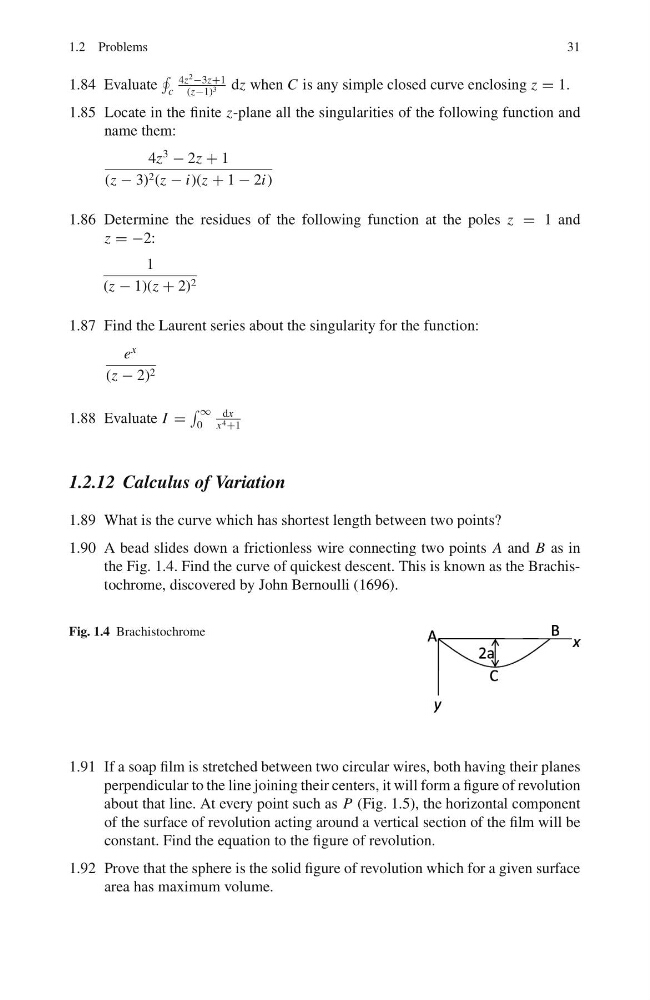
1.90 A bead slides down a frictionless wire connecting two points A and B as in
the Fig. 1.4. Find the curve of quickest descent. This is known as the Brachistochrome, discovered by John Bernoulli (1696).
Fig. 1.4 Brachistochrome
1.91 If a soap film is stretched between two circular wires, both having their planes
perpendicular to the line joining their centers, it will form a figure of revolution
about that line. At every point such as P (Fig. 1.5), the horizontal component
of the surface of revolution acting around a vertical section of the film will be
constant. Find the equation to the figure of revolution.
1.92 Prove that the sphere is the solid figure of revolution which for a given surface
area has maximum volume.
31
1.84 Evaluate
c
4z
2 −3z+1
(z−1) 3 dz when C is any simple closed curve enclosing z = 1.
1.85 Locate in the finite z-plane all the singularities of the following function and
name them:
4z
3
− 2z + 1
(z − 3) 2 (z − i)(z + 1 − 2i)
1.86 Determine the residues of the following function at the poles z = 1 and
z = −2:
1
(z − 1)(z + 2) 2
1.87 Find the Laurent series about the singularity for the function:
e
x
(z − 2) 2
1.88 Evaluate I =
∞
0
dx
x 4 +1
1.2.12 Calculus of Variation
1.89 What is the curve which has shortest length between two points?
1.90 A bead slides down a frictionless wire connecting two points A and B as in
the Fig. 1.4. Find the curve of quickest descent. This is known as the Brachistochrome, discovered by John Bernoulli (1696).
Fig. 1.4 Brachistochrome
1.91 If a soap film is stretched between two circular wires, both having their planes
perpendicular to the line joining their centers, it will form a figure of revolution
about that line. At every point such as P (Fig. 1.5), the horizontal component
of the surface of revolution acting around a vertical section of the film will be
constant. Find the equation to the figure of revolution.
1.92 Prove that the sphere is the solid figure of revolution which for a given surface
area has maximum volume.