

8.3 Solutions
461
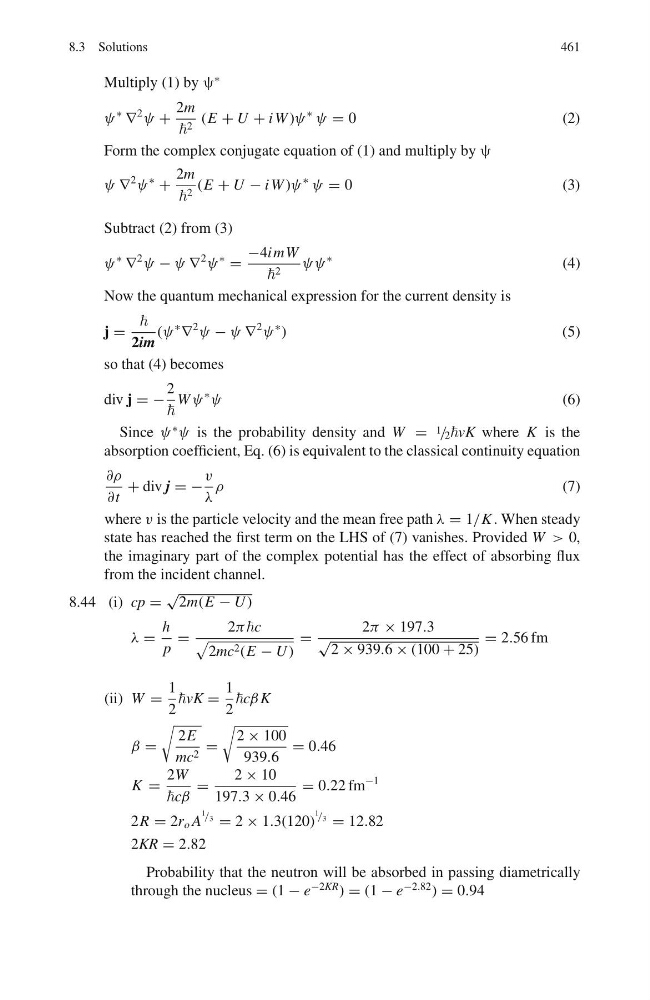
Multiply (1) by ψ
∗
ψ
∗
∇
2
ψ +
2m
2 (E + U + i W )ψ
∗
ψ = 0
( 2 )
Form the complex conjugate equation of (1) and multiply by ψ
ψ ∇
2
ψ
∗
+
2m
2 (E + U − i W )ψ
∗
ψ = 0
( 3 )
Subtract (2) from (3)
ψ
∗
∇
2
ψ − ψ ∇
2
ψ
∗
=
−4imW
2 ψψ
∗
(4)
Now the quantum mechanical expression for the current density is
j =
2im
(ψ
∗
∇
2
ψ − ψ ∇
2
ψ
∗ )
( 5 )
so that (4) becomes
div j = −
2
W ψ
∗
ψ
(6)
Since ψ
∗
ψ is the probability density and W = 1 / 2 vK where K is the
absorption coefficient, Eq. (6) is equivalent to the classical continuity equation
∂ρ
∂t
+ div j = −
v
λ
ρ
(7)
where v is the particle velocity and the mean free path λ = 1/K . When steady
state has reached the first term on the LHS of (7) vanishes. Provided W > 0,
the imaginary part of the complex potential has the effect of absorbing flux
from the incident channel.
8.44 (i) cp =
√
2m(E − U )
λ =
h
p
=
2πc
2mc 2 (E − U )
=
2π × 197.3
√
2 × 939.6 × (100 + 25)
= 2.56 fm
(ii) W =
1
2
vK =
1
2
cβ K
β =
2E
mc 2 =
2 × 100
939.6
= 0.46
K =
2W
cβ
=
2 × 10
197.3 × 0.46
= 0.22 fm
−1
2R = 2r o A
1
/3
= 2 × 1.3(120)
1
/3
= 12.82
2KR = 2.82
Probability that the neutron will be absorbed in passing diametrically
through the nucleus = (1 − e
−2KR ) = (1 − e
−2.82 ) = 0.94
461
Multiply (1) by ψ
∗
ψ
∗
∇
2
ψ +
2m
2 (E + U + i W )ψ
∗
ψ = 0
( 2 )
Form the complex conjugate equation of (1) and multiply by ψ
ψ ∇
2
ψ
∗
+
2m
2 (E + U − i W )ψ
∗
ψ = 0
( 3 )
Subtract (2) from (3)
ψ
∗
∇
2
ψ − ψ ∇
2
ψ
∗
=
−4imW
2 ψψ
∗
(4)
Now the quantum mechanical expression for the current density is
j =
2im
(ψ
∗
∇
2
ψ − ψ ∇
2
ψ
∗ )
( 5 )
so that (4) becomes
div j = −
2
W ψ
∗
ψ
(6)
Since ψ
∗
ψ is the probability density and W = 1 / 2 vK where K is the
absorption coefficient, Eq. (6) is equivalent to the classical continuity equation
∂ρ
∂t
+ div j = −
v
λ
ρ
(7)
where v is the particle velocity and the mean free path λ = 1/K . When steady
state has reached the first term on the LHS of (7) vanishes. Provided W > 0,
the imaginary part of the complex potential has the effect of absorbing flux
from the incident channel.
8.44 (i) cp =
√
2m(E − U )
λ =
h
p
=
2πc
2mc 2 (E − U )
=
2π × 197.3
√
2 × 939.6 × (100 + 25)
= 2.56 fm
(ii) W =
1
2
vK =
1
2
cβ K
β =
2E
mc 2 =
2 × 100
939.6
= 0.46
K =
2W
cβ
=
2 × 10
197.3 × 0.46
= 0.22 fm
−1
2R = 2r o A
1
/3
= 2 × 1.3(120)
1
/3
= 12.82
2KR = 2.82
Probability that the neutron will be absorbed in passing diametrically
through the nucleus = (1 − e
−2KR ) = (1 − e
−2.82 ) = 0.94