

8.3 Solutions
459
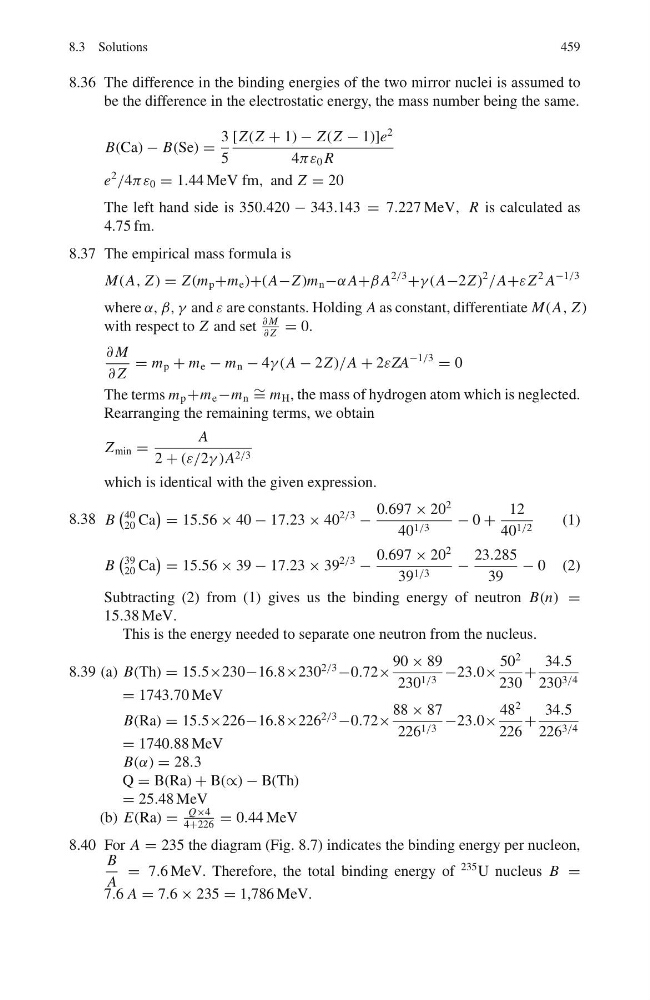
8.36 The difference in the binding energies of the two mirror nuclei is assumed to
be the difference in the electrostatic energy, the mass number being the same.
B(Ca) − B(Se) =
3
5
[Z (Z + 1) − Z (Z − 1)]e
2
4πε 0 R
e
2
/4πε 0 = 1.44 MeV fm, and Z = 20
The left hand side is 350.420 − 343.143 = 7.227 MeV, R is calculated as
4.75 fm.
8.37 The empirical mass formula is
M( A, Z ) = Z (m p +m e )+( A−Z )m n −α A+β A
2/3
+γ ( A−2Z )
2
/A+ε Z
2 A
−1/3
where α, β, γ and ε are constants. Holding A as constant, differentiate M(A, Z )
with respect to Z and set
∂ M
∂ Z
= 0.
∂ M
∂ Z
= m p + m e − m n − 4γ (A − 2Z )/A + 2εZA
−1/3
= 0
The terms m p +m e −m n ∼ = m H , the mass of hydrogen atom which is neglected.
Rearranging the remaining terms, we obtain
Z min =
A
2 + (ε/2γ )A 2/3
which is identical with the given expression.
8.38 B
40
20 Ca
= 15.56 × 40 − 17.23 × 40
2/3
−
0.697 × 20
2
40 1/3
− 0 +
12
40 1/2
(1)
B
39
20 Ca
= 15.56 × 39 − 17.23 × 39
2/3
−
0.697 × 20
2
39 1/3
−
23.285
39
− 0 (2)
Subtracting (2) from (1) gives us the binding energy of neutron B(n) =
15.38 MeV.
This is the energy needed to separate one neutron from the nucleus.
8.39 (a) B(Th) = 15.5×230−16.8×230
2/3
−0.72×
90 × 89
230 1/3 −23.0×
50
2
230
+
34.5
230 3/4
= 1743.70 MeV
B(Ra) = 15.5×226−16.8×226
2/3
−0.72×
88 × 87
226 1/3 −23.0×
48
2
226
+
34.5
226 3/4
= 1740.88 MeV
B(α) = 28.3
Q = B(Ra) + B(∝) − B(Th)
= 25.48 MeV
(b) E(Ra) =
Q×4
4+226
= 0.44 MeV
8.40 For A = 235 the diagram (Fig. 8.7) indicates the binding energy per nucleon,
B
A
= 7.6 MeV. Therefore, the total binding energy of
235 U nucleus B =
7.6 A = 7.6 × 235 = 1,786 MeV.
459
8.36 The difference in the binding energies of the two mirror nuclei is assumed to
be the difference in the electrostatic energy, the mass number being the same.
B(Ca) − B(Se) =
3
5
[Z (Z + 1) − Z (Z − 1)]e
2
4πε 0 R
e
2
/4πε 0 = 1.44 MeV fm, and Z = 20
The left hand side is 350.420 − 343.143 = 7.227 MeV, R is calculated as
4.75 fm.
8.37 The empirical mass formula is
M( A, Z ) = Z (m p +m e )+( A−Z )m n −α A+β A
2/3
+γ ( A−2Z )
2
/A+ε Z
2 A
−1/3
where α, β, γ and ε are constants. Holding A as constant, differentiate M(A, Z )
with respect to Z and set
∂ M
∂ Z
= 0.
∂ M
∂ Z
= m p + m e − m n − 4γ (A − 2Z )/A + 2εZA
−1/3
= 0
The terms m p +m e −m n ∼ = m H , the mass of hydrogen atom which is neglected.
Rearranging the remaining terms, we obtain
Z min =
A
2 + (ε/2γ )A 2/3
which is identical with the given expression.
8.38 B
40
20 Ca
= 15.56 × 40 − 17.23 × 40
2/3
−
0.697 × 20
2
40 1/3
− 0 +
12
40 1/2
(1)
B
39
20 Ca
= 15.56 × 39 − 17.23 × 39
2/3
−
0.697 × 20
2
39 1/3
−
23.285
39
− 0 (2)
Subtracting (2) from (1) gives us the binding energy of neutron B(n) =
15.38 MeV.
This is the energy needed to separate one neutron from the nucleus.
8.39 (a) B(Th) = 15.5×230−16.8×230
2/3
−0.72×
90 × 89
230 1/3 −23.0×
50
2
230
+
34.5
230 3/4
= 1743.70 MeV
B(Ra) = 15.5×226−16.8×226
2/3
−0.72×
88 × 87
226 1/3 −23.0×
48
2
226
+
34.5
226 3/4
= 1740.88 MeV
B(α) = 28.3
Q = B(Ra) + B(∝) − B(Th)
= 25.48 MeV
(b) E(Ra) =
Q×4
4+226
= 0.44 MeV
8.40 For A = 235 the diagram (Fig. 8.7) indicates the binding energy per nucleon,
B
A
= 7.6 MeV. Therefore, the total binding energy of
235 U nucleus B =
7.6 A = 7.6 × 235 = 1,786 MeV.