

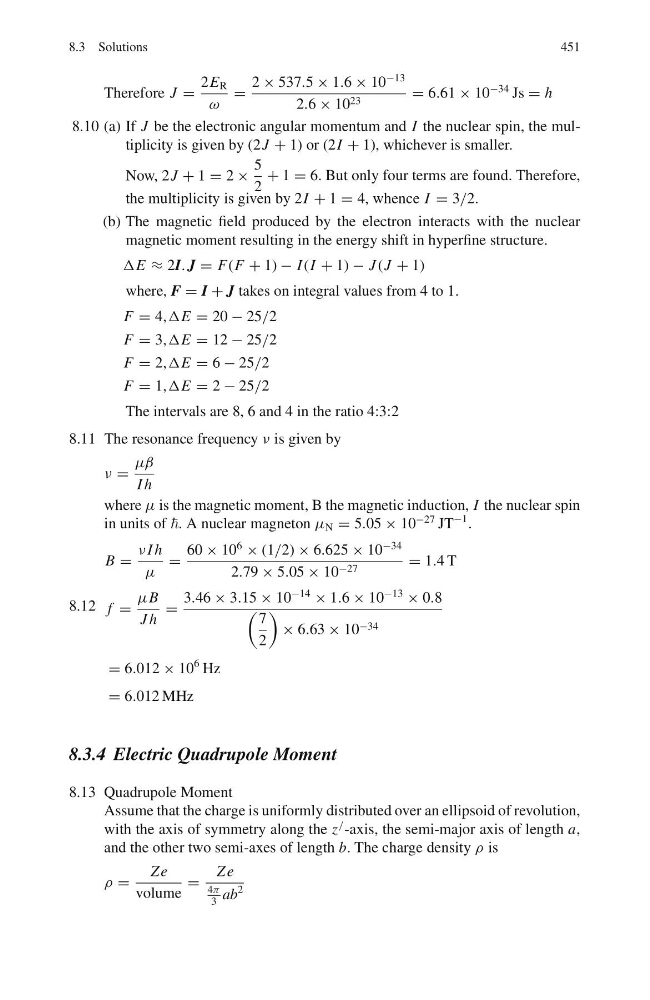
8.3 Solutions
451
Therefore J =
2E R
ω
=
2 × 537.5 × 1.6 × 10
−13
2.6 × 10 23
= 6.61 × 10
−34 Js = h
8.10 (a) If J be the electronic angular momentum and I the nuclear spin, the multiplicity is given by (2J + 1) or (2I + 1), whichever is smaller.
Now, 2J + 1 = 2 ×
5
2
+ 1 = 6. But only four terms are found. Therefore,
the multiplicity is given by 2I + 1 = 4, whence I = 3/2.
(b) The magnetic field produced by the electron interacts with the nuclear
magnetic moment resulting in the energy shift in hyperfine structure.
ΔE ≈ 2I. J = F(F + 1) − I (I + 1) − J (J + 1)
where, F = I + J takes on integral values from 4 to 1.
F = 4,ΔE = 20 − 25/2
F = 3,ΔE = 12 − 25/2
F = 2,ΔE = 6 − 25/2
F = 1,ΔE = 2 − 25/2
The intervals are 8, 6 and 4 in the ratio 4:3:2
8.11 The resonance frequency ν is given by
ν =
μβ
I h
where μ is the magnetic moment, B the magnetic induction, I the nuclear spin
in units of . A nuclear magneton μ N = 5.05 × 10
−27 JT
−1 .
B =
ν I h
μ
=
60 × 10
6
× (1/2) × 6.625 × 10
−34
2.79 × 5.05 × 10 −27
= 1.4 T
8.12 f =
μB
J h
=
3.46 × 3.15 × 10
−14
× 1.6 × 10
−13
× 0.8
7
2
× 6.63 × 10 −34
= 6.012 × 10
6 Hz
= 6.012 MHz
8.3.4 Electric Quadrupole Moment
8.13 Quadrupole Moment
Assume that the charge is uniformly distributed over an ellipsoid of revolution,
with the axis of symmetry along the z
/ -axis, the semi-major axis of length a,
and the other two semi-axes of length b. The charge density ρ is
ρ =
Ze
volume
=
Ze
4π
3
ab
2
451
Therefore J =
2E R
ω
=
2 × 537.5 × 1.6 × 10
−13
2.6 × 10 23
= 6.61 × 10
−34 Js = h
8.10 (a) If J be the electronic angular momentum and I the nuclear spin, the multiplicity is given by (2J + 1) or (2I + 1), whichever is smaller.
Now, 2J + 1 = 2 ×
5
2
+ 1 = 6. But only four terms are found. Therefore,
the multiplicity is given by 2I + 1 = 4, whence I = 3/2.
(b) The magnetic field produced by the electron interacts with the nuclear
magnetic moment resulting in the energy shift in hyperfine structure.
ΔE ≈ 2I. J = F(F + 1) − I (I + 1) − J (J + 1)
where, F = I + J takes on integral values from 4 to 1.
F = 4,ΔE = 20 − 25/2
F = 3,ΔE = 12 − 25/2
F = 2,ΔE = 6 − 25/2
F = 1,ΔE = 2 − 25/2
The intervals are 8, 6 and 4 in the ratio 4:3:2
8.11 The resonance frequency ν is given by
ν =
μβ
I h
where μ is the magnetic moment, B the magnetic induction, I the nuclear spin
in units of . A nuclear magneton μ N = 5.05 × 10
−27 JT
−1 .
B =
ν I h
μ
=
60 × 10
6
× (1/2) × 6.625 × 10
−34
2.79 × 5.05 × 10 −27
= 1.4 T
8.12 f =
μB
J h
=
3.46 × 3.15 × 10
−14
× 1.6 × 10
−13
× 0.8
7
2
× 6.63 × 10 −34
= 6.012 × 10
6 Hz
= 6.012 MHz
8.3.4 Electric Quadrupole Moment
8.13 Quadrupole Moment
Assume that the charge is uniformly distributed over an ellipsoid of revolution,
with the axis of symmetry along the z
/ -axis, the semi-major axis of length a,
and the other two semi-axes of length b. The charge density ρ is
ρ =
Ze
volume
=
Ze
4π
3
ab
2