

8.2 Problems
441
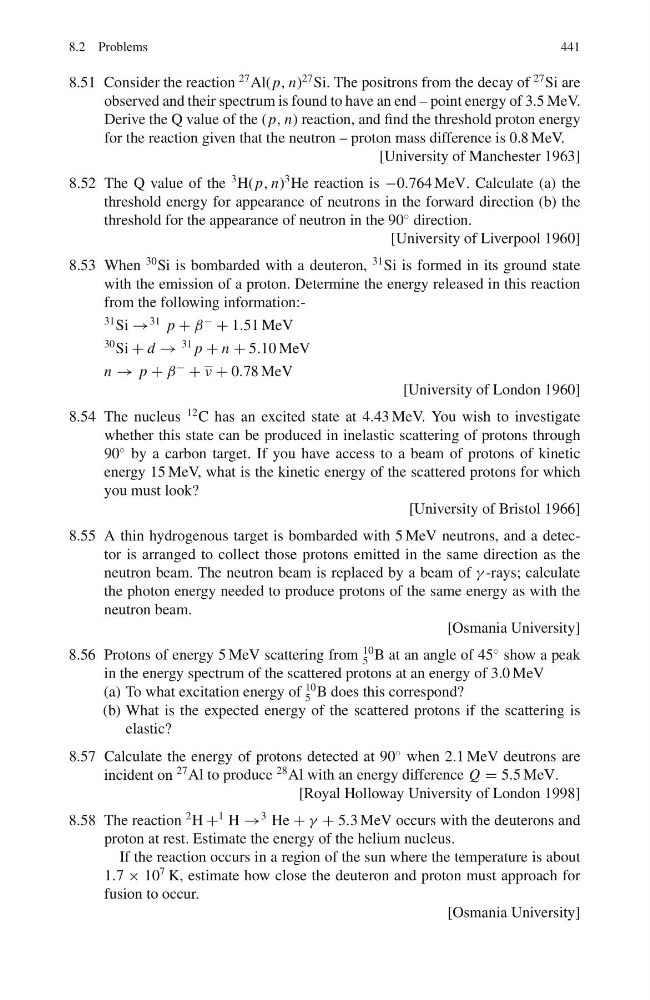
8.51 Consider the reaction
27 Al( p, n)
27 Si. The positrons from the decay of
27 Si are
observed and their spectrum is found to have an end – point energy of 3.5 MeV.
Derive the Q value of the ( p, n) reaction, and find the threshold proton energy
for the reaction given that the neutron – proton mass difference is 0.8 MeV.
[University of Manchester 1963]
8.52 The Q value of the
3 H( p, n)
3 He reaction is −0.764 MeV. Calculate (a) the
threshold energy for appearance of neutrons in the forward direction (b) the
threshold for the appearance of neutron in the 90
◦ direction.
[University of Liverpool 1960]
8.53 When
30 Si is bombarded with a deuteron,
31 Si is formed in its ground state
with the emission of a proton. Determine the energy released in this reaction
from the following information:31 Si →
31 p + β
−
+ 1.51 MeV
30 Si + d →
31 p + n + 5.10 MeV
n → p + β
−
+ ν + 0.78 MeV
[University of London 1960]
8.54 The nucleus
12 C has an excited state at 4.43 MeV. You wish to investigate
whether this state can be produced in inelastic scattering of protons through
90
◦ by a carbon target. If you have access to a beam of protons of kinetic
energy 15 MeV, what is the kinetic energy of the scattered protons for which
you must look?
[University of Bristol 1966]
8.55 A thin hydrogenous target is bombarded with 5 MeV neutrons, and a detector is arranged to collect those protons emitted in the same direction as the
neutron beam. The neutron beam is replaced by a beam of γ -rays; calculate
the photon energy needed to produce protons of the same energy as with the
neutron beam.
[Osmania University]
8.56 Protons of energy 5 MeV scattering from
10
5 B at an angle of 45
◦ show a peak
in the energy spectrum of the scattered protons at an energy of 3.0 MeV
(a) To what excitation energy of
10
5 B does this correspond?
(b) What is the expected energy of the scattered protons if the scattering is
elastic?
8.57 Calculate the energy of protons detected at 90
◦ when 2.1 MeV deutrons are
incident on
27 Al to produce
28 Al with an energy difference Q = 5.5 MeV.
[Royal Holloway University of London 1998]
8.58 The reaction
2 H +
1 H →
3 He + γ + 5.3 MeV occurs with the deuterons and
proton at rest. Estimate the energy of the helium nucleus.
If the reaction occurs in a region of the sun where the temperature is about
1.7 × 10
7 K, estimate how close the deuteron and proton must approach for
fusion to occur.
[Osmania University]
441
8.51 Consider the reaction
27 Al( p, n)
27 Si. The positrons from the decay of
27 Si are
observed and their spectrum is found to have an end – point energy of 3.5 MeV.
Derive the Q value of the ( p, n) reaction, and find the threshold proton energy
for the reaction given that the neutron – proton mass difference is 0.8 MeV.
[University of Manchester 1963]
8.52 The Q value of the
3 H( p, n)
3 He reaction is −0.764 MeV. Calculate (a) the
threshold energy for appearance of neutrons in the forward direction (b) the
threshold for the appearance of neutron in the 90
◦ direction.
[University of Liverpool 1960]
8.53 When
30 Si is bombarded with a deuteron,
31 Si is formed in its ground state
with the emission of a proton. Determine the energy released in this reaction
from the following information:31 Si →
31 p + β
−
+ 1.51 MeV
30 Si + d →
31 p + n + 5.10 MeV
n → p + β
−
+ ν + 0.78 MeV
[University of London 1960]
8.54 The nucleus
12 C has an excited state at 4.43 MeV. You wish to investigate
whether this state can be produced in inelastic scattering of protons through
90
◦ by a carbon target. If you have access to a beam of protons of kinetic
energy 15 MeV, what is the kinetic energy of the scattered protons for which
you must look?
[University of Bristol 1966]
8.55 A thin hydrogenous target is bombarded with 5 MeV neutrons, and a detector is arranged to collect those protons emitted in the same direction as the
neutron beam. The neutron beam is replaced by a beam of γ -rays; calculate
the photon energy needed to produce protons of the same energy as with the
neutron beam.
[Osmania University]
8.56 Protons of energy 5 MeV scattering from
10
5 B at an angle of 45
◦ show a peak
in the energy spectrum of the scattered protons at an energy of 3.0 MeV
(a) To what excitation energy of
10
5 B does this correspond?
(b) What is the expected energy of the scattered protons if the scattering is
elastic?
8.57 Calculate the energy of protons detected at 90
◦ when 2.1 MeV deutrons are
incident on
27 Al to produce
28 Al with an energy difference Q = 5.5 MeV.
[Royal Holloway University of London 1998]
8.58 The reaction
2 H +
1 H →
3 He + γ + 5.3 MeV occurs with the deuterons and
proton at rest. Estimate the energy of the helium nucleus.
If the reaction occurs in a region of the sun where the temperature is about
1.7 × 10
7 K, estimate how close the deuteron and proton must approach for
fusion to occur.
[Osmania University]