

430
8 Nuclear Physics – II
Electric quadrupole moment
For nuclei with J = 0 or
1
2
, electric dipole moment is zero. For spherical nuclei
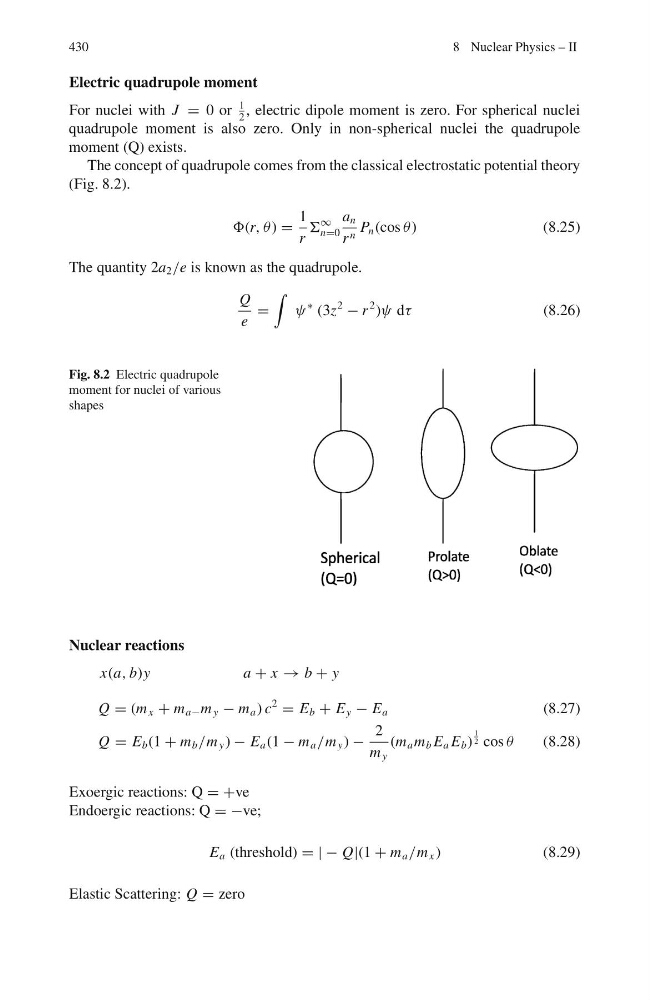
quadrupole moment is also zero. Only in non-spherical nuclei the quadrupole
moment (Q) exists.
The concept of quadrupole comes from the classical electrostatic potential theory
(Fig. 8.2).
Φ(r, θ) =
1
r
Σ
∞
n=0
a n
r n P n (cos θ )
(8.25)
The quantity 2a 2 /e is known as the quadrupole.
Q
e
=
ψ
∗ (3z
2
− r
2 )ψ dτ
(8.26)
Fig. 8.2 Electric quadrupole
moment for nuclei of various
shapes
Nuclear reactions
x(a, b)y
a + x → b + y
Q = (m x + m a− m y − m a ) c
2
= E b + E y − E a
(8.27)
Q = E b (1 + m b /m y ) − E a (1 − m a /m y ) −
2
m y
(m a m b E a E b )
1
2 cos θ
(8.28)
Exoergic reactions: Q = +ve
Endoergic reactions: Q = −ve;
E a (threshold) = | − Q|(1 + m a /m x )
(8.29)
Elastic Scattering: Q = zero
8 Nuclear Physics – II
Electric quadrupole moment
For nuclei with J = 0 or
1
2
, electric dipole moment is zero. For spherical nuclei
quadrupole moment is also zero. Only in non-spherical nuclei the quadrupole
moment (Q) exists.
The concept of quadrupole comes from the classical electrostatic potential theory
(Fig. 8.2).
Φ(r, θ) =
1
r
Σ
∞
n=0
a n
r n P n (cos θ )
(8.25)
The quantity 2a 2 /e is known as the quadrupole.
Q
e
=
ψ
∗ (3z
2
− r
2 )ψ dτ
(8.26)
Fig. 8.2 Electric quadrupole
moment for nuclei of various
shapes
Nuclear reactions
x(a, b)y
a + x → b + y
Q = (m x + m a− m y − m a ) c
2
= E b + E y − E a
(8.27)
Q = E b (1 + m b /m y ) − E a (1 − m a /m y ) −
2
m y
(m a m b E a E b )
1
2 cos θ
(8.28)
Exoergic reactions: Q = +ve
Endoergic reactions: Q = −ve;
E a (threshold) = | − Q|(1 + m a /m x )
(8.29)
Elastic Scattering: Q = zero