

428
8 Nuclear Physics – II
The shell model energy levels are:
1s 1
2
1 p 3
2
, 1 p 1
2
1d 5
2
, 2s 1
2
, 1d 3
2
1 f 7
2
2 p 3
2
, 1 f 5
2
, 2 p 1
2
, 1g 9
2
1g 7
2
, 2d 5
2
, 2d 3
2
, 3s 1
2
, 1h 11
2
. . .
(8.4)
Liquid drop model
(8.5)
M(atom) = Z M H + ( A − Z )M n − Δ
(8.6)
Δ = mass defect
P =
M − A
A
= packing fraction.
(8.7)
1 amu =
1
12
of atomic mass of
12 C atom
(8.8)
f =
B.E
A
(8.9)
1 amu = 931.5 Mev
(8.10)
1 amu = 1.66 × 10
−27 kg
(8.11)
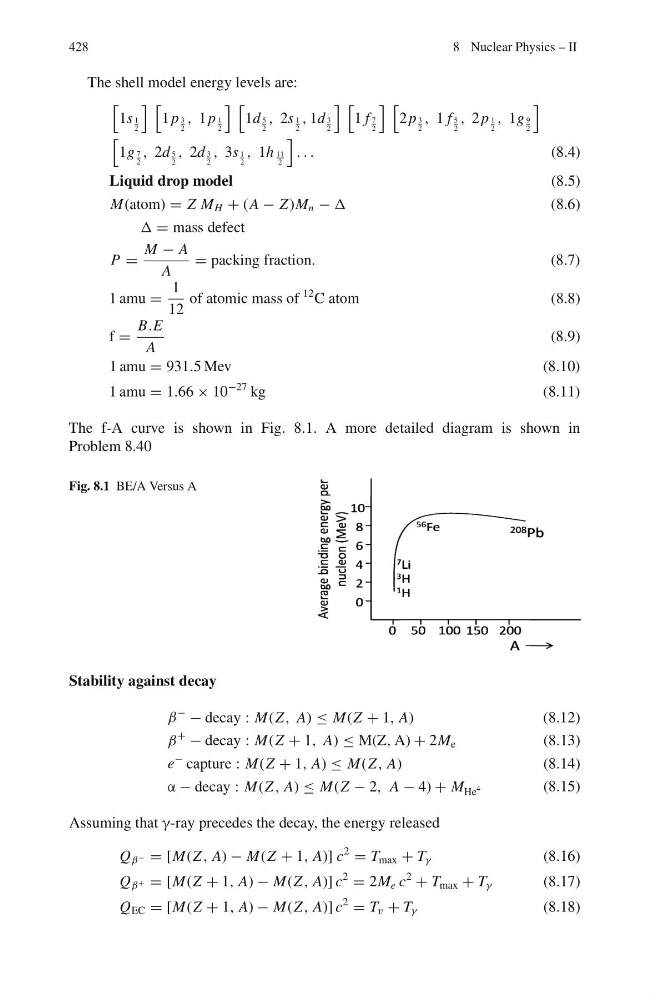
The f-A curve is shown in Fig. 8.1. A more detailed diagram is shown in
Problem 8.40
Fig. 8.1 BE/A Versus A
Stability against decay
β
−
− decay : M(Z , A) ≤ M(Z + 1, A)
(8.12)
β
+
− decay : M(Z + 1, A) ≤ M(Z, A) + 2M e
(8.13)
e
− capture : M(Z + 1, A) ≤ M(Z , A)
(8.14)
α − decay : M(Z , A) ≤ M(Z − 2, A − 4) + M He
4
(8.15)
Assuming that γ-ray precedes the decay, the energy released
Q β − = [M(Z , A) − M(Z + 1, A)] c
2
= T max + T γ
(8.16)
Q β + = [M(Z + 1, A) − M(Z , A)] c
2
= 2M e c
2
+ T max + T γ
(8.17)
Q EC = [M(Z + 1, A) − M(Z , A)] c
2
= T v + T γ
(8.18)
8 Nuclear Physics – II
The shell model energy levels are:
1s 1
2
1 p 3
2
, 1 p 1
2
1d 5
2
, 2s 1
2
, 1d 3
2
1 f 7
2
2 p 3
2
, 1 f 5
2
, 2 p 1
2
, 1g 9
2
1g 7
2
, 2d 5
2
, 2d 3
2
, 3s 1
2
, 1h 11
2
. . .
(8.4)
Liquid drop model
(8.5)
M(atom) = Z M H + ( A − Z )M n − Δ
(8.6)
Δ = mass defect
P =
M − A
A
= packing fraction.
(8.7)
1 amu =
1
12
of atomic mass of
12 C atom
(8.8)
f =
B.E
A
(8.9)
1 amu = 931.5 Mev
(8.10)
1 amu = 1.66 × 10
−27 kg
(8.11)
The f-A curve is shown in Fig. 8.1. A more detailed diagram is shown in
Problem 8.40
Fig. 8.1 BE/A Versus A
Stability against decay
β
−
− decay : M(Z , A) ≤ M(Z + 1, A)
(8.12)
β
+
− decay : M(Z + 1, A) ≤ M(Z, A) + 2M e
(8.13)
e
− capture : M(Z + 1, A) ≤ M(Z , A)
(8.14)
α − decay : M(Z , A) ≤ M(Z − 2, A − 4) + M He
4
(8.15)
Assuming that γ-ray precedes the decay, the energy released
Q β − = [M(Z , A) − M(Z + 1, A)] c
2
= T max + T γ
(8.16)
Q β + = [M(Z + 1, A) − M(Z , A)] c
2
= 2M e c
2
+ T max + T γ
(8.17)
Q EC = [M(Z + 1, A) − M(Z , A)] c
2
= T v + T γ
(8.18)