

420
7 Nuclear Physics – I
Now at time t
N E = N E
0 exp(−λ E t)
(3)
Solution of (2) is
N F = A exp(−λ E t) + B exp(−λ F t)
( 4 )
where A and B are constants which can be determined by the use of the
initial conditions. At t = 0, the initial number of F is zero, that is N F
0
= 0.
Using this condition in (4) gives B = −A and (4) becomes
N F = A[exp(−λ E t) − exp(−λ F t)]
(5)
Further, dN F /dt = −λ E A exp(−λ E t) + λ F A exp(−λ F t)
At t = 0
dN F
0
/dt = λ E N E
0
= −λ E A + λ F A
or A = λ E N A
0
/(λ B − λ A )
( 6 )
Using (6) in (5)
N F =
λ E N
0
E
λ F − λ E
[exp(−λ E t) − exp(−λ F t)]
(7)
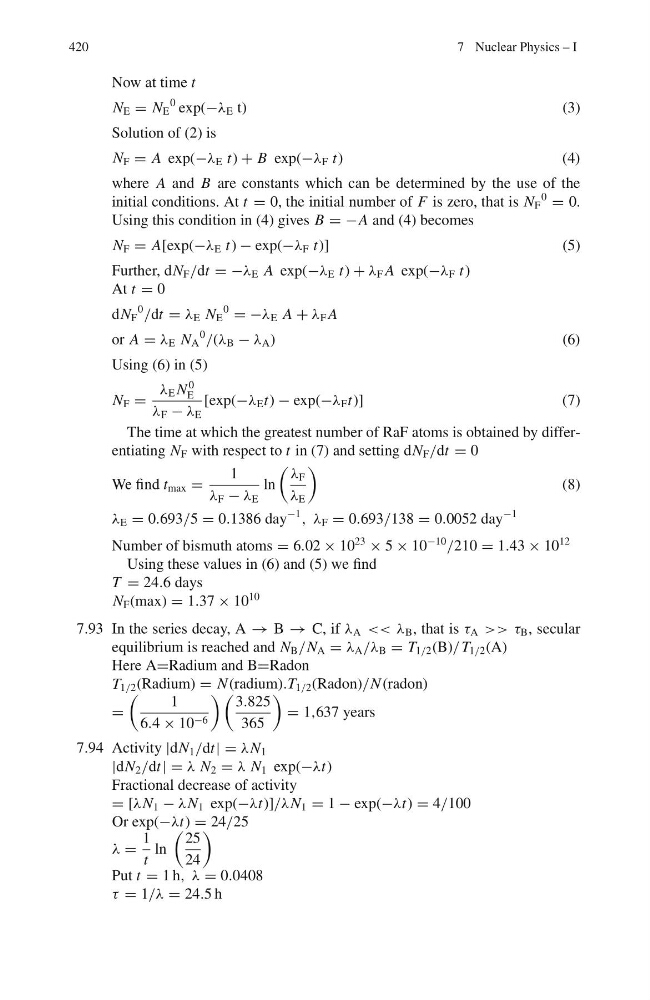
The time at which the greatest number of RaF atoms is obtained by differentiating N F with respect to t in (7) and setting dN F /dt = 0
We find t max =
1
λ F − λ E
ln
λ F
λ E
(8)
λ E = 0.693/5 = 0.1386 day
−1
, λ F = 0.693/138 = 0.0052 day
−1
Number of bismuth atoms = 6.02 × 10
23
× 5 × 10
−10
/210 = 1.43 × 10
12
Using these values in (6) and (5) we find
T = 24.6 days
N F (max) = 1.37 × 10
10
7.93 In the series decay, A → B → C, if λ A << λ B , that is τ A >> τ B , secular
equilibrium is reached and N B /N A = λ A /λ B = T 1/2 (B)/T 1/2 (A)
Here A=Radium and B=Radon
T 1/2 (Radium) = N (radium).T 1/2 (Radon)/N (radon)
=
1
6.4 × 10 −6
3.825
365
= 1,637 years
7.94 Activity |dN 1 /dt| = λN 1
|dN 2 /dt| = λ N 2 = λ N 1 exp(−λt)
Fractional decrease of activity
= [λN 1 − λN 1 exp(−λt)]/λN 1 = 1 − exp(−λt) = 4/100
Or exp(−λt) = 24/25
λ =
1
t
ln
25
24
Put t = 1 h, λ = 0.0408
τ = 1/λ = 24.5 h
7 Nuclear Physics – I
Now at time t
N E = N E
0 exp(−λ E t)
(3)
Solution of (2) is
N F = A exp(−λ E t) + B exp(−λ F t)
( 4 )
where A and B are constants which can be determined by the use of the
initial conditions. At t = 0, the initial number of F is zero, that is N F
0
= 0.
Using this condition in (4) gives B = −A and (4) becomes
N F = A[exp(−λ E t) − exp(−λ F t)]
(5)
Further, dN F /dt = −λ E A exp(−λ E t) + λ F A exp(−λ F t)
At t = 0
dN F
0
/dt = λ E N E
0
= −λ E A + λ F A
or A = λ E N A
0
/(λ B − λ A )
( 6 )
Using (6) in (5)
N F =
λ E N
0
E
λ F − λ E
[exp(−λ E t) − exp(−λ F t)]
(7)
The time at which the greatest number of RaF atoms is obtained by differentiating N F with respect to t in (7) and setting dN F /dt = 0
We find t max =
1
λ F − λ E
ln
λ F
λ E
(8)
λ E = 0.693/5 = 0.1386 day
−1
, λ F = 0.693/138 = 0.0052 day
−1
Number of bismuth atoms = 6.02 × 10
23
× 5 × 10
−10
/210 = 1.43 × 10
12
Using these values in (6) and (5) we find
T = 24.6 days
N F (max) = 1.37 × 10
10
7.93 In the series decay, A → B → C, if λ A << λ B , that is τ A >> τ B , secular
equilibrium is reached and N B /N A = λ A /λ B = T 1/2 (B)/T 1/2 (A)
Here A=Radium and B=Radon
T 1/2 (Radium) = N (radium).T 1/2 (Radon)/N (radon)
=
1
6.4 × 10 −6
3.825
365
= 1,637 years
7.94 Activity |dN 1 /dt| = λN 1
|dN 2 /dt| = λ N 2 = λ N 1 exp(−λt)
Fractional decrease of activity
= [λN 1 − λN 1 exp(−λt)]/λN 1 = 1 − exp(−λt) = 4/100
Or exp(−λt) = 24/25
λ =
1
t
ln
25
24
Put t = 1 h, λ = 0.0408
τ = 1/λ = 24.5 h