

7.3 Solutions
417
Optical Doppler effect is given by
h ν = h ν 0 (1 + β cos θ
∗ )
The maximum and minimum energy of photons will be h ν 0 (1 + β) and
h ν 0 (1 − β) or 661 keV ± 0.5 eV
7.84 The gravitational red shift is due to the change in the energy of a photon as
it moves from one region of space to another differing gravitational potential. The photon carries an inertial as well as the gravitational mass given by
h ν/c
2 . In its passage from a point where the gravitational potential is ϕ 1
to another point where the potential is ϕ 2 there will be expenditure of work
given by h ν/c
2 times the potential difference (ϕ 2 − ϕ 1 ). This would result
in an equivalent decrease in the energy content of the photon and hence its
frequency.
ΔE = E(ϕ 2 − ϕ 1 )/c
2
A level difference of H near the earth’s surface would result in the fractional
shift of frequency
Δν/ν = gH /c
Now, Δ ν/ν = v/c = gH /c
2
or v = gH /c = 9.8 × 22.6/3 × 10
8
= 7.38 × 10
−7 m/s = 7.38 × 10
−4 mm/s
Thus resonance fluorescence would occur for downward velocity of the
absorber of magnitude 7.38 mm/s.
7.3.9 Radioactivity (General)
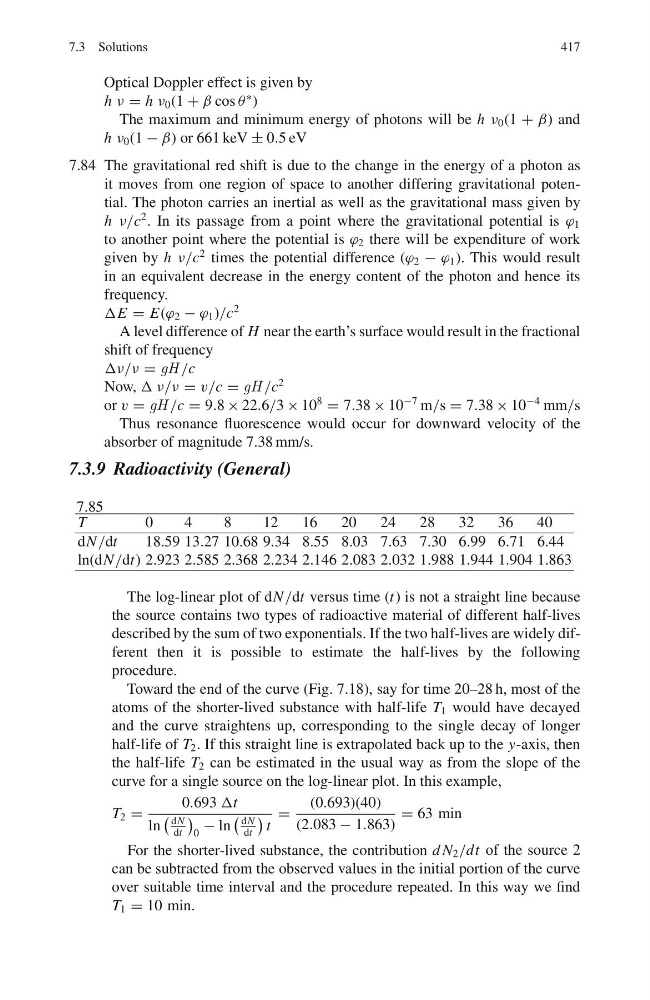
7.85
T
0
4
8
12
16
20
24
28
32
36
40
dN /dt
18.59 13.27 10.68 9.34 8.55 8.03 7.63 7.30 6.99 6.71 6.44
ln(dN /dt) 2.923 2.585 2.368 2.234 2.146 2.083 2.032 1.988 1.944 1.904 1.863
The log-linear plot of dN /dt versus time (t) is not a straight line because
the source contains two types of radioactive material of different half-lives
described by the sum of two exponentials. If the two half-lives are widely different then it is possible to estimate the half-lives by the following
procedure.
Toward the end of the curve (Fig. 7.18), say for time 20–28 h, most of the
atoms of the shorter-lived substance with half-life T 1 would have decayed
and the curve straightens up, corresponding to the single decay of longer
half-life of T 2 . If this straight line is extrapolated back up to the y-axis, then
the half-life T 2 can be estimated in the usual way as from the slope of the
curve for a single source on the log-linear plot. In this example,
T 2 =
0.693 Δt
ln
dN
dt
0
− ln
dN
dt
t
=
(0.693)(40)
(2.083 − 1.863)
= 63 min
For the shorter-lived substance, the contribution d N 2 /dt of the source 2
can be subtracted from the observed values in the initial portion of the curve
over suitable time interval and the procedure repeated. In this way we find
T 1 = 10 min.
417
Optical Doppler effect is given by
h ν = h ν 0 (1 + β cos θ
∗ )
The maximum and minimum energy of photons will be h ν 0 (1 + β) and
h ν 0 (1 − β) or 661 keV ± 0.5 eV
7.84 The gravitational red shift is due to the change in the energy of a photon as
it moves from one region of space to another differing gravitational potential. The photon carries an inertial as well as the gravitational mass given by
h ν/c
2 . In its passage from a point where the gravitational potential is ϕ 1
to another point where the potential is ϕ 2 there will be expenditure of work
given by h ν/c
2 times the potential difference (ϕ 2 − ϕ 1 ). This would result
in an equivalent decrease in the energy content of the photon and hence its
frequency.
ΔE = E(ϕ 2 − ϕ 1 )/c
2
A level difference of H near the earth’s surface would result in the fractional
shift of frequency
Δν/ν = gH /c
Now, Δ ν/ν = v/c = gH /c
2
or v = gH /c = 9.8 × 22.6/3 × 10
8
= 7.38 × 10
−7 m/s = 7.38 × 10
−4 mm/s
Thus resonance fluorescence would occur for downward velocity of the
absorber of magnitude 7.38 mm/s.
7.3.9 Radioactivity (General)
7.85
T
0
4
8
12
16
20
24
28
32
36
40
dN /dt
18.59 13.27 10.68 9.34 8.55 8.03 7.63 7.30 6.99 6.71 6.44
ln(dN /dt) 2.923 2.585 2.368 2.234 2.146 2.083 2.032 1.988 1.944 1.904 1.863
The log-linear plot of dN /dt versus time (t) is not a straight line because
the source contains two types of radioactive material of different half-lives
described by the sum of two exponentials. If the two half-lives are widely different then it is possible to estimate the half-lives by the following
procedure.
Toward the end of the curve (Fig. 7.18), say for time 20–28 h, most of the
atoms of the shorter-lived substance with half-life T 1 would have decayed
and the curve straightens up, corresponding to the single decay of longer
half-life of T 2 . If this straight line is extrapolated back up to the y-axis, then
the half-life T 2 can be estimated in the usual way as from the slope of the
curve for a single source on the log-linear plot. In this example,
T 2 =
0.693 Δt
ln
dN
dt
0
− ln
dN
dt
t
=
(0.693)(40)
(2.083 − 1.863)
= 63 min
For the shorter-lived substance, the contribution d N 2 /dt of the source 2
can be subtracted from the observed values in the initial portion of the curve
over suitable time interval and the procedure repeated. In this way we find
T 1 = 10 min.