

7.3 Solutions
415
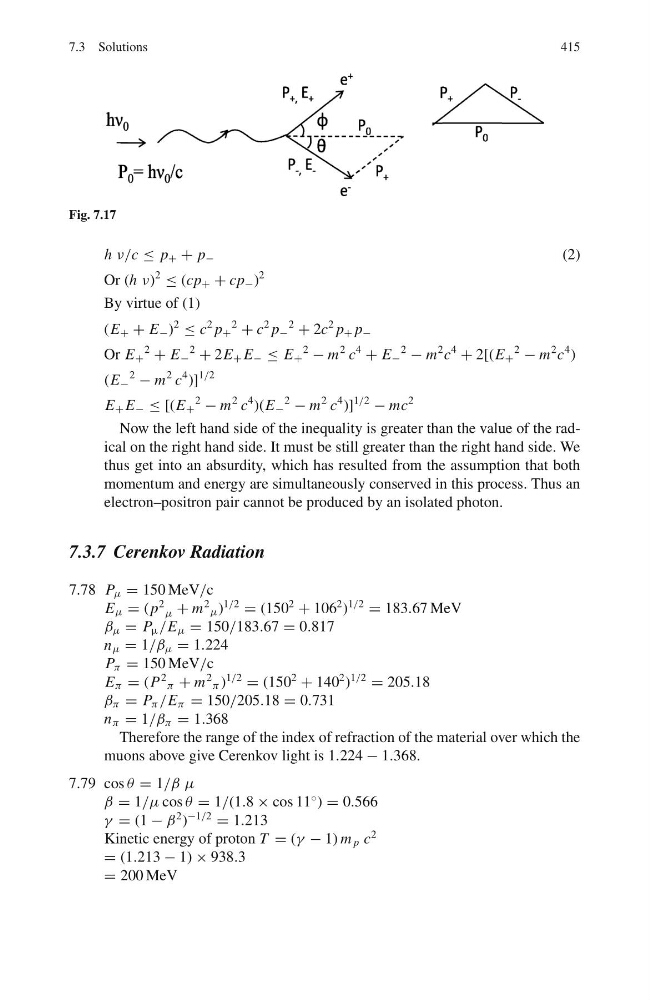
Fig. 7.17
h ν/c ≤ p + + p −
(2)
Or (h ν)
2
≤ (cp + + cp − )
2
By virtue of (1)
(E + + E − )
2
≤ c
2 p +
2
+ c
2 p −
2
+ 2c
2 p + p −
Or E +
2
+ E −
2
+ 2E + E − ≤ E +
2
− m
2 c
4
+ E −
2
− m
2 c
4
+ 2[(E +
2
− m
2 c
4 )
(E −
2
− m
2 c
4 )]
1/2
E + E − ≤ [(E +
2
− m
2 c
4 )(E −
2
− m
2 c
4 )]
1/2
− mc
2
Now the left hand side of the inequality is greater than the value of the radical on the right hand side. It must be still greater than the right hand side. We
thus get into an absurdity, which has resulted from the assumption that both
momentum and energy are simultaneously conserved in this process. Thus an
electron–positron pair cannot be produced by an isolated photon.
7.3.7 Cerenkov Radiation
7.78 P μ = 150 MeV/c
E μ = ( p
2 μ + m
2 μ )
1/2
= (150
2
+ 106
2 )
1/2
= 183.67 MeV
β μ = P μ /E μ = 150/183.67 = 0.817
n μ = 1/β μ = 1.224
P π = 150 MeV/c
E π = (P
2 π + m
2 π )
1/2
= (150
2
+ 140
2 )
1/2
= 205.18
β π = P π /E π = 150/205.18 = 0.731
n π = 1/β π = 1.368
Therefore the range of the index of refraction of the material over which the
muons above give Cerenkov light is 1.224 − 1.368.
7.79 cos θ = 1/β μ
β = 1/μ cos θ = 1/(1.8 × cos 11
◦ ) = 0.566
γ = (1 − β
2 )
−1/2
= 1.213
Kinetic energy of proton T = (γ − 1) m p c
2
= (1.213 − 1) × 938.3
= 200 MeV
415
Fig. 7.17
h ν/c ≤ p + + p −
(2)
Or (h ν)
2
≤ (cp + + cp − )
2
By virtue of (1)
(E + + E − )
2
≤ c
2 p +
2
+ c
2 p −
2
+ 2c
2 p + p −
Or E +
2
+ E −
2
+ 2E + E − ≤ E +
2
− m
2 c
4
+ E −
2
− m
2 c
4
+ 2[(E +
2
− m
2 c
4 )
(E −
2
− m
2 c
4 )]
1/2
E + E − ≤ [(E +
2
− m
2 c
4 )(E −
2
− m
2 c
4 )]
1/2
− mc
2
Now the left hand side of the inequality is greater than the value of the radical on the right hand side. It must be still greater than the right hand side. We
thus get into an absurdity, which has resulted from the assumption that both
momentum and energy are simultaneously conserved in this process. Thus an
electron–positron pair cannot be produced by an isolated photon.
7.3.7 Cerenkov Radiation
7.78 P μ = 150 MeV/c
E μ = ( p
2 μ + m
2 μ )
1/2
= (150
2
+ 106
2 )
1/2
= 183.67 MeV
β μ = P μ /E μ = 150/183.67 = 0.817
n μ = 1/β μ = 1.224
P π = 150 MeV/c
E π = (P
2 π + m
2 π )
1/2
= (150
2
+ 140
2 )
1/2
= 205.18
β π = P π /E π = 150/205.18 = 0.731
n π = 1/β π = 1.368
Therefore the range of the index of refraction of the material over which the
muons above give Cerenkov light is 1.224 − 1.368.
7.79 cos θ = 1/β μ
β = 1/μ cos θ = 1/(1.8 × cos 11
◦ ) = 0.566
γ = (1 − β
2 )
−1/2
= 1.213
Kinetic energy of proton T = (γ − 1) m p c
2
= (1.213 − 1) × 938.3
= 200 MeV