

7.3 Solutions
413
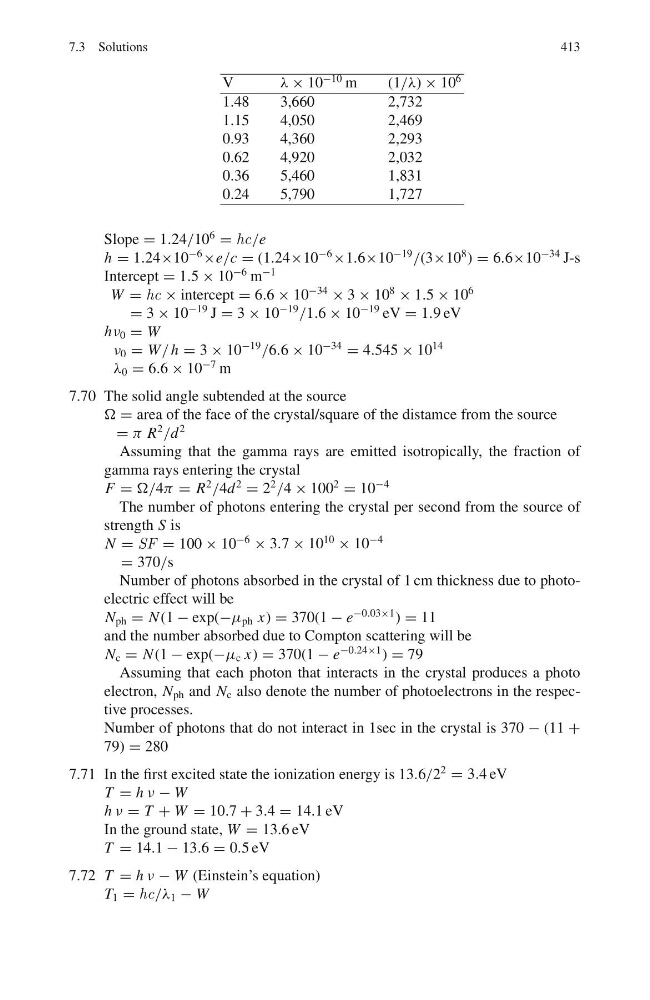
V
λ × 10
−10 m
(1/λ) × 10
6
1.48
3,660
2,732
1.15
4,050
2,469
0.93
4,360
2,293
0.62
4,920
2,032
0.36
5,460
1,831
0.24
5,790
1,727
Slope = 1.24/10
6
= hc/e
h = 1.24×10
−6
×e/c = (1.24×10
−6
×1.6×10
−19
/(3×10
8 ) = 6.6×10
−34 J-s
Intercept = 1.5 × 10
−6 m
−1
W = hc × intercept = 6.6 × 10
−34
× 3 × 10
8
× 1.5 × 10
6
= 3 × 10
−19 J = 3 × 10
−19
/1.6 × 10
−19 eV = 1.9 eV
hν 0 = W
ν 0 = W/ h = 3 × 10
−19
/6.6 × 10
−34
= 4.545 × 10
14
λ 0 = 6.6 × 10
−7 m
7.70 The solid angle subtended at the source
Ω = area of the face of the crystal/square of the distamce from the source
= π R
2
/d
2
Assuming that the gamma rays are emitted isotropically, the fraction of
gamma rays entering the crystal
F = Ω/4π = R
2
/4d
2
= 2
2
/4 × 100
2
= 10
−4
The number of photons entering the crystal per second from the source of
strength S is
N = SF = 100 × 10
−6
× 3.7 × 10
10
× 10
−4
= 370/s
Number of photons absorbed in the crystal of 1 cm thickness due to photoelectric effect will be
N ph = N (1 − exp(−μ ph x) = 370(1 − e
−0.03×1 ) = 11
and the number absorbed due to Compton scattering will be
N c = N (1 − exp(−μ c x) = 370(1 − e
−0.24×1 ) = 79
Assuming that each photon that interacts in the crystal produces a photo
electron, N ph and N c also denote the number of photoelectrons in the respective processes.
Number of photons that do not interact in 1sec in the crystal is 370 − (11 +
79) = 280
7.71 In the first excited state the ionization energy is 13.6/2
2
= 3.4 eV
T = h ν − W
h ν = T + W = 10.7 + 3.4 = 14.1 eV
In the ground state, W = 13.6 eV
T = 14.1 − 13.6 = 0.5 eV
7.72 T = h ν − W (Einstein’s equation)
T 1 = hc/λ 1 − W
413
V
λ × 10
−10 m
(1/λ) × 10
6
1.48
3,660
2,732
1.15
4,050
2,469
0.93
4,360
2,293
0.62
4,920
2,032
0.36
5,460
1,831
0.24
5,790
1,727
Slope = 1.24/10
6
= hc/e
h = 1.24×10
−6
×e/c = (1.24×10
−6
×1.6×10
−19
/(3×10
8 ) = 6.6×10
−34 J-s
Intercept = 1.5 × 10
−6 m
−1
W = hc × intercept = 6.6 × 10
−34
× 3 × 10
8
× 1.5 × 10
6
= 3 × 10
−19 J = 3 × 10
−19
/1.6 × 10
−19 eV = 1.9 eV
hν 0 = W
ν 0 = W/ h = 3 × 10
−19
/6.6 × 10
−34
= 4.545 × 10
14
λ 0 = 6.6 × 10
−7 m
7.70 The solid angle subtended at the source
Ω = area of the face of the crystal/square of the distamce from the source
= π R
2
/d
2
Assuming that the gamma rays are emitted isotropically, the fraction of
gamma rays entering the crystal
F = Ω/4π = R
2
/4d
2
= 2
2
/4 × 100
2
= 10
−4
The number of photons entering the crystal per second from the source of
strength S is
N = SF = 100 × 10
−6
× 3.7 × 10
10
× 10
−4
= 370/s
Number of photons absorbed in the crystal of 1 cm thickness due to photoelectric effect will be
N ph = N (1 − exp(−μ ph x) = 370(1 − e
−0.03×1 ) = 11
and the number absorbed due to Compton scattering will be
N c = N (1 − exp(−μ c x) = 370(1 − e
−0.24×1 ) = 79
Assuming that each photon that interacts in the crystal produces a photo
electron, N ph and N c also denote the number of photoelectrons in the respective processes.
Number of photons that do not interact in 1sec in the crystal is 370 − (11 +
79) = 280
7.71 In the first excited state the ionization energy is 13.6/2
2
= 3.4 eV
T = h ν − W
h ν = T + W = 10.7 + 3.4 = 14.1 eV
In the ground state, W = 13.6 eV
T = 14.1 − 13.6 = 0.5 eV
7.72 T = h ν − W (Einstein’s equation)
T 1 = hc/λ 1 − W