

7.3 Solutions
403
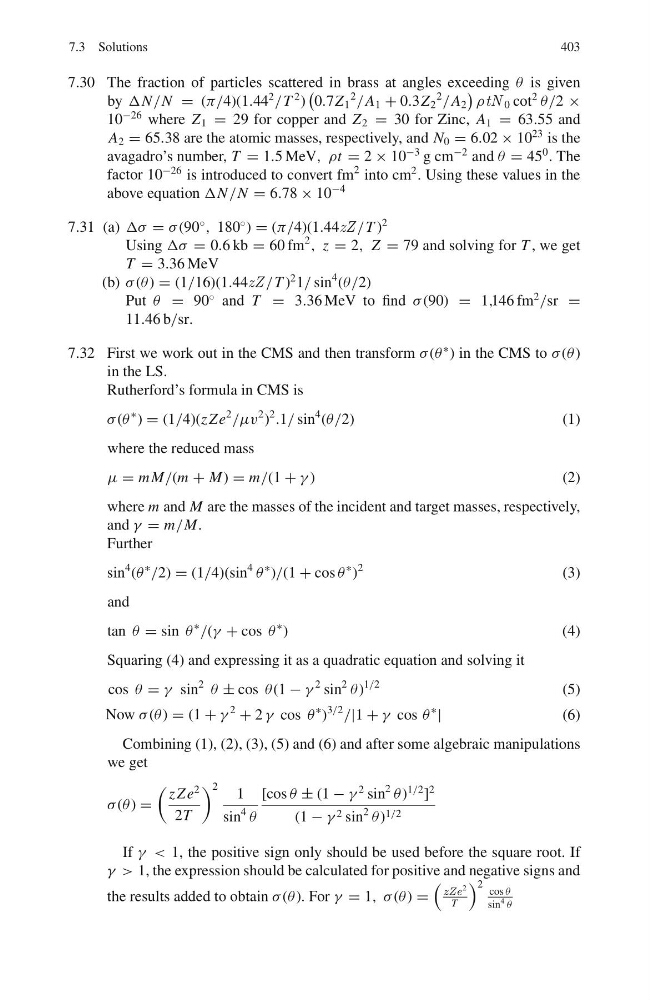
7.30 The fraction of particles scattered in brass at angles exceeding θ is given
by ΔN /N = (π/4)(1.44
2
/T
2 )
0.7Z 1
2
/A 1 + 0.3Z 2
2
/A 2
ρtN 0 cot
2
θ/2 ×
10
−26 where Z 1 = 29 for copper and Z 2 = 30 for Zinc, A 1 = 63.55 and
A 2 = 65.38 are the atomic masses, respectively, and N 0 = 6.02 × 10
23 is the
avagadro’s number, T = 1.5 MeV, ρt = 2 × 10
−3 g cm
−2 and θ = 45
0 . The
factor 10
−26 is introduced to convert fm
2 into cm
2 . Using these values in the
above equation ΔN /N = 6.78 × 10
−4
7.31 (a) Δσ = σ (90
◦
, 180
◦ ) = (π/4)(1.44zZ /T )
2
Using Δσ = 0.6 kb = 60 fm
2
, z = 2, Z = 79 and solving for T , we get
T = 3.36 MeV
(b) σ (θ ) = (1/16)(1.44zZ /T )
2 1/ sin
4 (θ/2)
Put θ = 90
◦ and T = 3.36 MeV to find σ (90) = 1,146 fm
2
/sr =
11.46 b/sr.
7.32 First we work out in the CMS and then transform σ (θ
∗ ) in the CMS to σ (θ )
in the LS.
Rutherford’s formula in CMS is
σ (θ
∗ ) = (1/4)(z Ze
2
/μv
2 )
2
.1/ sin
4 (θ/2)
(1)
where the reduced mass
μ = m M/(m + M) = m/(1 + γ )
( 2 )
where m and M are the masses of the incident and target masses, respectively,
and γ = m/M.
Further
sin
4 (θ
∗
/2) = (1/4)(sin
4
θ
∗ )/(1 + cos θ
∗ )
2
(3)
and
tan θ = sin θ
∗
/(γ + cos θ
∗ )
( 4 )
Squaring (4) and expressing it as a quadratic equation and solving it
cos θ = γ sin
2
θ ± cos θ(1 − γ
2 sin
2
θ)
1/2
(5)
Now σ (θ ) = (1 + γ
2
+ 2 γ cos θ
∗ )
3/2
/|1 + γ cos θ
∗
|
(6)
Combining (1), (2), (3), (5) and (6) and after some algebraic manipulations
we get
σ (θ ) =
z Ze
2
2T
2 1
sin
4
θ
[cos θ ± (1 − γ
2 sin
2
θ )
1/2 ]
2
(1 − γ 2 sin
2
θ) 1/2
If γ < 1, the positive sign only should be used before the square root. If
γ > 1, the expression should be calculated for positive and negative signs and
the results added to obtain σ (θ ). For γ = 1, σ(θ ) =
zZe
2
T
2 cos θ
sin
4 θ
403
7.30 The fraction of particles scattered in brass at angles exceeding θ is given
by ΔN /N = (π/4)(1.44
2
/T
2 )
0.7Z 1
2
/A 1 + 0.3Z 2
2
/A 2
ρtN 0 cot
2
θ/2 ×
10
−26 where Z 1 = 29 for copper and Z 2 = 30 for Zinc, A 1 = 63.55 and
A 2 = 65.38 are the atomic masses, respectively, and N 0 = 6.02 × 10
23 is the
avagadro’s number, T = 1.5 MeV, ρt = 2 × 10
−3 g cm
−2 and θ = 45
0 . The
factor 10
−26 is introduced to convert fm
2 into cm
2 . Using these values in the
above equation ΔN /N = 6.78 × 10
−4
7.31 (a) Δσ = σ (90
◦
, 180
◦ ) = (π/4)(1.44zZ /T )
2
Using Δσ = 0.6 kb = 60 fm
2
, z = 2, Z = 79 and solving for T , we get
T = 3.36 MeV
(b) σ (θ ) = (1/16)(1.44zZ /T )
2 1/ sin
4 (θ/2)
Put θ = 90
◦ and T = 3.36 MeV to find σ (90) = 1,146 fm
2
/sr =
11.46 b/sr.
7.32 First we work out in the CMS and then transform σ (θ
∗ ) in the CMS to σ (θ )
in the LS.
Rutherford’s formula in CMS is
σ (θ
∗ ) = (1/4)(z Ze
2
/μv
2 )
2
.1/ sin
4 (θ/2)
(1)
where the reduced mass
μ = m M/(m + M) = m/(1 + γ )
( 2 )
where m and M are the masses of the incident and target masses, respectively,
and γ = m/M.
Further
sin
4 (θ
∗
/2) = (1/4)(sin
4
θ
∗ )/(1 + cos θ
∗ )
2
(3)
and
tan θ = sin θ
∗
/(γ + cos θ
∗ )
( 4 )
Squaring (4) and expressing it as a quadratic equation and solving it
cos θ = γ sin
2
θ ± cos θ(1 − γ
2 sin
2
θ)
1/2
(5)
Now σ (θ ) = (1 + γ
2
+ 2 γ cos θ
∗ )
3/2
/|1 + γ cos θ
∗
|
(6)
Combining (1), (2), (3), (5) and (6) and after some algebraic manipulations
we get
σ (θ ) =
z Ze
2
2T
2 1
sin
4
θ
[cos θ ± (1 − γ
2 sin
2
θ )
1/2 ]
2
(1 − γ 2 sin
2
θ) 1/2
If γ < 1, the positive sign only should be used before the square root. If
γ > 1, the expression should be calculated for positive and negative signs and
the results added to obtain σ (θ ). For γ = 1, σ(θ ) =
zZe
2
T
2 cos θ
sin
4 θ