

7.2 Problems
389
7.67 Estimate the thickness of lead (density 11.3 g cm
−3 ) required to absorb 90%
of gamma rays of energy 1 MeV. The absorption cross-section or gammas of
1 MeV in lead ( A = 207) is 20 barns/atom.
7.68 An X-ray absorption survey of a specimen of silver shows a sharp absorption
edge at the expected λ kα value for silver of 0.0485 nm and a smaller edge at
0.0424 nm due to an impurity. If the atomic number of silver is 47, identify
the impurity as being 44 Ru, 45 Rh, 46 Pd, v 48 Cd, V 49 In or 50 Sn.
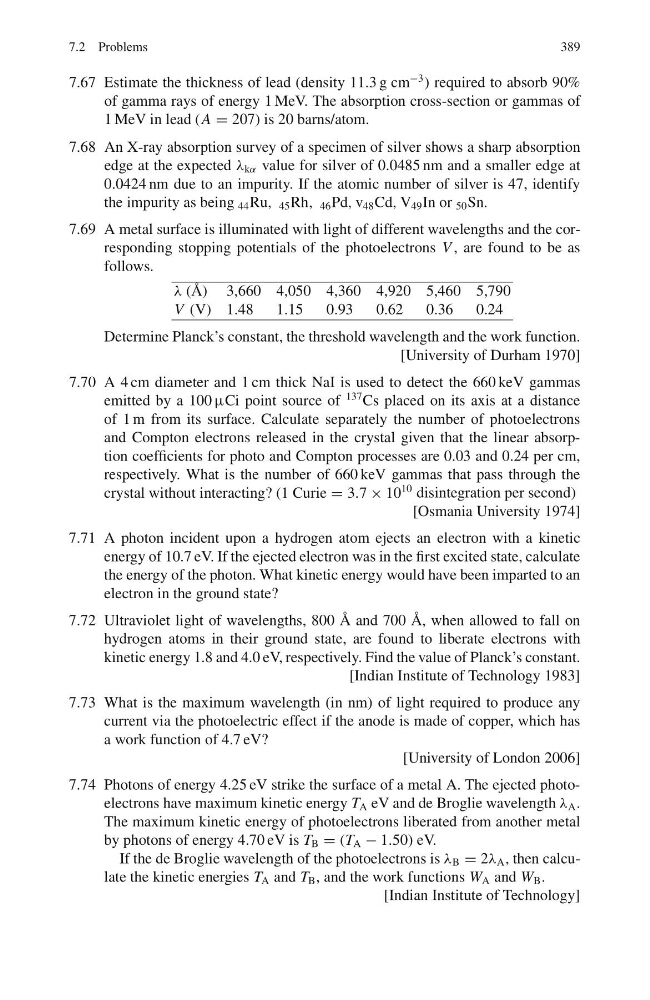
7.69 A metal surface is illuminated with light of different wavelengths and the corresponding stopping potentials of the photoelectrons V , are found to be as
follows.
λ ( ˚
A) 3,660 4,050 4,360 4,920 5,460 5,790
V (V) 1.48
1.15
0.93 0.62
0.36
0.24
Determine Planck’s constant, the threshold wavelength and the work function.
[University of Durham 1970]
7.70 A 4 cm diameter and 1 cm thick NaI is used to detect the 660 keV gammas
emitted by a 100 μCi point source of
137 Cs placed on its axis at a distance
of 1 m from its surface. Calculate separately the number of photoelectrons
and Compton electrons released in the crystal given that the linear absorption coefficients for photo and Compton processes are 0.03 and 0.24 per cm,
respectively. What is the number of 660 keV gammas that pass through the
crystal without interacting? (1 Curie = 3.7 × 10
10 disintegration per second)
[Osmania University 1974]
7.71 A photon incident upon a hydrogen atom ejects an electron with a kinetic
energy of 10.7 eV. If the ejected electron was in the first excited state, calculate
the energy of the photon. What kinetic energy would have been imparted to an
electron in the ground state?
7.72 Ultraviolet light of wavelengths, 800 ˚
A and 700 ˚
A, when allowed to fall on
hydrogen atoms in their ground state, are found to liberate electrons with
kinetic energy 1.8 and 4.0 eV, respectively. Find the value of Planck’s constant.
[Indian Institute of Technology 1983]
7.73 What is the maximum wavelength (in nm) of light required to produce any
current via the photoelectric effect if the anode is made of copper, which has
a work function of 4.7 eV?
[University of London 2006]
7.74 Photons of energy 4.25 eV strike the surface of a metal A. The ejected photoelectrons have maximum kinetic energy T A eV and de Broglie wavelength λ A .
The maximum kinetic energy of photoelectrons liberated from another metal
by photons of energy 4.70 eV is T B = (T A − 1.50) eV.
If the de Broglie wavelength of the photoelectrons is λ B = 2λ A , then calculate the kinetic energies T A and T B , and the work functions W A and W B .
[Indian Institute of Technology]
389
7.67 Estimate the thickness of lead (density 11.3 g cm
−3 ) required to absorb 90%
of gamma rays of energy 1 MeV. The absorption cross-section or gammas of
1 MeV in lead ( A = 207) is 20 barns/atom.
7.68 An X-ray absorption survey of a specimen of silver shows a sharp absorption
edge at the expected λ kα value for silver of 0.0485 nm and a smaller edge at
0.0424 nm due to an impurity. If the atomic number of silver is 47, identify
the impurity as being 44 Ru, 45 Rh, 46 Pd, v 48 Cd, V 49 In or 50 Sn.
7.69 A metal surface is illuminated with light of different wavelengths and the corresponding stopping potentials of the photoelectrons V , are found to be as
follows.
λ ( ˚
A) 3,660 4,050 4,360 4,920 5,460 5,790
V (V) 1.48
1.15
0.93 0.62
0.36
0.24
Determine Planck’s constant, the threshold wavelength and the work function.
[University of Durham 1970]
7.70 A 4 cm diameter and 1 cm thick NaI is used to detect the 660 keV gammas
emitted by a 100 μCi point source of
137 Cs placed on its axis at a distance
of 1 m from its surface. Calculate separately the number of photoelectrons
and Compton electrons released in the crystal given that the linear absorption coefficients for photo and Compton processes are 0.03 and 0.24 per cm,
respectively. What is the number of 660 keV gammas that pass through the
crystal without interacting? (1 Curie = 3.7 × 10
10 disintegration per second)
[Osmania University 1974]
7.71 A photon incident upon a hydrogen atom ejects an electron with a kinetic
energy of 10.7 eV. If the ejected electron was in the first excited state, calculate
the energy of the photon. What kinetic energy would have been imparted to an
electron in the ground state?
7.72 Ultraviolet light of wavelengths, 800 ˚
A and 700 ˚
A, when allowed to fall on
hydrogen atoms in their ground state, are found to liberate electrons with
kinetic energy 1.8 and 4.0 eV, respectively. Find the value of Planck’s constant.
[Indian Institute of Technology 1983]
7.73 What is the maximum wavelength (in nm) of light required to produce any
current via the photoelectric effect if the anode is made of copper, which has
a work function of 4.7 eV?
[University of London 2006]
7.74 Photons of energy 4.25 eV strike the surface of a metal A. The ejected photoelectrons have maximum kinetic energy T A eV and de Broglie wavelength λ A .
The maximum kinetic energy of photoelectrons liberated from another metal
by photons of energy 4.70 eV is T B = (T A − 1.50) eV.
If the de Broglie wavelength of the photoelectrons is λ B = 2λ A , then calculate the kinetic energies T A and T B , and the work functions W A and W B .
[Indian Institute of Technology]