

1.2 Problems
23
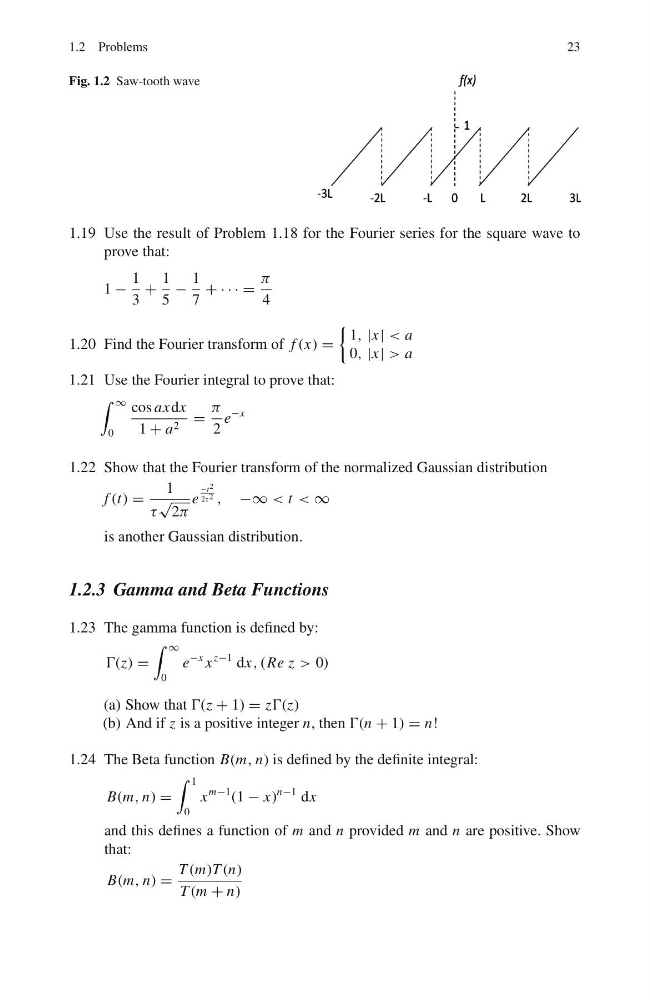
Fig. 1.2 Saw-tooth wave
1.19 Use the result of Problem 1.18 for the Fourier series for the square wave to
prove that:
1 −
1
3
+
1
5
−
1
7
+ · · · =
π
4
1.20 Find the Fourier transform of f (x) =
1, |x| < a
0, |x| > a
1.21 Use the Fourier integral to prove that:
∞
0
cos axdx
1 + a 2 =
π
2
e
−x
1.22 Show that the Fourier transform of the normalized Gaussian distribution
f (t) =
1
τ
√
2π
e
−t 2
2τ 2
, −∞ < t < ∞
is another Gaussian distribution.
1.2.3 Gamma and Beta Functions
1.23 The gamma function is defined by:
Γ(z) =
∞
0
e
−x x
z−1 dx, (Re z > 0)
(a) Show that Γ(z + 1) = zΓ(z)
(b) And if z is a positive integer n, then Γ(n + 1) = n!
1.24 The Beta function B(m, n) is defined by the definite integral:
B(m, n) =
1
0
x
m−1 (1 − x)
n−1 dx
and this defines a function of m and n provided m and n are positive. Show
that:
B(m, n) =
T (m)T (n)
T (m + n)
23
Fig. 1.2 Saw-tooth wave
1.19 Use the result of Problem 1.18 for the Fourier series for the square wave to
prove that:
1 −
1
3
+
1
5
−
1
7
+ · · · =
π
4
1.20 Find the Fourier transform of f (x) =
1, |x| < a
0, |x| > a
1.21 Use the Fourier integral to prove that:
∞
0
cos axdx
1 + a 2 =
π
2
e
−x
1.22 Show that the Fourier transform of the normalized Gaussian distribution
f (t) =
1
τ
√
2π
e
−t 2
2τ 2
, −∞ < t < ∞
is another Gaussian distribution.
1.2.3 Gamma and Beta Functions
1.23 The gamma function is defined by:
Γ(z) =
∞
0
e
−x x
z−1 dx, (Re z > 0)
(a) Show that Γ(z + 1) = zΓ(z)
(b) And if z is a positive integer n, then Γ(n + 1) = n!
1.24 The Beta function B(m, n) is defined by the definite integral:
B(m, n) =
1
0
x
m−1 (1 − x)
n−1 dx
and this defines a function of m and n provided m and n are positive. Show
that:
B(m, n) =
T (m)T (n)
T (m + n)