

7.1 Basic Concepts and Formulae
379
At low Photon energy
σ ph ∝ Z
5
/(hν)
7/2
(7.45)
μ ph = N σ ph
(7.46)
I = I 0 exp (−μ ph x)
(7.47)
Low photon energy can be measured from the observation of absorption edges.
E(eV) = 13.6 (Z − σ )
2
/n
2
(7.48)
where n = 1 for the K-series and n = 2 for the L-series etc, σ is the screening
constant and Z is the atomic number of the absorber.
The photoelectric absorption also follows the exponential law.
Pair production
At incident photon energies greater than 2mc
2 (1.02 MeV), the electron–positron
pair production becomes important.
h ν = T − + T + + 2mc
2
(7.49)
μ p ∝ Z
2
(7.50)
μ total = μ c + μ ph + μ β
(7.51)
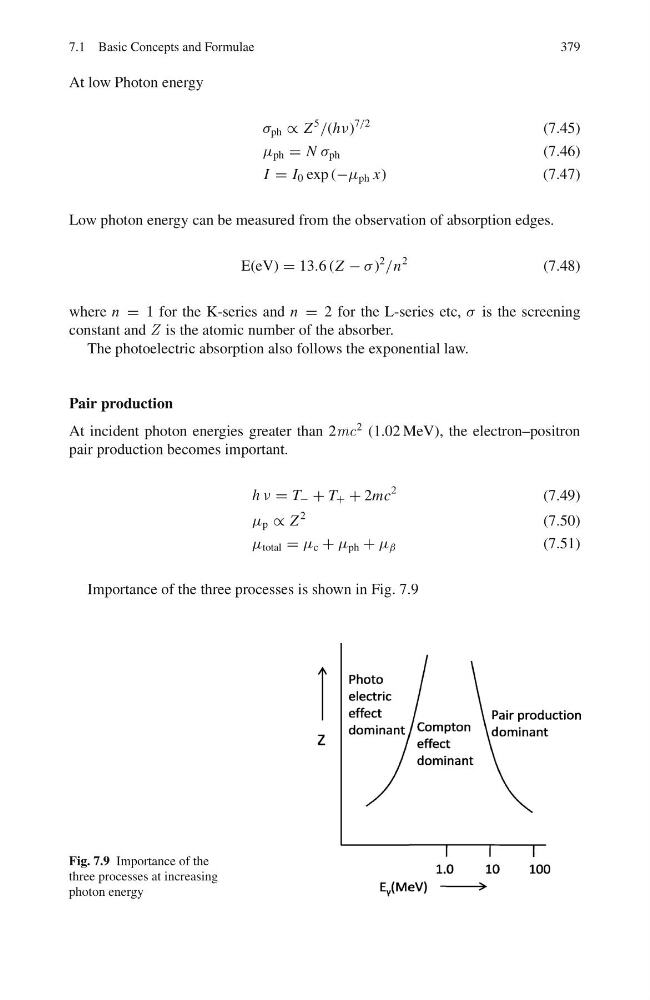
Importance of the three processes is shown in Fig. 7.9
Fig. 7.9 Importance of the
three processes at increasing
photon energy
379
At low Photon energy
σ ph ∝ Z
5
/(hν)
7/2
(7.45)
μ ph = N σ ph
(7.46)
I = I 0 exp (−μ ph x)
(7.47)
Low photon energy can be measured from the observation of absorption edges.
E(eV) = 13.6 (Z − σ )
2
/n
2
(7.48)
where n = 1 for the K-series and n = 2 for the L-series etc, σ is the screening
constant and Z is the atomic number of the absorber.
The photoelectric absorption also follows the exponential law.
Pair production
At incident photon energies greater than 2mc
2 (1.02 MeV), the electron–positron
pair production becomes important.
h ν = T − + T + + 2mc
2
(7.49)
μ p ∝ Z
2
(7.50)
μ total = μ c + μ ph + μ β
(7.51)
Importance of the three processes is shown in Fig. 7.9
Fig. 7.9 Importance of the
three processes at increasing
photon energy