

7.1 Basic Concepts and Formulae
377
Bremsstrahlung
When a relativistic particle of mass m, charge ze moves close to a target nucleus
of charge Ze, it undergoes acceleration which is proportional to zZ /m, and emits
radiation known as bremsstrahlung. Thus the radiation losses for electrons under
identical conditions, are 3 × 10
6 times greater than for protons. Since energy loss is
a one-shot process, the law of energy degradation is exponential. If E 0 is the initial
energy then at distance x
= E 0 exp(−x/ X 0 )
(7.36)
Radiation length X 0 is defined as that absorber thickness which reduces the particle
energy by a factor e.
Passage of radiation through matter
When electromagnetic radiation passes through matter the type of interaction depends
on (1) photon energy (2) Z of the material (3) particle or field with which the photon
interacts. The important processes in Nuclear physics are
1. Compton scattering
2. Photoelectric effect
3. Electron–positron pair production
4. Nuclear resonance fluorescence
The compton effect
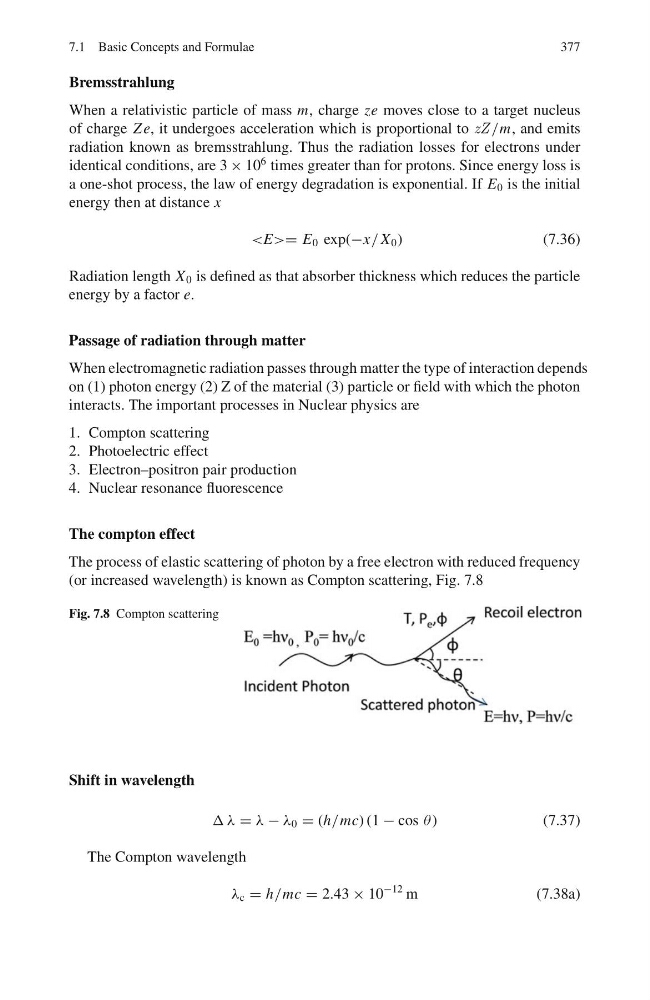
The process of elastic scattering of photon by a free electron with reduced frequency
(or increased wavelength) is known as Compton scattering, Fig. 7.8
Fig. 7.8 Compton scattering
Shift in wavelength
Δ λ = λ − λ 0 = (h/mc) (1 − cos θ )
(7.37)
The Compton wavelength
λ c = h/mc = 2.43 × 10
−12 m
(7.38a)
377
Bremsstrahlung
When a relativistic particle of mass m, charge ze moves close to a target nucleus
of charge Ze, it undergoes acceleration which is proportional to zZ /m, and emits
radiation known as bremsstrahlung. Thus the radiation losses for electrons under
identical conditions, are 3 × 10
6 times greater than for protons. Since energy loss is
a one-shot process, the law of energy degradation is exponential. If E 0 is the initial
energy then at distance x
(7.36)
Radiation length X 0 is defined as that absorber thickness which reduces the particle
energy by a factor e.
Passage of radiation through matter
When electromagnetic radiation passes through matter the type of interaction depends
on (1) photon energy (2) Z of the material (3) particle or field with which the photon
interacts. The important processes in Nuclear physics are
1. Compton scattering
2. Photoelectric effect
3. Electron–positron pair production
4. Nuclear resonance fluorescence
The compton effect
The process of elastic scattering of photon by a free electron with reduced frequency
(or increased wavelength) is known as Compton scattering, Fig. 7.8
Fig. 7.8 Compton scattering
Shift in wavelength
Δ λ = λ − λ 0 = (h/mc) (1 − cos θ )
(7.37)
The Compton wavelength
λ c = h/mc = 2.43 × 10
−12 m
(7.38a)