

7.1 Basic Concepts and Formulae
371
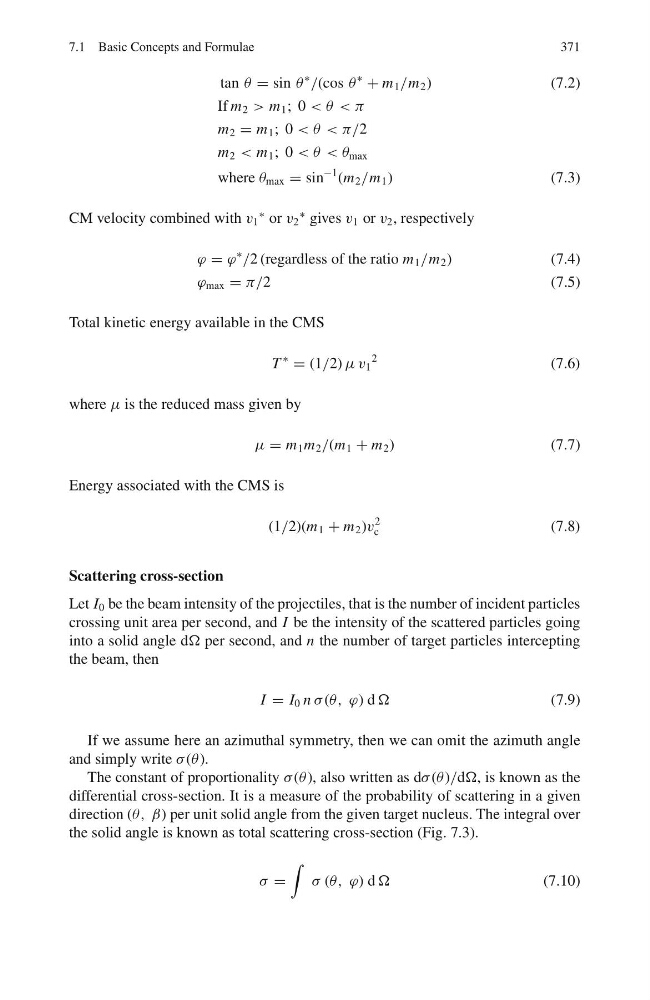
tan θ = sin θ
∗
/(cos θ
∗
+ m 1 /m 2 )
(7.2)
If m 2 > m 1 ; 0 < θ < π
m 2 = m 1 ; 0 < θ < π/2
m 2 < m 1 ; 0 < θ < θ max
where θ max = sin
−1 (m 2 /m 1 )
(7.3)
CM velocity combined with v 1
∗ or v 2
∗ gives v 1 or v 2 , respectively
ϕ = ϕ
∗
/2 (regardless of the ratio m 1 /m 2 )
(7.4)
ϕ max = π/2
(7.5)
Total kinetic energy available in the CMS
T
∗
= (1/2) μ v 1
2
(7.6)
where μ is the reduced mass given by
μ = m 1 m 2 /(m 1 + m 2 )
(7.7)
Energy associated with the CMS is
(1/2)(m 1 + m 2 )v
2
c
(7.8)
Scattering cross-section
Let I 0 be the beam intensity of the projectiles, that is the number of incident particles
crossing unit area per second, and I be the intensity of the scattered particles going
into a solid angle dΩ per second, and n the number of target particles intercepting
the beam, then
I = I 0 n σ (θ, ϕ) d Ω
(7.9)
If we assume here an azimuthal symmetry, then we can omit the azimuth angle
and simply write σ (θ ).
The constant of proportionality σ (θ ), also written as dσ (θ )/dΩ, is known as the
differential cross-section. It is a measure of the probability of scattering in a given
direction (θ, β) per unit solid angle from the given target nucleus. The integral over
the solid angle is known as total scattering cross-section (Fig. 7.3).
σ =
σ (θ, ϕ) d Ω
(7.10)
371
tan θ = sin θ
∗
/(cos θ
∗
+ m 1 /m 2 )
(7.2)
If m 2 > m 1 ; 0 < θ < π
m 2 = m 1 ; 0 < θ < π/2
m 2 < m 1 ; 0 < θ < θ max
where θ max = sin
−1 (m 2 /m 1 )
(7.3)
CM velocity combined with v 1
∗ or v 2
∗ gives v 1 or v 2 , respectively
ϕ = ϕ
∗
/2 (regardless of the ratio m 1 /m 2 )
(7.4)
ϕ max = π/2
(7.5)
Total kinetic energy available in the CMS
T
∗
= (1/2) μ v 1
2
(7.6)
where μ is the reduced mass given by
μ = m 1 m 2 /(m 1 + m 2 )
(7.7)
Energy associated with the CMS is
(1/2)(m 1 + m 2 )v
2
c
(7.8)
Scattering cross-section
Let I 0 be the beam intensity of the projectiles, that is the number of incident particles
crossing unit area per second, and I be the intensity of the scattered particles going
into a solid angle dΩ per second, and n the number of target particles intercepting
the beam, then
I = I 0 n σ (θ, ϕ) d Ω
(7.9)
If we assume here an azimuthal symmetry, then we can omit the azimuth angle
and simply write σ (θ ).
The constant of proportionality σ (θ ), also written as dσ (θ )/dΩ, is known as the
differential cross-section. It is a measure of the probability of scattering in a given
direction (θ, β) per unit solid angle from the given target nucleus. The integral over
the solid angle is known as total scattering cross-section (Fig. 7.3).
σ =
σ (θ, ϕ) d Ω
(7.10)