

6.3 Solutions
363
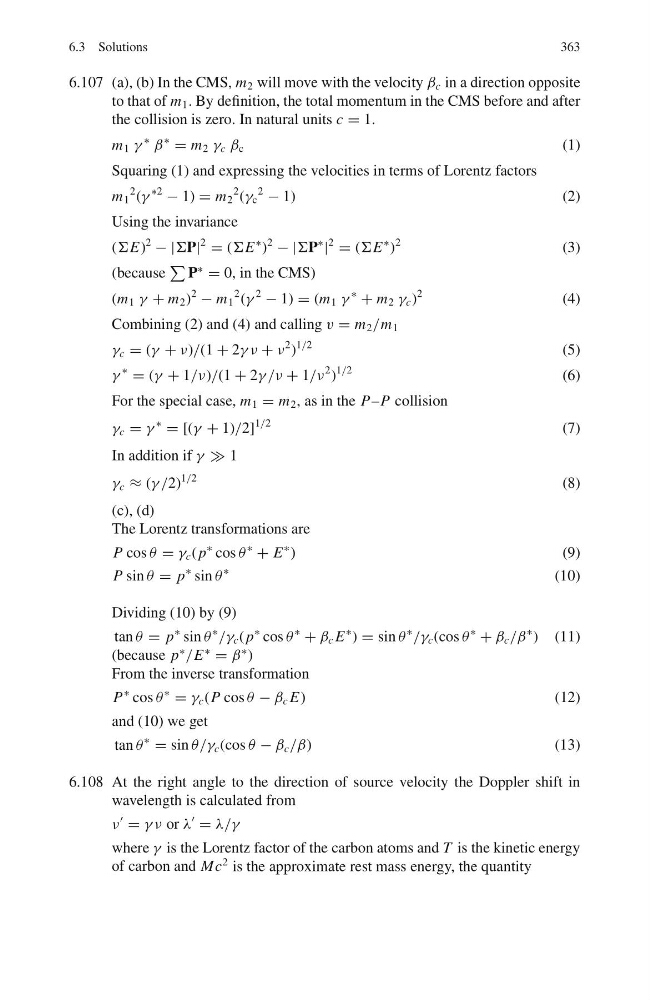
6.107 (a), (b) In the CMS, m 2 will move with the velocity β c in a direction opposite
to that of m 1 . By definition, the total momentum in the CMS before and after
the collision is zero. In natural units c = 1.
m 1 γ
∗
β
∗
= m 2 γ c β c
(1)
Squaring (1) and expressing the velocities in terms of Lorentz factors
m 1
2 (γ
∗2
− 1) = m 2
2 (γ c
2
− 1)
(2)
Using the invariance
(ΣE)
2
− |ΣP|
2
= (ΣE
∗ )
2
− |ΣP
∗
|
2
= (ΣE
∗ )
2
(3)
(because
P
∗
= 0, in the CMS)
(m 1 γ + m 2 )
2
− m 1
2 (γ
2
− 1) = (m 1 γ
∗
+ m 2 γ c )
2
(4)
Combining (2) and (4) and calling v = m 2 /m 1
γ c = (γ + ν)/(1 + 2γ ν + ν
2 )
1/2
(5)
γ
∗
= (γ + 1/ν)/(1 + 2γ /ν + 1/ν
2 )
1/2
(6)
For the special case, m 1 = m 2 , as in the P–P collision
γ c = γ
∗
= [(γ + 1)/2]
1/2
(7)
In addition if γ 1
γ c ≈ (γ /2)
1/2
(8)
(c), (d)
The Lorentz transformations are
P cos θ = γ c ( p
∗ cos θ
∗
+ E
∗ )
( 9 )
P sin θ = p
∗ sin θ
∗
(10)
Dividing (10) by (9)
tan θ = p
∗ sin θ
∗
/γ c ( p
∗ cos θ
∗
+ β c E
∗ ) = sin θ
∗
/γ c (cos θ
∗
+ β c /β
∗ ) (11)
(because p
∗
/E
∗
= β
∗ )
From the inverse transformation
P
∗ cos θ
∗
= γ c (P cos θ − β c E)
(12)
and (10) we get
tan θ
∗
= sin θ/γ c (cos θ − β c /β)
(13)
6.108 At the right angle to the direction of source velocity the Doppler shift in
wavelength is calculated from
ν
= γ ν or λ
= λ/γ
where γ is the Lorentz factor of the carbon atoms and T is the kinetic energy
of carbon and Mc
2 is the approximate rest mass energy, the quantity
363
6.107 (a), (b) In the CMS, m 2 will move with the velocity β c in a direction opposite
to that of m 1 . By definition, the total momentum in the CMS before and after
the collision is zero. In natural units c = 1.
m 1 γ
∗
β
∗
= m 2 γ c β c
(1)
Squaring (1) and expressing the velocities in terms of Lorentz factors
m 1
2 (γ
∗2
− 1) = m 2
2 (γ c
2
− 1)
(2)
Using the invariance
(ΣE)
2
− |ΣP|
2
= (ΣE
∗ )
2
− |ΣP
∗
|
2
= (ΣE
∗ )
2
(3)
(because
P
∗
= 0, in the CMS)
(m 1 γ + m 2 )
2
− m 1
2 (γ
2
− 1) = (m 1 γ
∗
+ m 2 γ c )
2
(4)
Combining (2) and (4) and calling v = m 2 /m 1
γ c = (γ + ν)/(1 + 2γ ν + ν
2 )
1/2
(5)
γ
∗
= (γ + 1/ν)/(1 + 2γ /ν + 1/ν
2 )
1/2
(6)
For the special case, m 1 = m 2 , as in the P–P collision
γ c = γ
∗
= [(γ + 1)/2]
1/2
(7)
In addition if γ 1
γ c ≈ (γ /2)
1/2
(8)
(c), (d)
The Lorentz transformations are
P cos θ = γ c ( p
∗ cos θ
∗
+ E
∗ )
( 9 )
P sin θ = p
∗ sin θ
∗
(10)
Dividing (10) by (9)
tan θ = p
∗ sin θ
∗
/γ c ( p
∗ cos θ
∗
+ β c E
∗ ) = sin θ
∗
/γ c (cos θ
∗
+ β c /β
∗ ) (11)
(because p
∗
/E
∗
= β
∗ )
From the inverse transformation
P
∗ cos θ
∗
= γ c (P cos θ − β c E)
(12)
and (10) we get
tan θ
∗
= sin θ/γ c (cos θ − β c /β)
(13)
6.108 At the right angle to the direction of source velocity the Doppler shift in
wavelength is calculated from
ν
= γ ν or λ
= λ/γ
where γ is the Lorentz factor of the carbon atoms and T is the kinetic energy
of carbon and Mc
2 is the approximate rest mass energy, the quantity