

6.3 Solutions
351
Because of (2) and (5)
p
e = p = E/c
(b) β = v/c = (1 − 1/γ
2 )
1/2
= (1 − m
2
/E e
2 )
1/2
= (1 − m
2
/( p e
2
+ m
2 ))
1/2
= ( p e
2
/( p e
2
+ m
2 ))
1/2
= (1 + (m c
2
/E)
2 )
−1/2
where P e = E and c = 1.
6.3.4 Invariance Principle
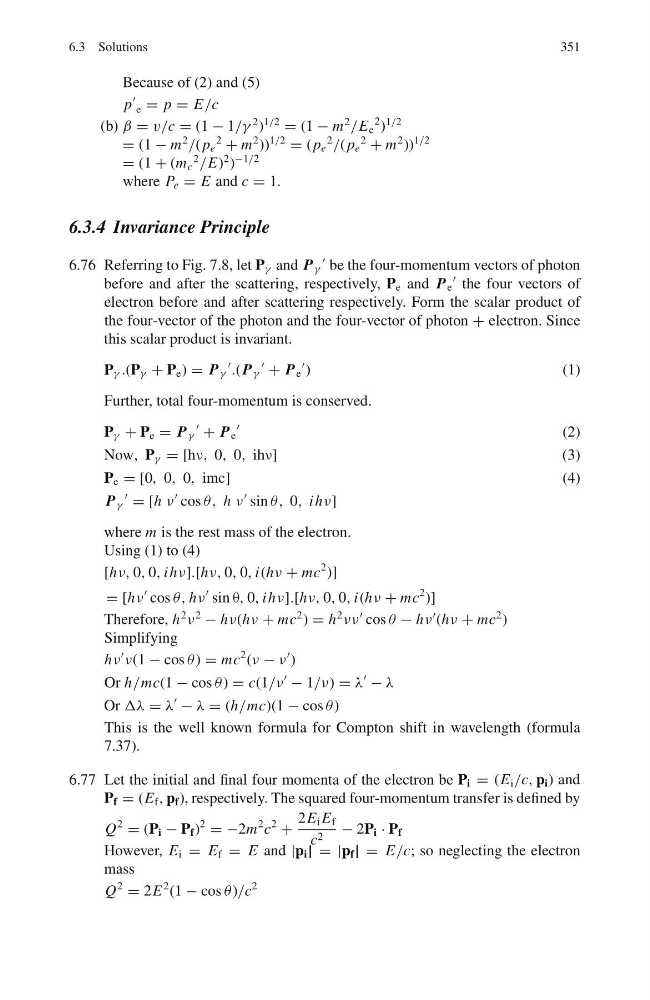
6.76 Referring to Fig. 7.8, let P γ and P γ
be the four-momentum vectors of photon
before and after the scattering, respectively, P e and P e
the four vectors of
electron before and after scattering respectively. Form the scalar product of
the four-vector of the photon and the four-vector of photon + electron. Since
this scalar product is invariant.
P γ .(P γ + P e ) = P γ
.( P γ
+ P e
)
( 1 )
Further, total four-momentum is conserved.
P γ + P e = P γ
+ P e
(2)
Now, P γ = [hν, 0, 0, ihν]
( 3 )
P e = [0, 0, 0, imc]
(4)
P γ
= [h ν
cos θ, h ν
sin θ, 0, ihν]
where m is the rest mass of the electron.
Using (1) to (4)
[hν, 0, 0, ihν].[hν, 0, 0, i(hν + mc
2 )]
= [hν
cos θ, hν
sin θ, 0, ihν].[hν, 0, 0, i(hν + mc
2 )]
Therefore, h
2
ν
2
− hν(hν + mc
2 ) = h
2
νν
cos θ − hν
(hν + mc
2 )
Simplifying
hν
ν(1 − cos θ) = mc
2 (ν − ν
)
Or h/mc(1 − cos θ) = c(1/ν
− 1/ν) = λ
− λ
Or Δλ = λ
− λ = (h/mc)(1 − cos θ)
This is the well known formula for Compton shift in wavelength (formula
7.37).
6.77 Let the initial and final four momenta of the electron be P i = (E i /c, p i ) and
P f = (E f , p f ), respectively. The squared four-momentum transfer is defined by
Q
2
= (P i − P f )
2
= −2m
2 c
2
+
2E i E f
c 2 − 2P i · P f
However, E i = E f = E and |p i | = |p f | = E/c; so neglecting the electron
mass
Q
2
= 2E
2 (1 − cos θ)/c
2
351
Because of (2) and (5)
p
e = p = E/c
(b) β = v/c = (1 − 1/γ
2 )
1/2
= (1 − m
2
/E e
2 )
1/2
= (1 − m
2
/( p e
2
+ m
2 ))
1/2
= ( p e
2
/( p e
2
+ m
2 ))
1/2
= (1 + (m c
2
/E)
2 )
−1/2
where P e = E and c = 1.
6.3.4 Invariance Principle
6.76 Referring to Fig. 7.8, let P γ and P γ
be the four-momentum vectors of photon
before and after the scattering, respectively, P e and P e
the four vectors of
electron before and after scattering respectively. Form the scalar product of
the four-vector of the photon and the four-vector of photon + electron. Since
this scalar product is invariant.
P γ .(P γ + P e ) = P γ
.( P γ
+ P e
)
( 1 )
Further, total four-momentum is conserved.
P γ + P e = P γ
+ P e
(2)
Now, P γ = [hν, 0, 0, ihν]
( 3 )
P e = [0, 0, 0, imc]
(4)
P γ
= [h ν
cos θ, h ν
sin θ, 0, ihν]
where m is the rest mass of the electron.
Using (1) to (4)
[hν, 0, 0, ihν].[hν, 0, 0, i(hν + mc
2 )]
= [hν
cos θ, hν
sin θ, 0, ihν].[hν, 0, 0, i(hν + mc
2 )]
Therefore, h
2
ν
2
− hν(hν + mc
2 ) = h
2
νν
cos θ − hν
(hν + mc
2 )
Simplifying
hν
ν(1 − cos θ) = mc
2 (ν − ν
)
Or h/mc(1 − cos θ) = c(1/ν
− 1/ν) = λ
− λ
Or Δλ = λ
− λ = (h/mc)(1 − cos θ)
This is the well known formula for Compton shift in wavelength (formula
7.37).
6.77 Let the initial and final four momenta of the electron be P i = (E i /c, p i ) and
P f = (E f , p f ), respectively. The squared four-momentum transfer is defined by
Q
2
= (P i − P f )
2
= −2m
2 c
2
+
2E i E f
c 2 − 2P i · P f
However, E i = E f = E and |p i | = |p f | = E/c; so neglecting the electron
mass
Q
2
= 2E
2 (1 − cos θ)/c
2