

6.3 Solutions
349
Therefore, γ = [1 + ( p/m)
2 ]
1/2
= [1 + (5/0.938)
2 ]
1/2
= 5.41
tan θ tan ϕ = tan 82
◦ tan 2
◦ 30
= 7.115 × 0.04366 = 0.3106
2/(γ + 1) = 2/(5.41 + 1) = 0.3120
Hence the event is consistent with elastic scattering.
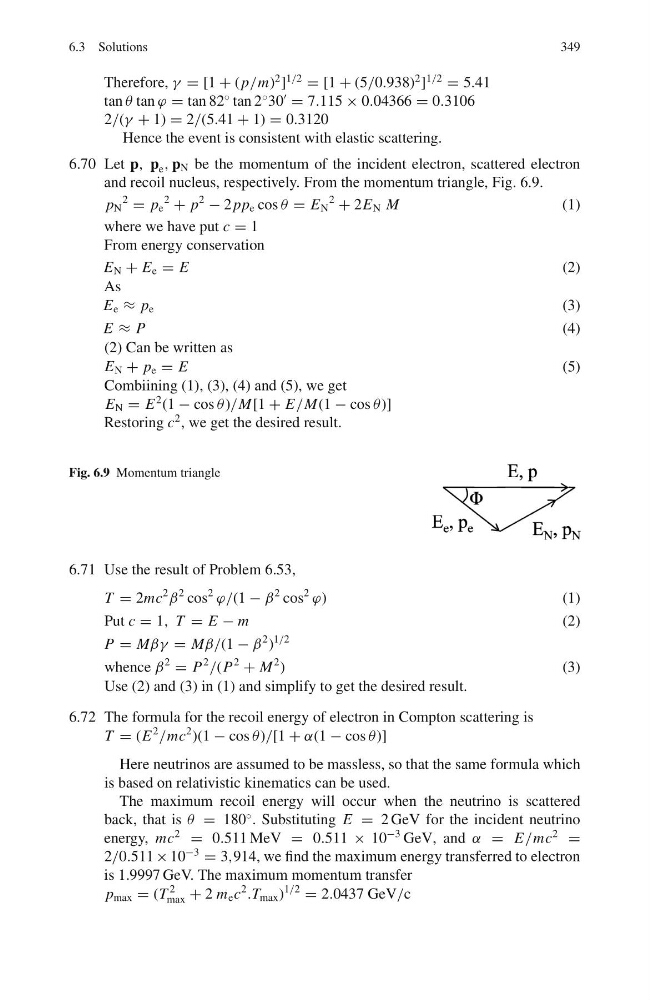
6.70 Let p, p e , p N be the momentum of the incident electron, scattered electron
and recoil nucleus, respectively. From the momentum triangle, Fig. 6.9.
p N
2
= p e
2
+ p
2
− 2 pp e cos θ = E N
2
+ 2E N M
(1)
where we have put c = 1
From energy conservation
E N + E e = E
(2)
As
E e ≈ p e
(3)
E ≈ P
(4)
(2) Can be written as
E N + p e = E
(5)
Combiining (1), (3), (4) and (5), we get
E N = E
2 (1 − cos θ)/M[1 + E/M(1 − cos θ )]
Restoring c
2 , we get the desired result.
Fig. 6.9 Momentum triangle
6.71 Use the result of Problem 6.53,
T = 2mc
2
β
2 cos
2
ϕ/(1 − β
2 cos
2
ϕ)
( 1 )
Put c = 1, T = E − m
(2)
P = Mβγ = Mβ/(1 − β
2 )
1/2
whence β
2
= P
2
/(P
2
+ M
2 )
( 3 )
Use (2) and (3) in (1) and simplify to get the desired result.
6.72 The formula for the recoil energy of electron in Compton scattering is
T = (E
2
/mc
2 )(1 − cos θ)/[1 + α(1 − cos θ)]
Here neutrinos are assumed to be massless, so that the same formula which
is based on relativistic kinematics can be used.
The maximum recoil energy will occur when the neutrino is scattered
back, that is θ = 180
◦ . Substituting E = 2 GeV for the incident neutrino
energy, mc
2
= 0.511 MeV = 0.511 × 10
−3 GeV, and α = E/mc
2
=
2/0.511 × 10
−3
= 3,914, we find the maximum energy transferred to electron
is 1.9997 GeV. The maximum momentum transfer
p max = (T
2
max + 2 m e c
2
.T max )
1/2
= 2.0437 GeV/c
349
Therefore, γ = [1 + ( p/m)
2 ]
1/2
= [1 + (5/0.938)
2 ]
1/2
= 5.41
tan θ tan ϕ = tan 82
◦ tan 2
◦ 30
= 7.115 × 0.04366 = 0.3106
2/(γ + 1) = 2/(5.41 + 1) = 0.3120
Hence the event is consistent with elastic scattering.
6.70 Let p, p e , p N be the momentum of the incident electron, scattered electron
and recoil nucleus, respectively. From the momentum triangle, Fig. 6.9.
p N
2
= p e
2
+ p
2
− 2 pp e cos θ = E N
2
+ 2E N M
(1)
where we have put c = 1
From energy conservation
E N + E e = E
(2)
As
E e ≈ p e
(3)
E ≈ P
(4)
(2) Can be written as
E N + p e = E
(5)
Combiining (1), (3), (4) and (5), we get
E N = E
2 (1 − cos θ)/M[1 + E/M(1 − cos θ )]
Restoring c
2 , we get the desired result.
Fig. 6.9 Momentum triangle
6.71 Use the result of Problem 6.53,
T = 2mc
2
β
2 cos
2
ϕ/(1 − β
2 cos
2
ϕ)
( 1 )
Put c = 1, T = E − m
(2)
P = Mβγ = Mβ/(1 − β
2 )
1/2
whence β
2
= P
2
/(P
2
+ M
2 )
( 3 )
Use (2) and (3) in (1) and simplify to get the desired result.
6.72 The formula for the recoil energy of electron in Compton scattering is
T = (E
2
/mc
2 )(1 − cos θ)/[1 + α(1 − cos θ)]
Here neutrinos are assumed to be massless, so that the same formula which
is based on relativistic kinematics can be used.
The maximum recoil energy will occur when the neutrino is scattered
back, that is θ = 180
◦ . Substituting E = 2 GeV for the incident neutrino
energy, mc
2
= 0.511 MeV = 0.511 × 10
−3 GeV, and α = E/mc
2
=
2/0.511 × 10
−3
= 3,914, we find the maximum energy transferred to electron
is 1.9997 GeV. The maximum momentum transfer
p max = (T
2
max + 2 m e c
2
.T max )
1/2
= 2.0437 GeV/c