

6.3 Solutions
343
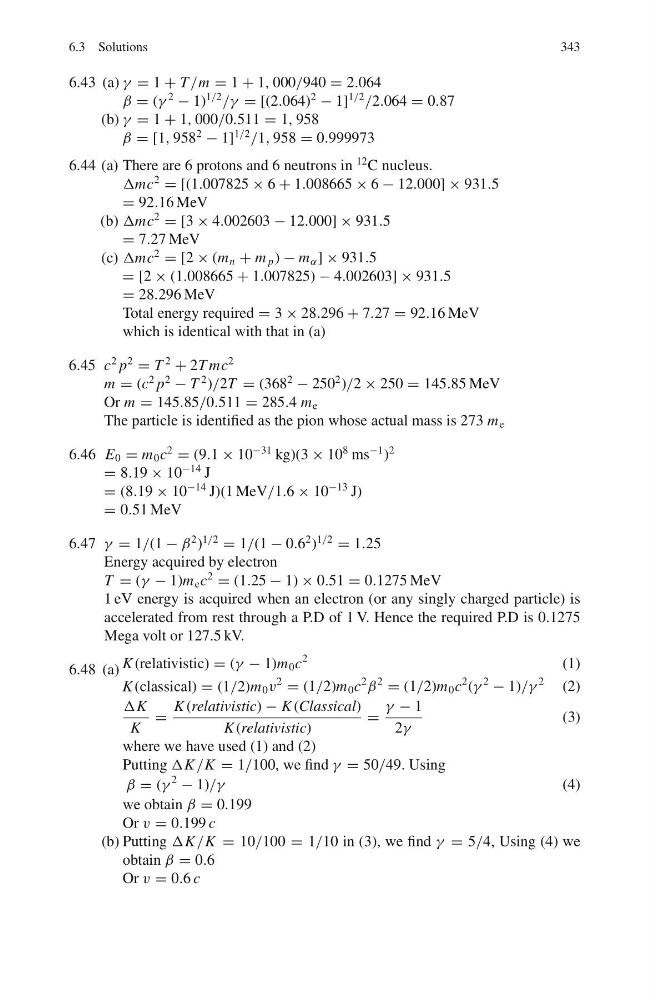
6.43 (a) γ = 1 + T /m = 1 + 1, 000/940 = 2.064
β = (γ
2
− 1)
1/2
/γ = [(2.064)
2
− 1]
1/2
/2.064 = 0.87
(b) γ = 1 + 1, 000/0.511 = 1, 958
β = [1, 958
2
− 1]
1/2
/1, 958 = 0.999973
6.44 (a) There are 6 protons and 6 neutrons in
12 C nucleus.
Δmc
2
= [(1.007825 × 6 + 1.008665 × 6 − 12.000] × 931.5
= 92.16 MeV
(b) Δmc
2
= [3 × 4.002603 − 12.000] × 931.5
= 7.27 MeV
(c) Δmc
2
= [2 × (m n + m p ) − m α ] × 931.5
= [2 × (1.008665 + 1.007825) − 4.002603] × 931.5
= 28.296 MeV
Total energy required = 3 × 28.296 + 7.27 = 92.16 MeV
which is identical with that in (a)
6.45 c
2 p
2
= T
2
+ 2T mc
2
m = (c
2 p
2
− T
2 )/2T = (368
2
− 250
2 )/2 × 250 = 145.85 MeV
Or m = 145.85/0.511 = 285.4 m e
The particle is identified as the pion whose actual mass is 273 m e
6.46 E 0 = m 0 c
2
= (9.1 × 10
−31 kg)(3 × 10
8 ms
−1 )
2
= 8.19 × 10
−14 J
= (8.19 × 10
−14 J)(1 MeV/1.6 × 10
−13 J)
= 0.51 MeV
6.47 γ = 1/(1 − β
2 )
1/2
= 1/(1 − 0.6
2 )
1/2
= 1.25
Energy acquired by electron
T = (γ − 1)m e c
2
= (1.25 − 1) × 0.51 = 0.1275 MeV
1 eV energy is acquired when an electron (or any singly charged particle) is
accelerated from rest through a P.D of 1 V. Hence the required P.D is 0.1275
Mega volt or 127.5 kV.
6.48 (a) K (relativistic) = (γ − 1)m 0 c
2
(1)
K (classical) = (1/2)m 0 v
2
= (1/2)m 0 c
2
β
2
= (1/2)m 0 c
2 (γ
2
− 1)/γ
2
(2)
ΔK
K
=
K (relativistic) − K (Classical)
K (relativistic)
=
γ − 1
2γ
(3)
where we have used (1) and (2)
Putting ΔK /K = 1/100, we find γ = 50/49. Using
β = (γ
2
− 1)/γ
(4)
we obtain β = 0.199
Or v = 0.199 c
(b) Putting ΔK /K = 10/100 = 1/10 in (3), we find γ = 5/4, Using (4) we
obtain β = 0.6
Or v = 0.6 c
343
6.43 (a) γ = 1 + T /m = 1 + 1, 000/940 = 2.064
β = (γ
2
− 1)
1/2
/γ = [(2.064)
2
− 1]
1/2
/2.064 = 0.87
(b) γ = 1 + 1, 000/0.511 = 1, 958
β = [1, 958
2
− 1]
1/2
/1, 958 = 0.999973
6.44 (a) There are 6 protons and 6 neutrons in
12 C nucleus.
Δmc
2
= [(1.007825 × 6 + 1.008665 × 6 − 12.000] × 931.5
= 92.16 MeV
(b) Δmc
2
= [3 × 4.002603 − 12.000] × 931.5
= 7.27 MeV
(c) Δmc
2
= [2 × (m n + m p ) − m α ] × 931.5
= [2 × (1.008665 + 1.007825) − 4.002603] × 931.5
= 28.296 MeV
Total energy required = 3 × 28.296 + 7.27 = 92.16 MeV
which is identical with that in (a)
6.45 c
2 p
2
= T
2
+ 2T mc
2
m = (c
2 p
2
− T
2 )/2T = (368
2
− 250
2 )/2 × 250 = 145.85 MeV
Or m = 145.85/0.511 = 285.4 m e
The particle is identified as the pion whose actual mass is 273 m e
6.46 E 0 = m 0 c
2
= (9.1 × 10
−31 kg)(3 × 10
8 ms
−1 )
2
= 8.19 × 10
−14 J
= (8.19 × 10
−14 J)(1 MeV/1.6 × 10
−13 J)
= 0.51 MeV
6.47 γ = 1/(1 − β
2 )
1/2
= 1/(1 − 0.6
2 )
1/2
= 1.25
Energy acquired by electron
T = (γ − 1)m e c
2
= (1.25 − 1) × 0.51 = 0.1275 MeV
1 eV energy is acquired when an electron (or any singly charged particle) is
accelerated from rest through a P.D of 1 V. Hence the required P.D is 0.1275
Mega volt or 127.5 kV.
6.48 (a) K (relativistic) = (γ − 1)m 0 c
2
(1)
K (classical) = (1/2)m 0 v
2
= (1/2)m 0 c
2
β
2
= (1/2)m 0 c
2 (γ
2
− 1)/γ
2
(2)
ΔK
K
=
K (relativistic) − K (Classical)
K (relativistic)
=
γ − 1
2γ
(3)
where we have used (1) and (2)
Putting ΔK /K = 1/100, we find γ = 50/49. Using
β = (γ
2
− 1)/γ
(4)
we obtain β = 0.199
Or v = 0.199 c
(b) Putting ΔK /K = 10/100 = 1/10 in (3), we find γ = 5/4, Using (4) we
obtain β = 0.6
Or v = 0.6 c