

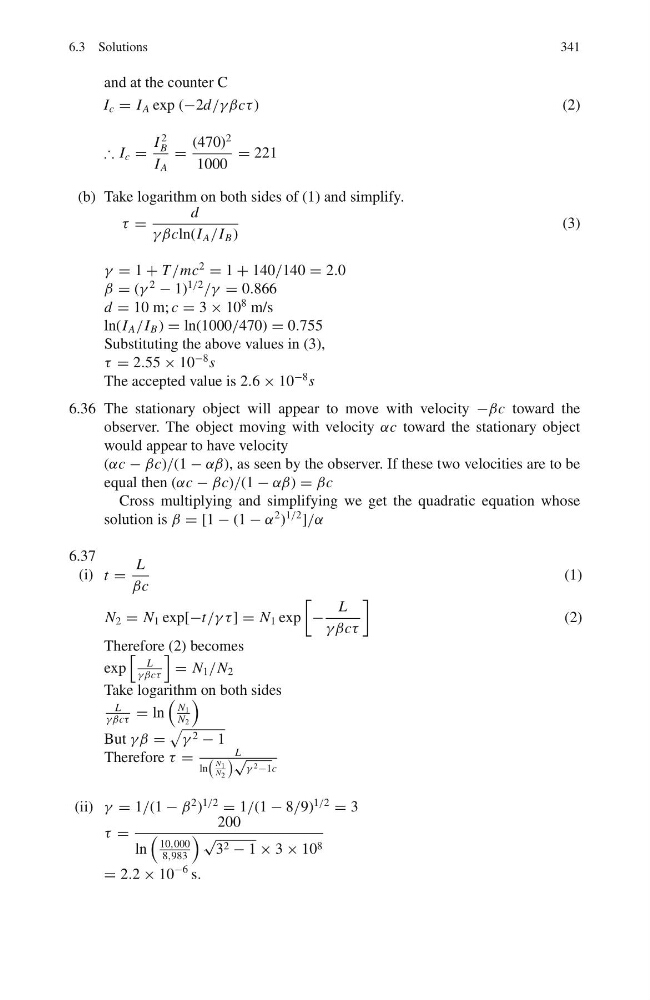
6.3 Solutions
341
and at the counter C
I c = I A exp (−2d/γβcτ )
( 2 )
∴ I c =
I
2
B
I A
=
(470)
2
1000
= 221
(b) Take logarithm on both sides of (1) and simplify.
τ =
d
γβcln(I A /I B )
(3)
γ = 1 + T /mc
2
= 1 + 140/140 = 2.0
β = (γ
2
− 1)
1/2
/γ = 0.866
d = 10 m; c = 3 × 10
8 m/s
ln(I A /I B ) = ln(1000/470) = 0.755
Substituting the above values in (3),
τ = 2.55 × 10
−8 s
The accepted value is 2.6 × 10
−8 s
6.36 The stationary object will appear to move with velocity −βc toward the
observer. The object moving with velocity αc toward the stationary object
would appear to have velocity
(αc − βc)/(1 − αβ), as seen by the observer. If these two velocities are to be
equal then (αc − βc)/(1 − αβ) = βc
Cross multiplying and simplifying we get the quadratic equation whose
solution is β = [1 − (1 − α
2 )
1/2 ]/α
6.37
(i) t =
L
βc
(1)
N 2 = N 1 exp[−t/γ τ ] = N 1 exp
−
L
γβcτ
(2)
Therefore (2) becomes
exp
L
γβcτ
= N 1 /N 2
Take logarithm on both sides
L
γβcτ
= ln
N1
N 2
But γβ =
γ 2 − 1
Therefore τ =
L
ln
N 1
N 2
√
γ 2 −1c
(ii) γ = 1/(1 − β
2 )
1/2
= 1/(1 − 8/9)
1/2
= 3
τ =
200
ln
10,000
8,983
√
3 2 − 1 × 3 × 10 8
= 2.2 × 10
−6 s.
341
and at the counter C
I c = I A exp (−2d/γβcτ )
( 2 )
∴ I c =
I
2
B
I A
=
(470)
2
1000
= 221
(b) Take logarithm on both sides of (1) and simplify.
τ =
d
γβcln(I A /I B )
(3)
γ = 1 + T /mc
2
= 1 + 140/140 = 2.0
β = (γ
2
− 1)
1/2
/γ = 0.866
d = 10 m; c = 3 × 10
8 m/s
ln(I A /I B ) = ln(1000/470) = 0.755
Substituting the above values in (3),
τ = 2.55 × 10
−8 s
The accepted value is 2.6 × 10
−8 s
6.36 The stationary object will appear to move with velocity −βc toward the
observer. The object moving with velocity αc toward the stationary object
would appear to have velocity
(αc − βc)/(1 − αβ), as seen by the observer. If these two velocities are to be
equal then (αc − βc)/(1 − αβ) = βc
Cross multiplying and simplifying we get the quadratic equation whose
solution is β = [1 − (1 − α
2 )
1/2 ]/α
6.37
(i) t =
L
βc
(1)
N 2 = N 1 exp[−t/γ τ ] = N 1 exp
−
L
γβcτ
(2)
Therefore (2) becomes
exp
L
γβcτ
= N 1 /N 2
Take logarithm on both sides
L
γβcτ
= ln
N1
N 2
But γβ =
γ 2 − 1
Therefore τ =
L
ln
N 1
N 2
√
γ 2 −1c
(ii) γ = 1/(1 − β
2 )
1/2
= 1/(1 − 8/9)
1/2
= 3
τ =
200
ln
10,000
8,983
√
3 2 − 1 × 3 × 10 8
= 2.2 × 10
−6 s.