

332
6 Special Theory of Relativity
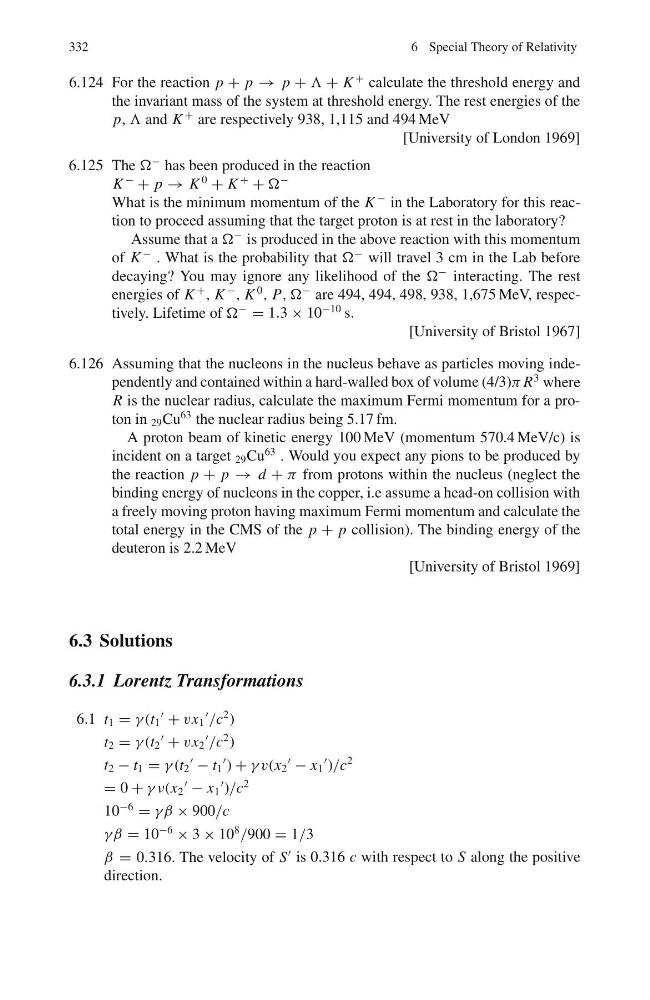
6.124 For the reaction p + p → p + Λ + K
+ calculate the threshold energy and
the invariant mass of the system at threshold energy. The rest energies of the
p, Λ and K
+ are respectively 938, 1,115 and 494 MeV
[University of London 1969]
6.125 The Ω
− has been produced in the reaction
K
−
+ p → K
0
+ K
+
+ Ω
−
What is the minimum momentum of the K
− in the Laboratory for this reaction to proceed assuming that the target proton is at rest in the laboratory?
Assume that a Ω
− is produced in the above reaction with this momentum
of K
− . What is the probability that Ω
− will travel 3 cm in the Lab before
decaying? You may ignore any likelihood of the Ω
− interacting. The rest
energies of K
+
, K
−
, K
0
, P, Ω
− are 494, 494, 498, 938, 1,675 MeV, respectively. Lifetime of Ω
−
= 1.3 × 10
−10 s.
[University of Bristol 1967]
6.126 Assuming that the nucleons in the nucleus behave as particles moving independently and contained within a hard-walled box of volume (4/3)π R
3 where
R is the nuclear radius, calculate the maximum Fermi momentum for a proton in 29 Cu
63 the nuclear radius being 5.17 fm.
A proton beam of kinetic energy 100 MeV (momentum 570.4 MeV/c) is
incident on a target 29 Cu
63 . Would you expect any pions to be produced by
the reaction p + p → d + π from protons within the nucleus (neglect the
binding energy of nucleons in the copper, i.e assume a head-on collision with
a freely moving proton having maximum Fermi momentum and calculate the
total energy in the CMS of the p + p collision). The binding energy of the
deuteron is 2.2 MeV
[University of Bristol 1969]
6.3 Solutions
6.3.1 Lorentz Transformations
6.1 t 1 = γ (t 1
+ vx 1
/c
2 )
t 2 = γ (t 2
+ vx 2
/c
2 )
t 2 − t 1 = γ (t 2
− t 1
) + γ v(x 2
− x 1
)/c
2
= 0 + γ ν(x 2
− x 1
)/c
2
10
−6
= γβ × 900/c
γβ = 10
−6
× 3 × 10
8
/900 = 1/3
β = 0.316. The velocity of S
is 0.316 c with respect to S along the positive
direction.
6 Special Theory of Relativity
6.124 For the reaction p + p → p + Λ + K
+ calculate the threshold energy and
the invariant mass of the system at threshold energy. The rest energies of the
p, Λ and K
+ are respectively 938, 1,115 and 494 MeV
[University of London 1969]
6.125 The Ω
− has been produced in the reaction
K
−
+ p → K
0
+ K
+
+ Ω
−
What is the minimum momentum of the K
− in the Laboratory for this reaction to proceed assuming that the target proton is at rest in the laboratory?
Assume that a Ω
− is produced in the above reaction with this momentum
of K
− . What is the probability that Ω
− will travel 3 cm in the Lab before
decaying? You may ignore any likelihood of the Ω
− interacting. The rest
energies of K
+
, K
−
, K
0
, P, Ω
− are 494, 494, 498, 938, 1,675 MeV, respectively. Lifetime of Ω
−
= 1.3 × 10
−10 s.
[University of Bristol 1967]
6.126 Assuming that the nucleons in the nucleus behave as particles moving independently and contained within a hard-walled box of volume (4/3)π R
3 where
R is the nuclear radius, calculate the maximum Fermi momentum for a proton in 29 Cu
63 the nuclear radius being 5.17 fm.
A proton beam of kinetic energy 100 MeV (momentum 570.4 MeV/c) is
incident on a target 29 Cu
63 . Would you expect any pions to be produced by
the reaction p + p → d + π from protons within the nucleus (neglect the
binding energy of nucleons in the copper, i.e assume a head-on collision with
a freely moving proton having maximum Fermi momentum and calculate the
total energy in the CMS of the p + p collision). The binding energy of the
deuteron is 2.2 MeV
[University of Bristol 1969]
6.3 Solutions
6.3.1 Lorentz Transformations
6.1 t 1 = γ (t 1
+ vx 1
/c
2 )
t 2 = γ (t 2
+ vx 2
/c
2 )
t 2 − t 1 = γ (t 2
− t 1
) + γ v(x 2
− x 1
)/c
2
= 0 + γ ν(x 2
− x 1
)/c
2
10
−6
= γβ × 900/c
γβ = 10
−6
× 3 × 10
8
/900 = 1/3
β = 0.316. The velocity of S
is 0.316 c with respect to S along the positive
direction.