

330
6 Special Theory of Relativity
6.108 A linear accelerator produces a beam of excited carbon atoms of kinetic
energy 120 MeV. Light emitted on de-excitation is viewed at right angles
to the beam and has a wavelength λ
. If λ is the wavelength emitted by a
stationary atom, what is the value of (λ
− λ)/λ? (Take the rest energies of
both protons and neutrons to be 10
9 eV)
[University of Manchester 1970]
6.109 A certain spectral line of a star has natural frequency of 5 × 10
17 c/s. If the
star is approaching the earth at 300 km/s, what would be the fractional change
of frequency?
6.110 A neutral pion (mass 135 MeV/c
2 ) travelling with speed β = v/c = 0.8
decays into two photons at right angle to the line of flight. Find the angle
between the two photons as observed in the lab system.
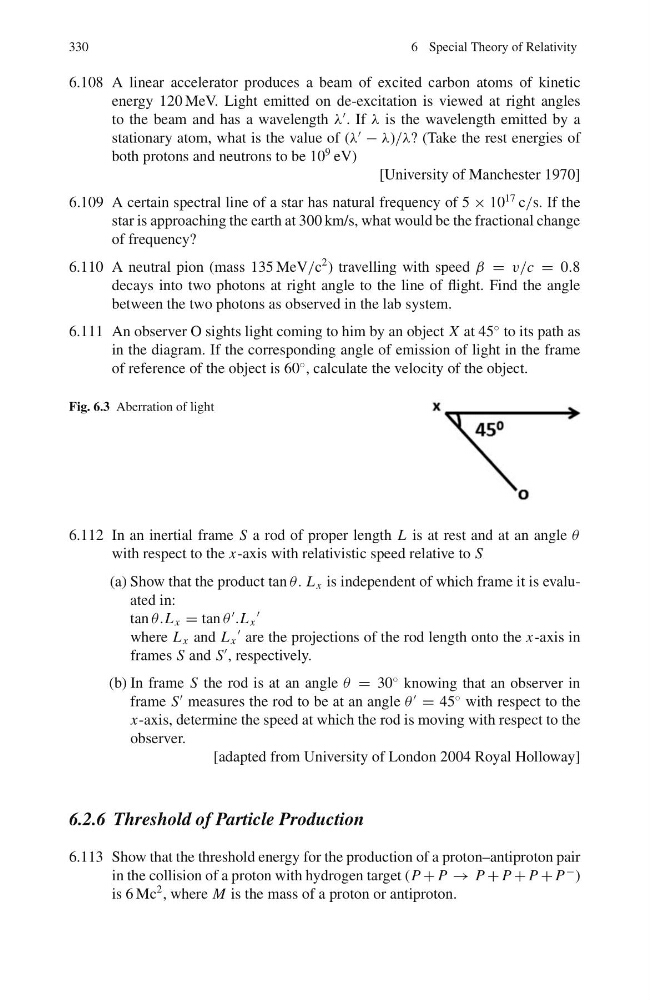
6.111 An observer O sights light coming to him by an object X at 45
◦ to its path as
in the diagram. If the corresponding angle of emission of light in the frame
of reference of the object is 60
◦ , calculate the velocity of the object.
Fig. 6.3 Aberration of light
6.112 In an inertial frame S a rod of proper length L is at rest and at an angle θ
with respect to the x-axis with relativistic speed relative to S
(a) Show that the product tan θ. L x is independent of which frame it is evaluated in:
tan θ.L x = tan θ
.L x
where L x and L x
are the projections of the rod length onto the x-axis in
frames S and S
, respectively.
(b) In frame S the rod is at an angle θ = 30
◦ knowing that an observer in
frame S
measures the rod to be at an angle θ
= 45
◦ with respect to the
x-axis, determine the speed at which the rod is moving with respect to the
observer.
[adapted from University of London 2004 Royal Holloway]
6.2.6 Threshold of Particle Production
6.113 Show that the threshold energy for the production of a proton–antiproton pair
in the collision of a proton with hydrogen target (P + P → P + P + P + P
− )
is 6 Mc
2 , where M is the mass of a proton or antiproton.
6 Special Theory of Relativity
6.108 A linear accelerator produces a beam of excited carbon atoms of kinetic
energy 120 MeV. Light emitted on de-excitation is viewed at right angles
to the beam and has a wavelength λ
. If λ is the wavelength emitted by a
stationary atom, what is the value of (λ
− λ)/λ? (Take the rest energies of
both protons and neutrons to be 10
9 eV)
[University of Manchester 1970]
6.109 A certain spectral line of a star has natural frequency of 5 × 10
17 c/s. If the
star is approaching the earth at 300 km/s, what would be the fractional change
of frequency?
6.110 A neutral pion (mass 135 MeV/c
2 ) travelling with speed β = v/c = 0.8
decays into two photons at right angle to the line of flight. Find the angle
between the two photons as observed in the lab system.
6.111 An observer O sights light coming to him by an object X at 45
◦ to its path as
in the diagram. If the corresponding angle of emission of light in the frame
of reference of the object is 60
◦ , calculate the velocity of the object.
Fig. 6.3 Aberration of light
6.112 In an inertial frame S a rod of proper length L is at rest and at an angle θ
with respect to the x-axis with relativistic speed relative to S
(a) Show that the product tan θ. L x is independent of which frame it is evaluated in:
tan θ.L x = tan θ
.L x
where L x and L x
are the projections of the rod length onto the x-axis in
frames S and S
, respectively.
(b) In frame S the rod is at an angle θ = 30
◦ knowing that an observer in
frame S
measures the rod to be at an angle θ
= 45
◦ with respect to the
x-axis, determine the speed at which the rod is moving with respect to the
observer.
[adapted from University of London 2004 Royal Holloway]
6.2.6 Threshold of Particle Production
6.113 Show that the threshold energy for the production of a proton–antiproton pair
in the collision of a proton with hydrogen target (P + P → P + P + P + P
− )
is 6 Mc
2 , where M is the mass of a proton or antiproton.