

1.1 Basic Concepts and Formulae
17
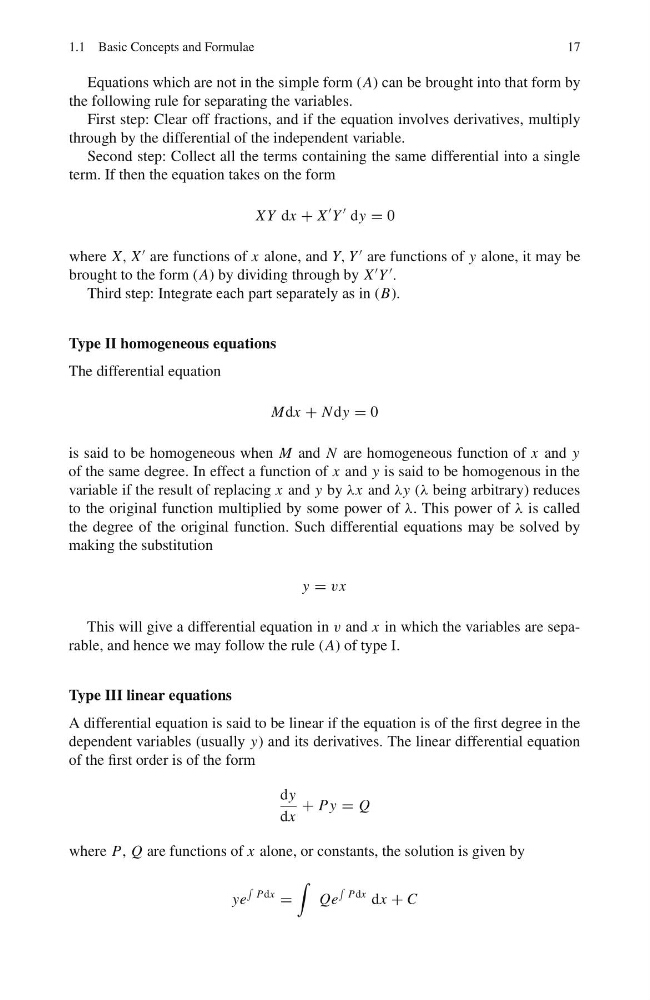
Equations which are not in the simple form ( A) can be brought into that form by
the following rule for separating the variables.
First step: Clear off fractions, and if the equation involves derivatives, multiply
through by the differential of the independent variable.
Second step: Collect all the terms containing the same differential into a single
term. If then the equation takes on the form
XY dx + X
Y
dy = 0
where X, X
are functions of x alone, and Y, Y
are functions of y alone, it may be
brought to the form ( A) by dividing through by X
Y
.
Third step: Integrate each part separately as in (B).
Type II homogeneous equations
The differential equation
Mdx + N dy = 0
is said to be homogeneous when M and N are homogeneous function of x and y
of the same degree. In effect a function of x and y is said to be homogenous in the
variable if the result of replacing x and y by λx and λy (λ being arbitrary) reduces
to the original function multiplied by some power of λ. This power of λ is called
the degree of the original function. Such differential equations may be solved by
making the substitution
y = vx
This will give a differential equation in v and x in which the variables are separable, and hence we may follow the rule ( A) of type I.
Type III linear equations
A differential equation is said to be linear if the equation is of the first degree in the
dependent variables (usually y) and its derivatives. The linear differential equation
of the first order is of the form
dy
dx
+ Py = Q
where P, Q are functions of x alone, or constants, the solution is given by
ye
Pdx
=
Qe
Pdx dx + C
17
Equations which are not in the simple form ( A) can be brought into that form by
the following rule for separating the variables.
First step: Clear off fractions, and if the equation involves derivatives, multiply
through by the differential of the independent variable.
Second step: Collect all the terms containing the same differential into a single
term. If then the equation takes on the form
XY dx + X
Y
dy = 0
where X, X
are functions of x alone, and Y, Y
are functions of y alone, it may be
brought to the form ( A) by dividing through by X
Y
.
Third step: Integrate each part separately as in (B).
Type II homogeneous equations
The differential equation
Mdx + N dy = 0
is said to be homogeneous when M and N are homogeneous function of x and y
of the same degree. In effect a function of x and y is said to be homogenous in the
variable if the result of replacing x and y by λx and λy (λ being arbitrary) reduces
to the original function multiplied by some power of λ. This power of λ is called
the degree of the original function. Such differential equations may be solved by
making the substitution
y = vx
This will give a differential equation in v and x in which the variables are separable, and hence we may follow the rule ( A) of type I.
Type III linear equations
A differential equation is said to be linear if the equation is of the first degree in the
dependent variables (usually y) and its derivatives. The linear differential equation
of the first order is of the form
dy
dx
+ Py = Q
where P, Q are functions of x alone, or constants, the solution is given by
ye
Pdx
=
Qe
Pdx dx + C