

5.3 Solutions
301
where E is in eV,
E =
0.286
λ
2
=
0.286
1.66
2
= 0.0297 eV.
5.7 (a) r = a/2
(b) r =
√
2 a/4
(c) r =
√
3 a/4
(d)
√
3 a/8
5.3.2 Crystal Properties
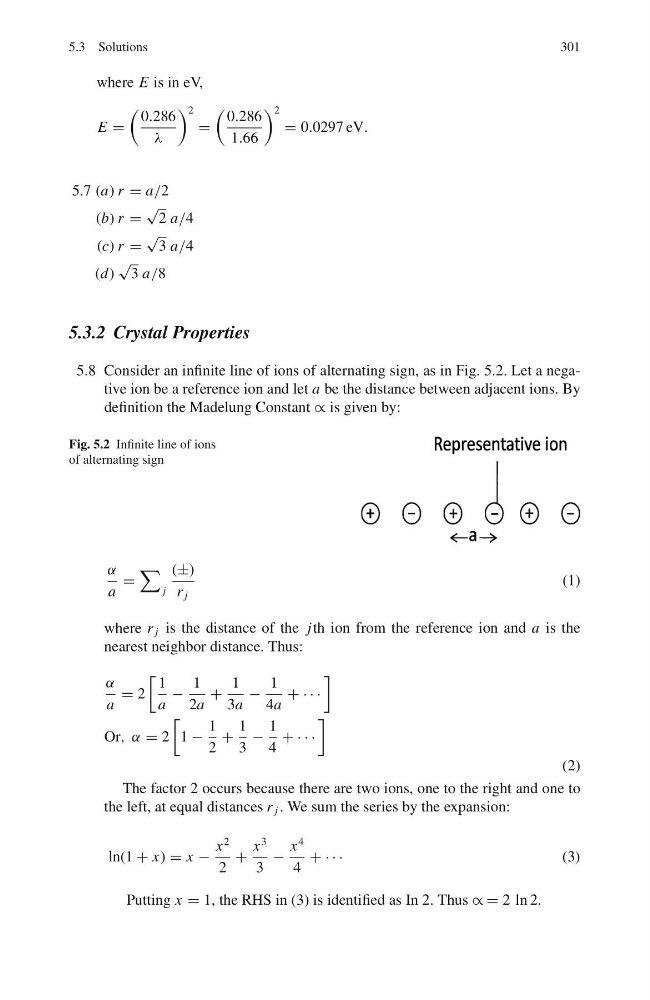
5.8 Consider an infinite line of ions of alternating sign, as in Fig. 5.2. Let a negative ion be a reference ion and let a be the distance between adjacent ions. By
definition the Madelung Constant ∝ is given by:
Fig. 5.2 Infinite line of ions
of alternating sign
α
a
=
j
(±)
r j
(1)
where r j is the distance of the jth ion from the reference ion and a is the
nearest neighbor distance. Thus:
α
a
= 2
1
a
−
1
2a
+
1
3a
−
1
4a
+ · · ·
Or, α = 2
1 −
1
2
+
1
3
−
1
4
+ · · ·
(2)
The factor 2 occurs because there are two ions, one to the right and one to
the left, at equal distances r j . We sum the series by the expansion:
ln(1 + x) = x −
x
2
2
+
x
3
3
−
x
4
4
+ · · ·
(3)
Putting x = 1, the RHS in (3) is identified as In 2. Thus ∝ = 2 ln 2.
301
where E is in eV,
E =
0.286
λ
2
=
0.286
1.66
2
= 0.0297 eV.
5.7 (a) r = a/2
(b) r =
√
2 a/4
(c) r =
√
3 a/4
(d)
√
3 a/8
5.3.2 Crystal Properties
5.8 Consider an infinite line of ions of alternating sign, as in Fig. 5.2. Let a negative ion be a reference ion and let a be the distance between adjacent ions. By
definition the Madelung Constant ∝ is given by:
Fig. 5.2 Infinite line of ions
of alternating sign
α
a
=
j
(±)
r j
(1)
where r j is the distance of the jth ion from the reference ion and a is the
nearest neighbor distance. Thus:
α
a
= 2
1
a
−
1
2a
+
1
3a
−
1
4a
+ · · ·
Or, α = 2
1 −
1
2
+
1
3
−
1
4
+ · · ·
(2)
The factor 2 occurs because there are two ions, one to the right and one to
the left, at equal distances r j . We sum the series by the expansion:
ln(1 + x) = x −
x
2
2
+
x
3
3
−
x
4
4
+ · · ·
(3)
Putting x = 1, the RHS in (3) is identified as In 2. Thus ∝ = 2 ln 2.