

1.1 Basic Concepts and Formulae
13
Matrices
Types of matrices and definitions
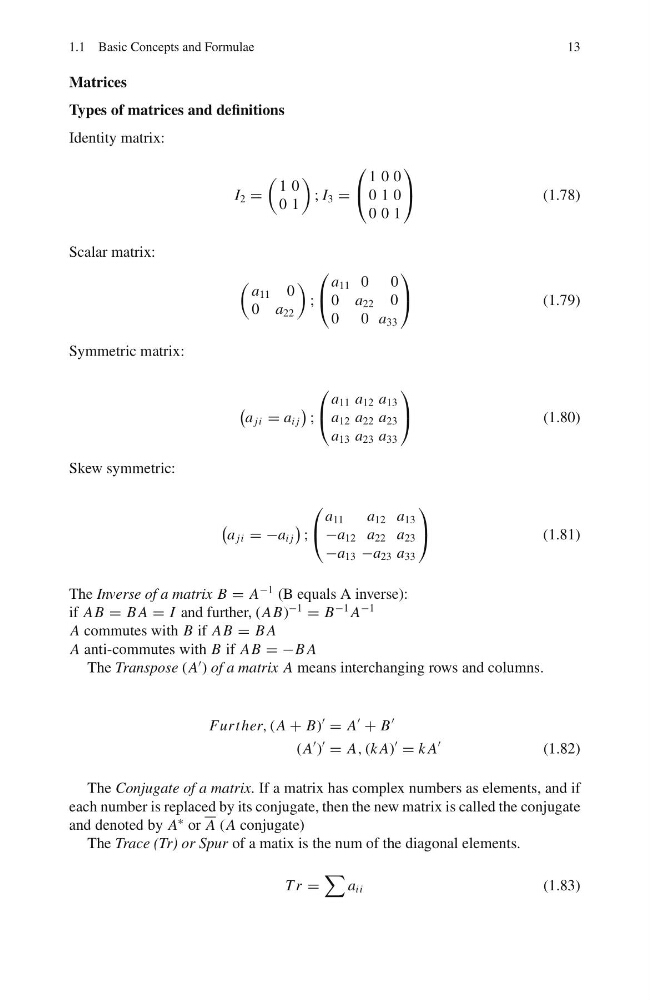
Identity matrix:
I 2 =
1 0
0 1
; I 3 =
⎛
⎝
1 0 0
0 1 0
0 0 1
⎞
⎠
(1.78)
Scalar matrix:
a 11 0
0 a 22
;
⎛
⎝
a 11 0 0
0 a 22 0
0 0 a 33
⎞
⎠
(1.79)
Symmetric matrix:
a ji = a i j
;
⎛
⎝
a 11 a 12 a 13
a 12 a 22 a 23
a 13 a 23 a 33
⎞
⎠
(1.80)
Skew symmetric:
a ji = −a i j
;
⎛
⎝
a 11
a 12 a 13
−a 12 a 22 a 23
−a 13 −a 23 a 33
⎞
⎠
(1.81)
The Inverse of a matrix B = A
−1 (B equals A inverse):
if AB = B A = I and further, (AB)
−1
= B
−1 A
−1
A commutes with B if AB = B A
A anti-commutes with B if AB = −B A
The Transpose ( A
) of a matrix A means interchanging rows and columns.
Further, ( A + B)
= A
+ B
(A
)
= A, (k A)
= k A
(1.82)
The Conjugate of a matrix. If a matrix has complex numbers as elements, and if
each number is replaced by its conjugate, then the new matrix is called the conjugate
and denoted by A
∗ or A ( A conjugate)
The Trace (Tr) or Spur of a matix is the num of the diagonal elements.
T r =
a ii
(1.83)
13
Matrices
Types of matrices and definitions
Identity matrix:
I 2 =
1 0
0 1
; I 3 =
⎛
⎝
1 0 0
0 1 0
0 0 1
⎞
⎠
(1.78)
Scalar matrix:
a 11 0
0 a 22
;
⎛
⎝
a 11 0 0
0 a 22 0
0 0 a 33
⎞
⎠
(1.79)
Symmetric matrix:
a ji = a i j
;
⎛
⎝
a 11 a 12 a 13
a 12 a 22 a 23
a 13 a 23 a 33
⎞
⎠
(1.80)
Skew symmetric:
a ji = −a i j
;
⎛
⎝
a 11
a 12 a 13
−a 12 a 22 a 23
−a 13 −a 23 a 33
⎞
⎠
(1.81)
The Inverse of a matrix B = A
−1 (B equals A inverse):
if AB = B A = I and further, (AB)
−1
= B
−1 A
−1
A commutes with B if AB = B A
A anti-commutes with B if AB = −B A
The Transpose ( A
) of a matrix A means interchanging rows and columns.
Further, ( A + B)
= A
+ B
(A
)
= A, (k A)
= k A
(1.82)
The Conjugate of a matrix. If a matrix has complex numbers as elements, and if
each number is replaced by its conjugate, then the new matrix is called the conjugate
and denoted by A
∗ or A ( A conjugate)
The Trace (Tr) or Spur of a matix is the num of the diagonal elements.
T r =
a ii
(1.83)