

4.3 Solutions
279
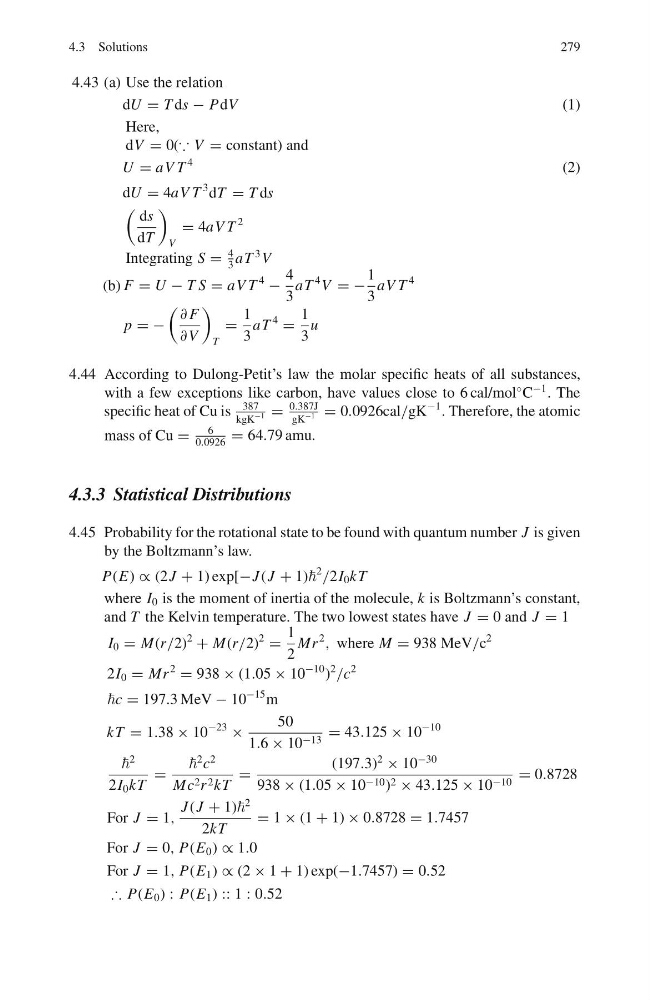
4.43 (a) Use the relation
dU = T ds − PdV
(1)
Here,
dV = 0(∵ V = constant) and
U = aV T
4
(2)
dU = 4aV T
3 dT = T ds
ds
dT
V
= 4aV T
2
Integrating S =
4
3
aT
3 V
(b) F = U − T S = aV T
4
−
4
3
aT
4 V = −
1
3
aV T
4
p = −
∂ F
∂ V
T
=
1
3
aT
4
=
1
3
u
4.44 According to Dulong-Petit’s law the molar specific heats of all substances,
with a few exceptions like carbon, have values close to 6 cal/mol
◦ C
−1 . The
specific heat of Cu is
387
kgK
−1 =
0.387J
gK
−1 = 0.0926cal/gK
−1 . Therefore, the atomic
mass of Cu =
6
0.0926
= 64.79 amu.
4.3.3 Statistical Distributions
4.45 Probability for the rotational state to be found with quantum number J is given
by the Boltzmann’s law.
P(E) ∝ (2J + 1) exp[−J (J + 1)
2
/2I 0 kT
where I 0 is the moment of inertia of the molecule, k is Boltzmann’s constant,
and T the Kelvin temperature. The two lowest states have J = 0 and J = 1
I 0 = M(r/2)
2
+ M(r/2)
2
=
1
2
Mr
2
, where M = 938 MeV/c
2
2I 0 = Mr
2
= 938 × (1.05 × 10
−10 )
2
/c
2
c = 197.3 MeV − 10
−15 m
kT = 1.38 × 10
−23
×
50
1.6 × 10 −13 = 43.125 × 10
−10
2
2I 0 kT
=
2 c
2
Mc 2 r 2 kT
=
(197.3)
2
× 10
−30
938 × (1.05 × 10 −10 ) 2 × 43.125 × 10 −10 = 0.8728
For J = 1,
J (J + 1)
2
2kT
= 1 × (1 + 1) × 0.8728 = 1.7457
For J = 0, P(E 0 ) ∝ 1.0
For J = 1, P(E 1 ) ∝ (2 × 1 + 1) exp(−1.7457) = 0.52
∴ P(E 0 ) : P(E 1 ) :: 1 : 0.52
279
4.43 (a) Use the relation
dU = T ds − PdV
(1)
Here,
dV = 0(∵ V = constant) and
U = aV T
4
(2)
dU = 4aV T
3 dT = T ds
ds
dT
V
= 4aV T
2
Integrating S =
4
3
aT
3 V
(b) F = U − T S = aV T
4
−
4
3
aT
4 V = −
1
3
aV T
4
p = −
∂ F
∂ V
T
=
1
3
aT
4
=
1
3
u
4.44 According to Dulong-Petit’s law the molar specific heats of all substances,
with a few exceptions like carbon, have values close to 6 cal/mol
◦ C
−1 . The
specific heat of Cu is
387
kgK
−1 =
0.387J
gK
−1 = 0.0926cal/gK
−1 . Therefore, the atomic
mass of Cu =
6
0.0926
= 64.79 amu.
4.3.3 Statistical Distributions
4.45 Probability for the rotational state to be found with quantum number J is given
by the Boltzmann’s law.
P(E) ∝ (2J + 1) exp[−J (J + 1)
2
/2I 0 kT
where I 0 is the moment of inertia of the molecule, k is Boltzmann’s constant,
and T the Kelvin temperature. The two lowest states have J = 0 and J = 1
I 0 = M(r/2)
2
+ M(r/2)
2
=
1
2
Mr
2
, where M = 938 MeV/c
2
2I 0 = Mr
2
= 938 × (1.05 × 10
−10 )
2
/c
2
c = 197.3 MeV − 10
−15 m
kT = 1.38 × 10
−23
×
50
1.6 × 10 −13 = 43.125 × 10
−10
2
2I 0 kT
=
2 c
2
Mc 2 r 2 kT
=
(197.3)
2
× 10
−30
938 × (1.05 × 10 −10 ) 2 × 43.125 × 10 −10 = 0.8728
For J = 1,
J (J + 1)
2
2kT
= 1 × (1 + 1) × 0.8728 = 1.7457
For J = 0, P(E 0 ) ∝ 1.0
For J = 1, P(E 1 ) ∝ (2 × 1 + 1) exp(−1.7457) = 0.52
∴ P(E 0 ) : P(E 1 ) :: 1 : 0.52