

276
4 Thermodynamics and Statistical Physics
= (V − b) +
2a
RT V 3 (V − b)
3
T
∂ V
∂ T
P
− V =
2a
RT
− b
(∴ b V )
Using this in the expression for Joule–Thompson effect (Problem 4.31),
ΔT =
1
C p
2a
RT
− b
ΔP
4.35 The equation of state for an imperfect gas is
p +
a
V 2
(V − b) = RT
It can be shown that
ΔT =
1
C p
2a
RT
− b
Δ p
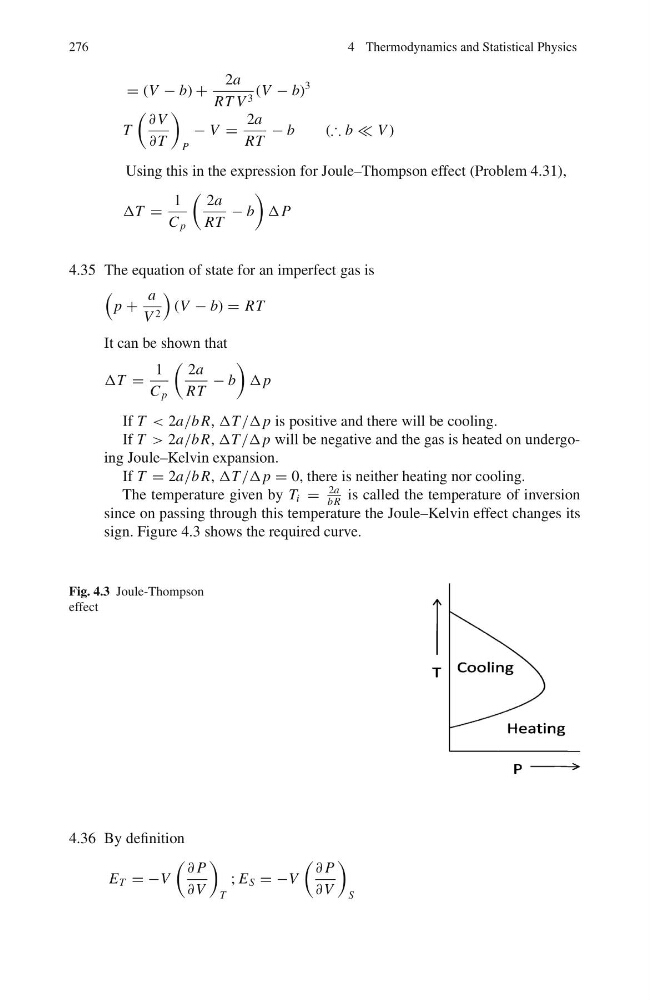
If T < 2a/bR, ΔT /Δ p is positive and there will be cooling.
If T > 2a/bR, ΔT /Δ p will be negative and the gas is heated on undergoing Joule–Kelvin expansion.
If T = 2a/bR, ΔT /Δ p = 0, there is neither heating nor cooling.
The temperature given by T i =
2a
bR
is called the temperature of inversion
since on passing through this temperature the Joule–Kelvin effect changes its
sign. Figure 4.3 shows the required curve.
Fig. 4.3 Joule-Thompson
effect
4.36 By definition
E T = −V
∂ P
∂ V
T
; E S = −V
∂ P
∂ V
S
4 Thermodynamics and Statistical Physics
= (V − b) +
2a
RT V 3 (V − b)
3
T
∂ V
∂ T
P
− V =
2a
RT
− b
(∴ b V )
Using this in the expression for Joule–Thompson effect (Problem 4.31),
ΔT =
1
C p
2a
RT
− b
ΔP
4.35 The equation of state for an imperfect gas is
p +
a
V 2
(V − b) = RT
It can be shown that
ΔT =
1
C p
2a
RT
− b
Δ p
If T < 2a/bR, ΔT /Δ p is positive and there will be cooling.
If T > 2a/bR, ΔT /Δ p will be negative and the gas is heated on undergoing Joule–Kelvin expansion.
If T = 2a/bR, ΔT /Δ p = 0, there is neither heating nor cooling.
The temperature given by T i =
2a
bR
is called the temperature of inversion
since on passing through this temperature the Joule–Kelvin effect changes its
sign. Figure 4.3 shows the required curve.
Fig. 4.3 Joule-Thompson
effect
4.36 By definition
E T = −V
∂ P
∂ V
T
; E S = −V
∂ P
∂ V
S