

4.3 Solutions
265
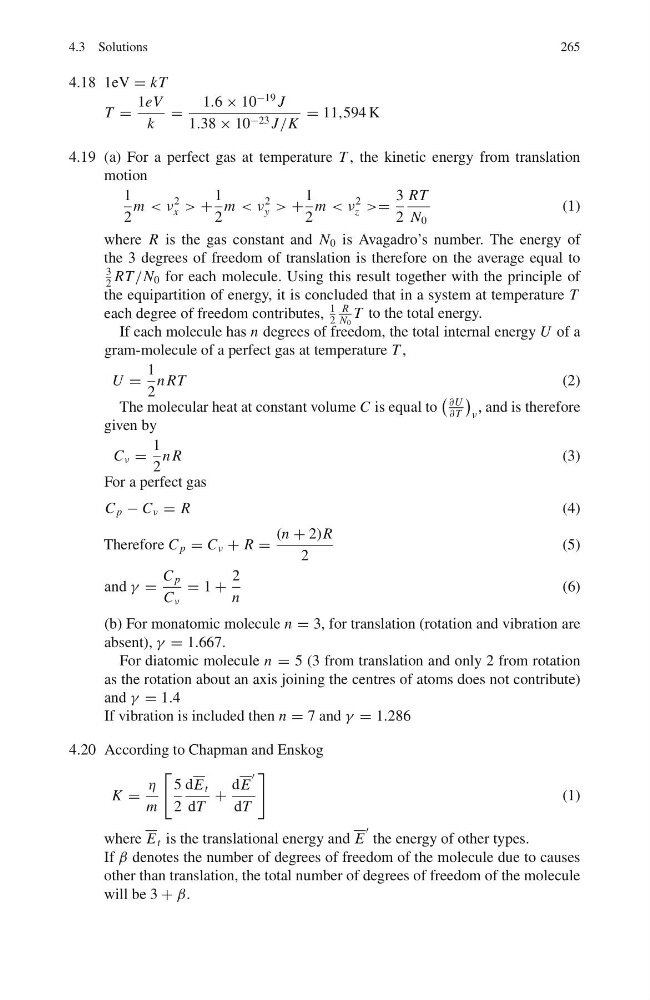
4.18 1eV = kT
T =
1eV
k
=
1.6 × 10
−19 J
1.38 × 10 −23 J/K
= 11,594 K
4.19 (a) For a perfect gas at temperature T , the kinetic energy from translation
motion
1
2
m < ν
2
x > +
1
2
m < ν
2
y > +
1
2
m < ν
2
z >=
3
2
RT
N 0
(1)
where R is the gas constant and N 0 is Avagadro’s number. The energy of
the 3 degrees of freedom of translation is therefore on the average equal to
3
2
RT /N 0 for each molecule. Using this result together with the principle of
the equipartition of energy, it is concluded that in a system at temperature T
each degree of freedom contributes,
1
2
R
N0
T to the total energy.
If each molecule has n degrees of freedom, the total internal energy U of a
gram-molecule of a perfect gas at temperature T ,
U =
1
2
n RT
(2)
The molecular heat at constant volume C is equal to
∂U
∂ T
ν
, and is therefore
given by
C ν =
1
2
n R
(3)
For a perfect gas
C p − C ν = R
(4)
Therefore C p = C ν + R =
(n + 2)R
2
(5)
and γ =
C p
C ν
= 1 +
2
n
(6)
(b) For monatomic molecule n = 3, for translation (rotation and vibration are
absent), γ = 1.667.
For diatomic molecule n = 5 (3 from translation and only 2 from rotation
as the rotation about an axis joining the centres of atoms does not contribute)
and γ = 1.4
If vibration is included then n = 7 and γ = 1.286
4.20 According to Chapman and Enskog
K =
η
m
5
2
dE t
dT
+
dE
dT
(1)
where E t is the translational energy and E
the energy of other types.
If β denotes the number of degrees of freedom of the molecule due to causes
other than translation, the total number of degrees of freedom of the molecule
will be 3 + β.
265
4.18 1eV = kT
T =
1eV
k
=
1.6 × 10
−19 J
1.38 × 10 −23 J/K
= 11,594 K
4.19 (a) For a perfect gas at temperature T , the kinetic energy from translation
motion
1
2
m < ν
2
x > +
1
2
m < ν
2
y > +
1
2
m < ν
2
z >=
3
2
RT
N 0
(1)
where R is the gas constant and N 0 is Avagadro’s number. The energy of
the 3 degrees of freedom of translation is therefore on the average equal to
3
2
RT /N 0 for each molecule. Using this result together with the principle of
the equipartition of energy, it is concluded that in a system at temperature T
each degree of freedom contributes,
1
2
R
N0
T to the total energy.
If each molecule has n degrees of freedom, the total internal energy U of a
gram-molecule of a perfect gas at temperature T ,
U =
1
2
n RT
(2)
The molecular heat at constant volume C is equal to
∂U
∂ T
ν
, and is therefore
given by
C ν =
1
2
n R
(3)
For a perfect gas
C p − C ν = R
(4)
Therefore C p = C ν + R =
(n + 2)R
2
(5)
and γ =
C p
C ν
= 1 +
2
n
(6)
(b) For monatomic molecule n = 3, for translation (rotation and vibration are
absent), γ = 1.667.
For diatomic molecule n = 5 (3 from translation and only 2 from rotation
as the rotation about an axis joining the centres of atoms does not contribute)
and γ = 1.4
If vibration is included then n = 7 and γ = 1.286
4.20 According to Chapman and Enskog
K =
η
m
5
2
dE t
dT
+
dE
dT
(1)
where E t is the translational energy and E
the energy of other types.
If β denotes the number of degrees of freedom of the molecule due to causes
other than translation, the total number of degrees of freedom of the molecule
will be 3 + β.