

262
4 Thermodynamics and Statistical Physics
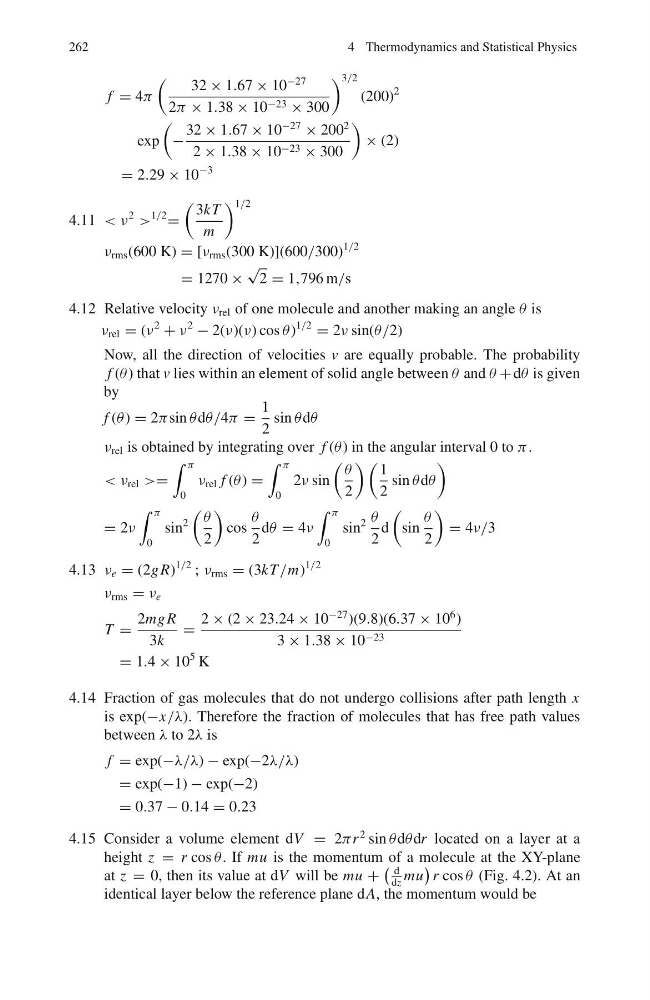
f = 4π
32 × 1.67 × 10
−27
2π × 1.38 × 10 −23 × 300
3/2
(200)
2
exp
−
32 × 1.67 × 10
−27
× 200
2
2 × 1.38 × 10 −23 × 300
× (2)
= 2.29 × 10
−3
4.11 < ν
2
>
1/2
=
3kT
m
1/2
ν rms (600 K) = [ν rms (300 K)](600/300)
1/2
= 1270 ×
√
2 = 1,796 m/s
4.12 Relative velocity ν rel of one molecule and another making an angle θ is
ν rel = (ν
2
+ ν
2
− 2(ν)(ν) cos θ)
1/2
= 2ν sin(θ/2)
Now, all the direction of velocities v are equally probable. The probability
f (θ ) that v lies within an element of solid angle between θ and θ + dθ is given
by
f (θ ) = 2πsin θdθ/4π =
1
2
sin θdθ
ν rel is obtained by integrating over f (θ ) in the angular interval 0 to π.
< ν rel >=
π
0
ν rel f (θ ) =
π
0
2ν sin
θ
2
1
2
sin θ dθ
= 2ν
π
0
sin
2
θ
2
cos
θ
2
dθ = 4ν
π
0
sin
2 θ
2
d
sin
θ
2
= 4ν/3
4.13 ν e = (2g R)
1/2 ; ν rms = (3kT /m)
1/2
ν rms = ν e
T =
2mg R
3k
=
2 × (2 × 23.24 × 10
−27 )(9.8)(6.37 × 10
6 )
3 × 1.38 × 10 −23
= 1.4 × 10
5 K
4.14 Fraction of gas molecules that do not undergo collisions after path length x
is exp(−x/λ). Therefore the fraction of molecules that has free path values
between λ to 2λ is
f = exp(−λ/λ) − exp(−2λ/λ)
= exp(−1) − exp(−2)
= 0.37 − 0.14 = 0.23
4.15 Consider a volume element dV = 2πr
2 sin θ dθ dr located on a layer at a
height z = r cos θ. If mu is the momentum of a molecule at the XY-plane
at z = 0, then its value at dV will be mu +
d
dz
mu
r cos θ (Fig. 4.2). At an
identical layer below the reference plane dA, the momentum would be
4 Thermodynamics and Statistical Physics
f = 4π
32 × 1.67 × 10
−27
2π × 1.38 × 10 −23 × 300
3/2
(200)
2
exp
−
32 × 1.67 × 10
−27
× 200
2
2 × 1.38 × 10 −23 × 300
× (2)
= 2.29 × 10
−3
4.11 < ν
2
>
1/2
=
3kT
m
1/2
ν rms (600 K) = [ν rms (300 K)](600/300)
1/2
= 1270 ×
√
2 = 1,796 m/s
4.12 Relative velocity ν rel of one molecule and another making an angle θ is
ν rel = (ν
2
+ ν
2
− 2(ν)(ν) cos θ)
1/2
= 2ν sin(θ/2)
Now, all the direction of velocities v are equally probable. The probability
f (θ ) that v lies within an element of solid angle between θ and θ + dθ is given
by
f (θ ) = 2πsin θdθ/4π =
1
2
sin θdθ
ν rel is obtained by integrating over f (θ ) in the angular interval 0 to π.
< ν rel >=
π
0
ν rel f (θ ) =
π
0
2ν sin
θ
2
1
2
sin θ dθ
= 2ν
π
0
sin
2
θ
2
cos
θ
2
dθ = 4ν
π
0
sin
2 θ
2
d
sin
θ
2
= 4ν/3
4.13 ν e = (2g R)
1/2 ; ν rms = (3kT /m)
1/2
ν rms = ν e
T =
2mg R
3k
=
2 × (2 × 23.24 × 10
−27 )(9.8)(6.37 × 10
6 )
3 × 1.38 × 10 −23
= 1.4 × 10
5 K
4.14 Fraction of gas molecules that do not undergo collisions after path length x
is exp(−x/λ). Therefore the fraction of molecules that has free path values
between λ to 2λ is
f = exp(−λ/λ) − exp(−2λ/λ)
= exp(−1) − exp(−2)
= 0.37 − 0.14 = 0.23
4.15 Consider a volume element dV = 2πr
2 sin θ dθ dr located on a layer at a
height z = r cos θ. If mu is the momentum of a molecule at the XY-plane
at z = 0, then its value at dV will be mu +
d
dz
mu
r cos θ (Fig. 4.2). At an
identical layer below the reference plane dA, the momentum would be